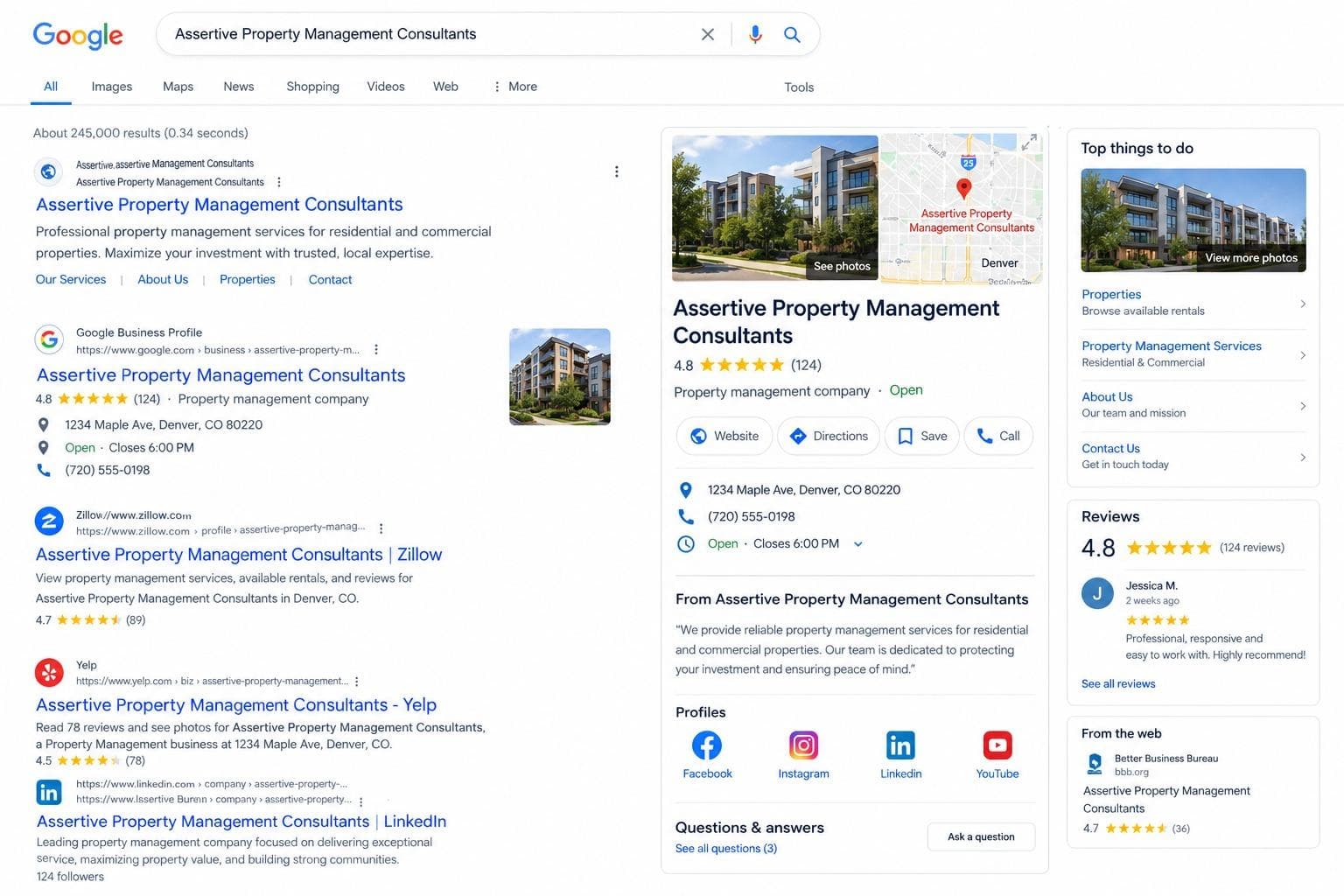











Construction company SEO rests on three things that outweigh everything else combined, a fully optimised Google Business Profile, a steady flow of five-star reviews, and dedicated pages for every service in every place work happens.
TL;DR
A complete Google Business Profile carries about a third of local ranking weight, more than reviews, content, and links combined.
The three listings in Google's map pack take close to half of all clicks on local searches, so position beats almost everything else.
Reviews carry close to a fifth of the ranking weight, and fourty steady reviews beat five perfect ones.
Suburb searches carry far less competition than city centre searches while converting at a similar rate, so suburbs deserve priority before city centres.
A dedicated page for every service and every town matches how customers search online, while thin duplicate pages drag the whole site down.
A fast, mobile-friendly site with a tap-to-call number is important for the site.
Accreditations such as CHAS, ISO 9001, and NHBC displayed on key pages give search engines and customers proof of legitimacy once a site ranks.
Links and citations carry about 15% of ranking weight.
Call tracking and form submissions show the real results of a campaign, not rankings alone, with the first shifts in visibility appearing within three to six months.
The Map Pack Takes Nearly Half of all Local Clicks, so Position Decides Everything
Someone with a leaking flat roof opens Google on their phone, types the service and their town, and rings one of the first three names they see. Search results for those queries carry paid ads at the top, then the Google Maps pack with its three business listings, then the organic links underneath.
The map pack sits closest to the decision because a searcher taps the phone number without visiting anyone's website. A study across 540 real queries found the pack appearing in around 39% of local results, and position inside those three listings decides almost everything.
The top spot converts roughly 17.6% of searchers into a click, second position around 15.4%, third around 15.1%, then the drop below third turns into a cliff edge. A business sitting in position four or five effectively disappears, no matter how strong the website underneath looks.
So try as much as possible to be on the 3 links included in the map pack.
Your Google Business Profile Does Most of the Heavy Lifting
A high-quality, complete profile makes customers 2.7 times more likely to see a business as reputable and drives 70% more site visits and 50% more purchase intent. The strongest single factor inside that share is the primary category, so a roofing firm listed simply as "contractor" loses ground before the comparison even starts. Choose the most specific option available, something like 'Roofing Contractor,' 'General Contractor,' or 'Home Builder,' then add secondary categories for specialists like 'kitchen fitters,' 'groundworkers,' or 'electricians.'
Make sure name, address, and phone number match exactly across the website, the profile, and every directory listing, since Google treats mismatched details as a trust problem rather than a typo, and every part of the profile needs to line up.
Visual proof builds heavily on that established trust, so you should upload real photography showing materials on site, work in progress, finished roofs, and your teams in safety gear. Stock imagery and artificial intelligence-generated pictures both carry a suspension risk from Google, so they are best avoided entirely. You can also comfortably skip anyone selling photo geotagging as an SEO service because it does absolutely nothing to help your rankings.
Post updates on a regular schedule, answer questions in the Q&A section, and keep opening hours accurate, since a business shown as open when someone searches ranks measurably better than one shown as closed, which is why plenty of firms extend their stated hours or pay for a call answering service to support round-the-clock availability.
Once your own house is in order, you can leverage a highly effective tactic that clients rarely hear about, known as spam fighting. This involves reporting competitors who artificially stuff keywords into their listing name or run listings from addresses they do not actually occupy. Filing these reports through the standard business redressal form helps clean up the map pack for legitimate businesses, and competitor removals may land within just a few weeks.
Chase the Suburbs Before the City Centres
You can often ignore the headline city first because targeting a phrase like 'kitchen extension Manchester' carries brutal competition, while the exact same phrase against a suburb ten minutes down the road carries a fraction of the difficulty and converts at a similar rate.
You also need to segment your approach by buyer type. A facilities manager searching for commercial roofing contracts writes nothing like a homeowner searching for home roof leak help, so the pages and phrases need to speak to each one differently.
Reviews Now Carry Close to a Fifth of Your Ranking Weight
Beyond the website itself, review signals now account for close to 20% of the overall local ranking weight.
You should send customers a review request the moment a job finishes and follow up with a direct link within a day or two before you stop chasing after that.
Nearly all people read feedback for local businesses, and a large share look only at reviews written in the last three months. A five-star rating with a handful of reviews consistently loses to a competitor holding 40 reviews at a slightly lower average.
You can encourage people to describe the specific repair or build and the town in their own words because keywords inside native Google reviews feed relevance, while keywords stuffed into owner responses rank near the bottom of the list.
You must also watch out for review gating, where a landing page routes five-star raters to Google and quietly diverts everyone else to a private complaints form. Google prohibits the practice entirely, and some contractors have lost their entire review history over it. To go around this, you need to give every single customer the direct public link, whether they are happy or not, while providing an alternative for the unhappy ones too, like an email link straight to a manager, so things can get support and be put right.
It also helps to seed the Q&A section with the 10 questions customers actually ask before hiring, rather than waiting for the public to post them, since answered questions there feed voice results and AI search answers.
Build One Page for Every Service and Every Place You Work
Google rewards a site structured the way customers actually search, meaning you need one dedicated page for every service and one for every local area, rather than a single crowded services list on the homepage.
A roofing company covering repairs, replacements, and flat roofing needs three separate pages, each with its own title, heading, and call to action. Blending everything together may dilute relevance for every term the website tries to rank for, especially when people are looking for dedicated specialists.
The exact same logic applies to geography. You should give every single town served its own page linked from an area's hub rather than buried in a footer list to ensure you capture the best leads. You must ensure you include specific local content for each one, such as project photos, named neighbourhoods, and reviews from customers in that area.
Copying one paragraph across a dozen city pages with only the place name swapped reads as thin and duplicate content which drags the whole site down under Google's doorway abuse policy.
Trust Signals Do the Convincing Once You Rank
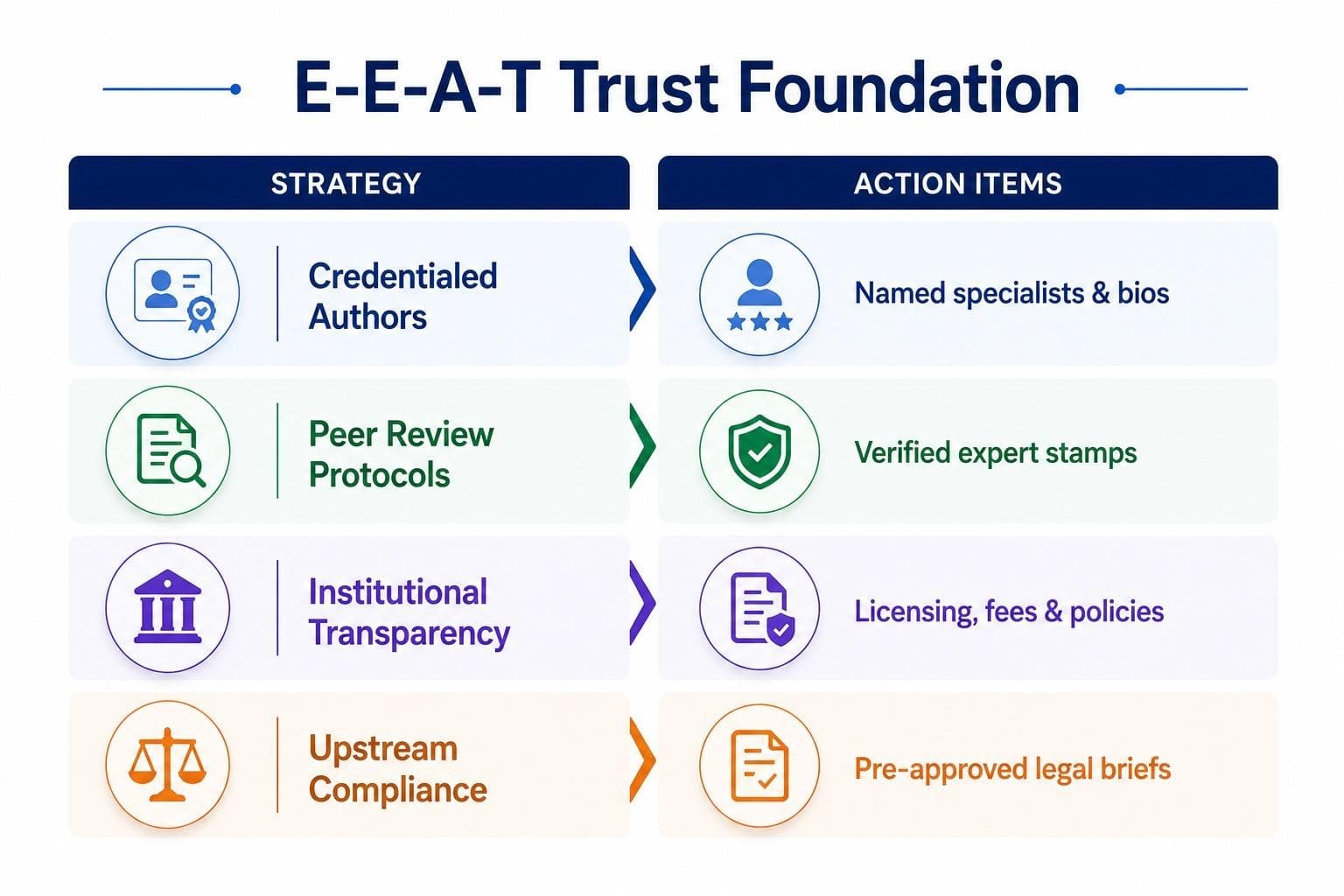
Google quality guidelines lean hard on experience, expertise, authority, and trust, and for the construction industry, those translate directly into compliance paperwork.
Accreditations like CHAS, Constructionline, SafeContractor, CSCS cards, CITB training records, awareness of current regulations and standards, ISO 9001, Federation of Master Builders membership, NHBC registration, TrustMark, and public liability insurance all work as verification signals.
These are the very details most construction websites bury in a footer or leave out completely. You should display them prominently on the pages where a decision gets made, including the commercial services page, the about page, and any page covering safety or compliance, then mark them up with structured technical data so search engines can easily read them.
Genuine experience signals matter too, and they come from named team members with real qualifications, project case studies with specific details, and testimonials that mention actual workmanship rather than a generic compliment.
You should list the firm across Checkatrade, TrustATrader, MyBuilder, Rated People, Bing Places, Apple Business Connect, and the relevant trade association directory for roofing contractors and other trades.
Links and Citations Build Your Prominence
Link signals still carry around 15% of the local SEO ranking factors. Manufacturer and supplier pages listing approved installers, national trade association directories, and sponsorship of a local sports team or charity event all provide links with genuine local relevance.
A completed, award-winning build, notable local projects, or storm-recovery commentary offered to a local journalist all make for a natural press mention that a bought link never replicates.
Twenty to thirty real and relevant links move rankings more than hundreds of low-quality ones. Citations across the standard directories, Yelp, Houzz, Checkatrade, and local chamber listings keep your core business data consistent everywhere a customer might find the company.
A Slow Mobile Site Loses the Job Before the Call Happens
Around seven in ten searches for construction and trade services happen on a phone, and that figure climbs closer to nine in ten for emergency callouts like storm damage. Research shows 53% of these mobile visitors abandon a page that takes longer than three seconds to load, and a delay of even one tenth of a second can cut conversions by around 7%.
For a construction site carrying high-quality project photography, that means compressing images to modern formats, enabling lazy loading, and testing regularly to ensure the site meets speed thresholds.
That requires keeping the largest contentful paint under 2.5 seconds, an interaction response under 200 milliseconds, and visual stability under 0.1. A tap-to-call phone number belongs in the header on every page large enough to hit on a small screen since so much of this business now happens online, and a firm digital presence needs to keep pace.
Keyword Research Fundamentals for the Trades
You must align your content with the precise problem-orientated language property owners actually use. It is important to split target keywords by intent to separate transactional terms from informational queries.
Transactional phrases pair a specific service with a geographical modifier like a city or county name (e.g., 'emergency plumber London'), to signal that a prospect needs help right away. Those are the highest intent phrases and represent the most valuable traffic available online.
Informational phrases usually take the form of questions about pricing, timelines, or the durability of building materials, e.g. How long does a new roof take to install? Capturing those early queries builds topical authority and introduces the brand to new property owners early in their decision process.
Free platforms like Google Keyword Planner make it easy to use real search data to uncover the exact terminology your local market uses.
Track Calls and Leads, Not Rankings
To properly evaluate this system you must track calls and leads rather than just obsessing over rankings. Measure the right outcomes by taking a closer look at enquiries and conversions, which means tracking form submissions, phone calls, and Google Business Profile interactions. The platform insights show how many people found a business online via search versus Google Maps and exactly how many clicked to call or visit the site.
Also, since a large percentage of trade conversions occur by phone, call tracking becomes an incredibly important part of the strategy. Dynamic number insertion attributes each inbound call to the exact query and page that generated it, so the cost per acquisition of a finalised job becomes calculable.
Results Take Three to Six Months to Build
Expect the first movement in map pack visibility within three to six months of consistent work. Speed and mobile fixes bring faster gains within weeks, while the full compounding effect of content and links builds across six months and beyond.
A firm seeing no measurable change after six months of paying a construction SEO agency has grounds to start asking hard questions about the work being delivered.
Get in touch with our SEO experts today to build this kind of strategy for your construction, roofing, or trades business, starting with a full audit of the profile, technical foundations, and current search visibility within the industry.