










I've been in the SEO industry 25+ years, I can tell you that a sudden drop in Google traffic can make any site owner panic, or those with some SEO know-how may reach for the word “penalty”. I've had clients over the years who came to me because they thought they'd been a victim of a Google penalty.
But, there's an important thing to distinguish here - and that's Google penalties are NOT the same as lost rankings and traffic from Google core updates - let me preface this by saying:
Lost rankings after a Google core update or spam update is NOT a penalty, losses through updates are not "penal" whilst the outcome may feel like it's penal, it's not - if Google changes ranking factors and your site loses out, you weren't punished, you just lost ground because your site no longer meets the mark be it a quality or trust issue
Penalties are SPECIFICALLY assigned to a website via Manual Actions within Google Search Console
It's REALLY important you understand the difference here.
Now, back to the clients, when they came, they would often assume they'd had a penalty, perhaps for dodgy links or an unscrupulous SEO / seo agency - either way, I often had to correct them and say that no, an algorithm related loss is not a penalty. However, sometimes that is exactly what has happened, sometimes it is/was an algorithm update, a technical change, seasonality, a weaker page, a stronger competitor, or a reporting issue and SOMETIMES (but quite rarely) it was a manual action. Those are VERY different problems, and they need different approaches to resolve them.
If you ever want to check for yourself, simply ensure you have Google search console setup for your website, login and head to the left menu, scroll down to:
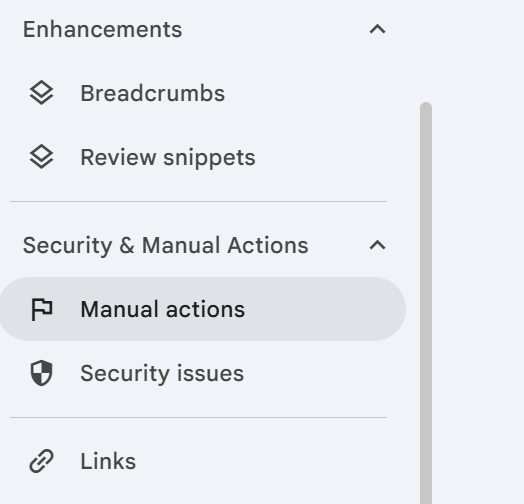
Click on MANUAL ACTIONS and, if you see this >
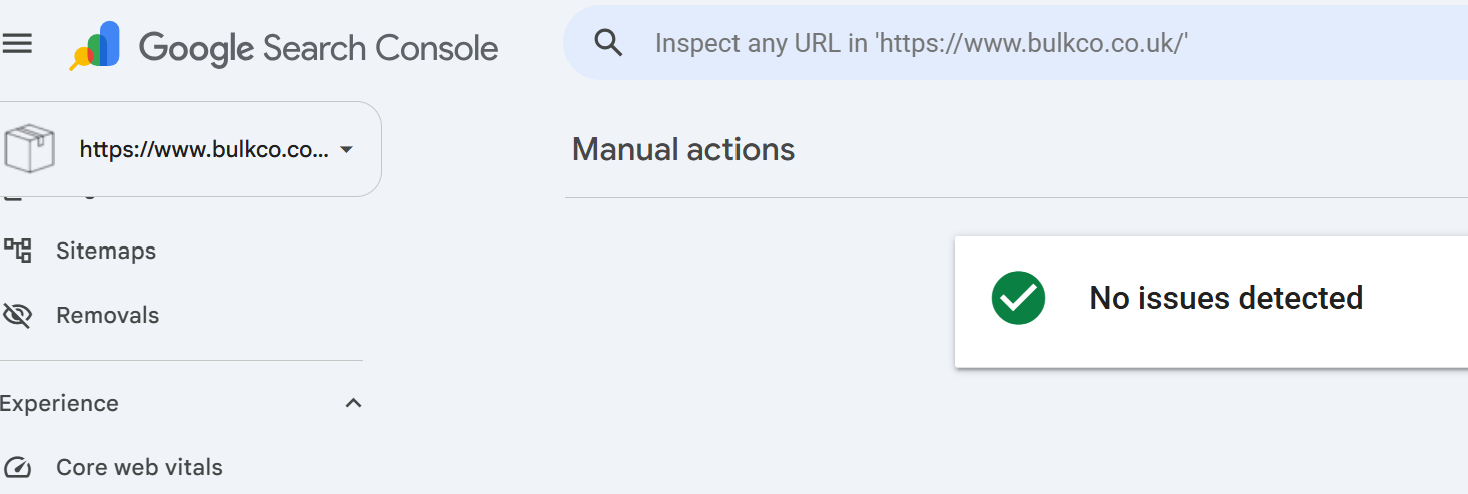
You are OKAY! No penalty.
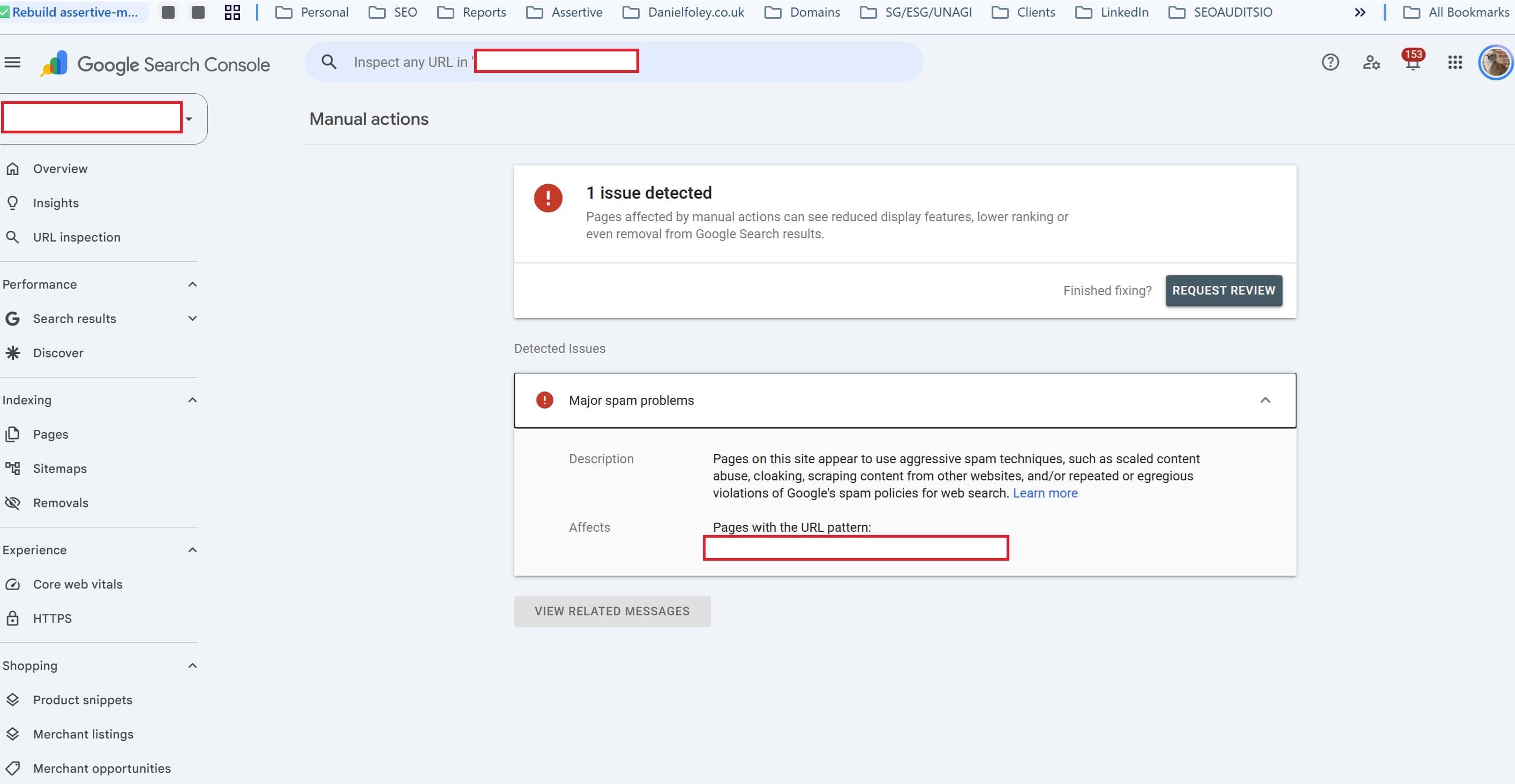
But, if you see anything other than that i.e.
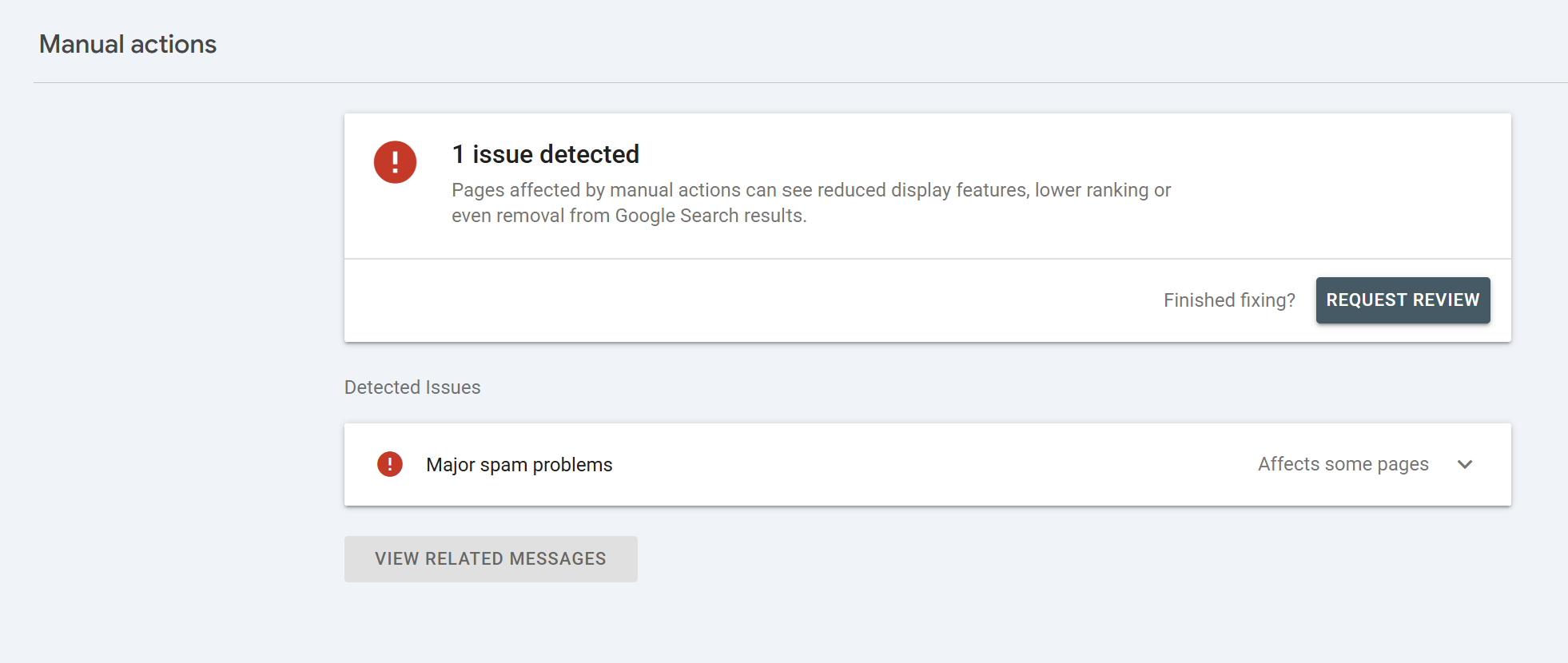
Then yeah, you have a penalty (manual action).
A Google manual action is a formal decision made after a human review that pages on a site do not comply with Google’s spam policies (you can read about their spam policies here - https://developers.google.com/search/docs/essentials/spam-policies.) Depending on the issue, Google may lower the visibility of particular pages, a section of a site, or the whole site.
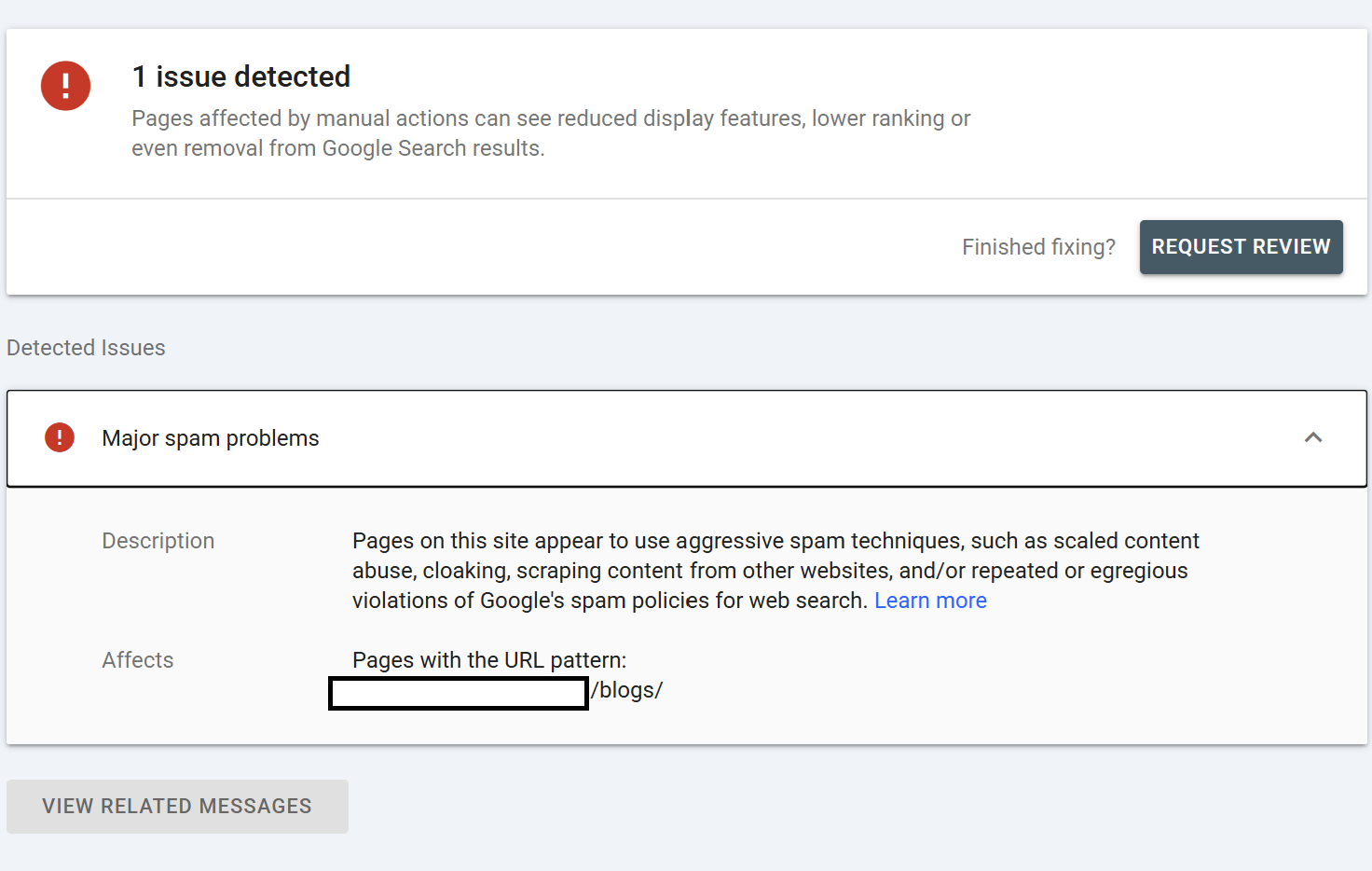
Below your manual action it will say whether it affects some pages or the entire domain >
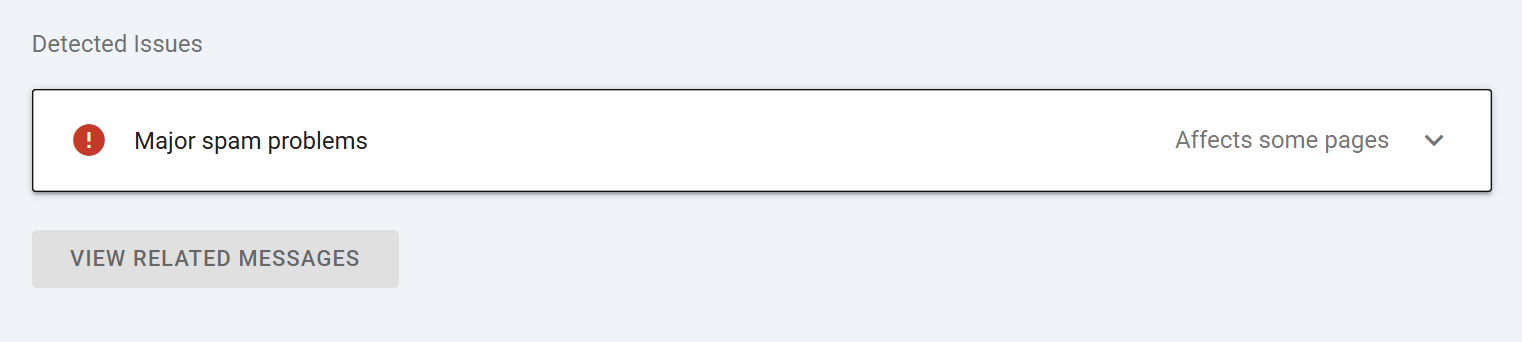
See above where it says AFFECTS SOME PAGES - so, the manual action is applied to SOME but not all of the website - this means whatever is highlighted will be suppressed from search.
However, some manual actions can impact the ENTIRE website >
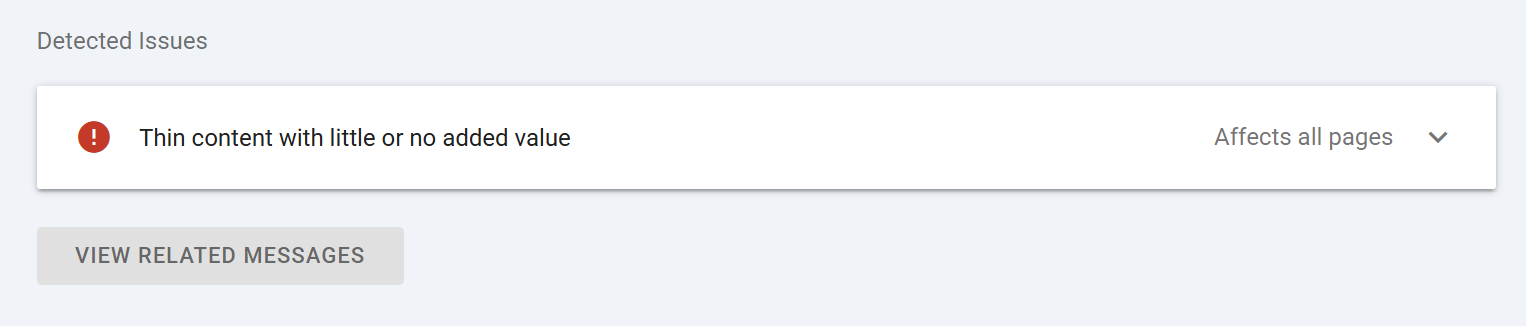
And see above - it says AFFECTS all pages - oooops!
Some actions affect a search feature rather than ordinary web rankings, google records the action in Search Console and notifies the site owner. Google’s Manual actions report explains the current action types, affected-page patterns and review process.
I’ve worked through enough SEO problems to know that “we’ve been penalised” is often the first diagnosis, but not always the right one. This guide explains how to check, what the different actions mean, and what a credible recovery process looks like.
I made a video about this the other week, in case you missed it you can watch it here!
The short answer
If you suspect a manual action, open the correct property in Google Search Console and check Security & Manual Actions > Manual actions. A traffic decline alone is not evidence of a manual action - you can rule this out easily, but, if the decline ISN'T a manual action and is algo related, it's often harder to actually diagnose the specific issues - manual actions give you an indication of the problem, algo updates we just have to figure out what was hit and why - so more obscure.
If the manual action report lists an issue, expand it, read the affected-page patterns, fix the underlying problem across the full affected area, and then request a review. Now, I've made that sound SUPER easy, but, reconsideration requests CAN be a nightmare to get through depending on WHAT the manual action is and the scale of it. If you've been pumping out AI content at scale (scaled content abuse) or scraping and republishing unoriginal content at scale - you could find yourself having to delete or rectify a huge amount of content to get a reconsideration request through.
Hit with a manual action for manipulative links? do not start by disavowing every link in sight! Hit with a manual action for thin, low value or deceptive content? don't go deleting half the site, or asking Google to “put things back” that's just wishful thinking.
Each manual action needs an investigation, an analysis and then a strategy to correct it, and that's where we can help! See our Google Manual Actions Recovery service!

What is a Google manual action penalty?
So, this is a manual action notification in Google Search Console >
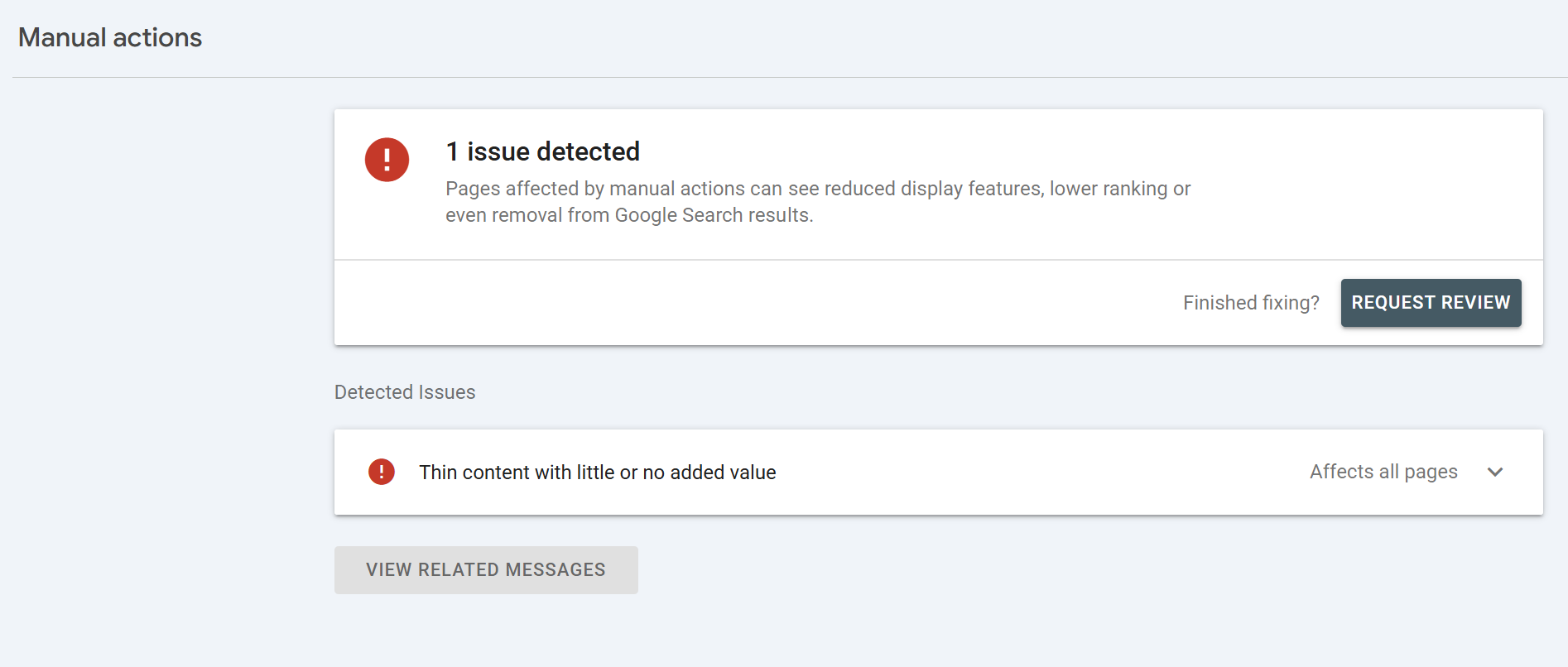
And this is the impact this specific action had on the websites traffic >
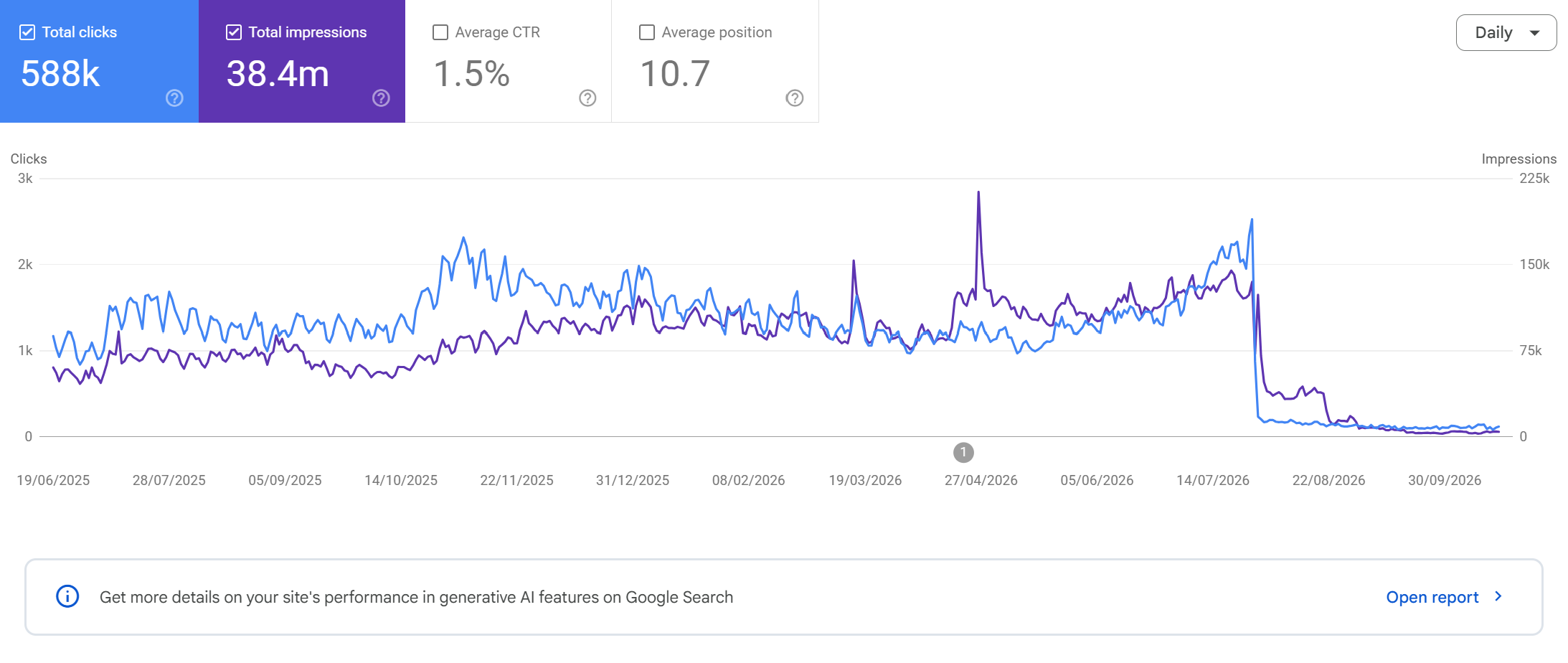
“Manual action” is Google’s term, “Penalty” is the SEO shorthand people tend to use, often for any unwelcome ranking changes or significant, often abrupt traffic losses/declines. For MANY years people have thrown around the words penalty when in reality, they were not penalties, more just devaluation.
I remember it like it was yesterday! Clients hit by Panda / Penguin or Hummingbird coined the term "we've been hit with a penalty" when in reailty, they just lost ground because Google put the hammer down on spammy SEO tactics i.e. link farms, FFA, dodgy reciprocal links etc.
Google says a manual action is issued when a human reviewer determines that pages on a site do not comply with its spam policies (naughty naughty). Most manual actions relate to attempts to manipulate Google’s search index - be it with on site SEO manipulation i.e. hidden text, cloaking, serving different content to users vs googlebot, aggregaterating or schema spam, or be it with content, so think publishing shit loads of low value or AI generated content without fact checking, plagarised or thin/weak content, or link spam - so buying shed loads of links, domain consolidation and PBNs. One or more of these strategies can cause affected pages to rank lower or disappear from search results, usually without warning (Google actions are quick and sudden). Google’s documentation also confirms that some or all of a site may be affected, as highlighted above a manual action might hit part of your site or all of it, depending on what spammy/dodgy tactics have been at play.
Google also uses automated systems to detect spam, these automated systems are enhanced across deployments of spam updates - 2026 has been a brutal year for spam updates, we actually see more spam updates this year than all previous years, more than core updates too. Many spam practices are handled by those systems without a manual action being recorded in Search Console, so a ranking decline may be algorithmic, technical or competitive rather than a manual action, even if it feels every bit as unpleasant & ruthless.
A manual action is therefore not a synonym for “Google traffic went down”. It is a specific, reportable issue with a specific remediation route - but, only if you know what you are doing! we've had a handful of clients come to us over the years who have tried to fix things themselves and gotten nowhere.
Manual action versus algorithmic ranking decline
This is where people can lose weeks doing the wrong work - generally non SEOs who are trying to understand what has happened or inexperienced SEOs who haven't dealt with manual actions or reconsideration requests before..
A manual action appears in the Manual actions report in GSC, so if nothing is there, you haven't got a manual action and instead, any lost rankings or traffic are MORE likely to be a result of a Google core/spam update, or, it could also be an indexing issue i.e. if important traffic driving pages suddenly get deindexed this can have an abrupt impact on rankings, clicks, impressions etc. In general, a broad ranking change normally does not come with that report or a reconsideration request button.
You can look at traffic and generally work it out - depending on your level of SEO expertise, i.e.
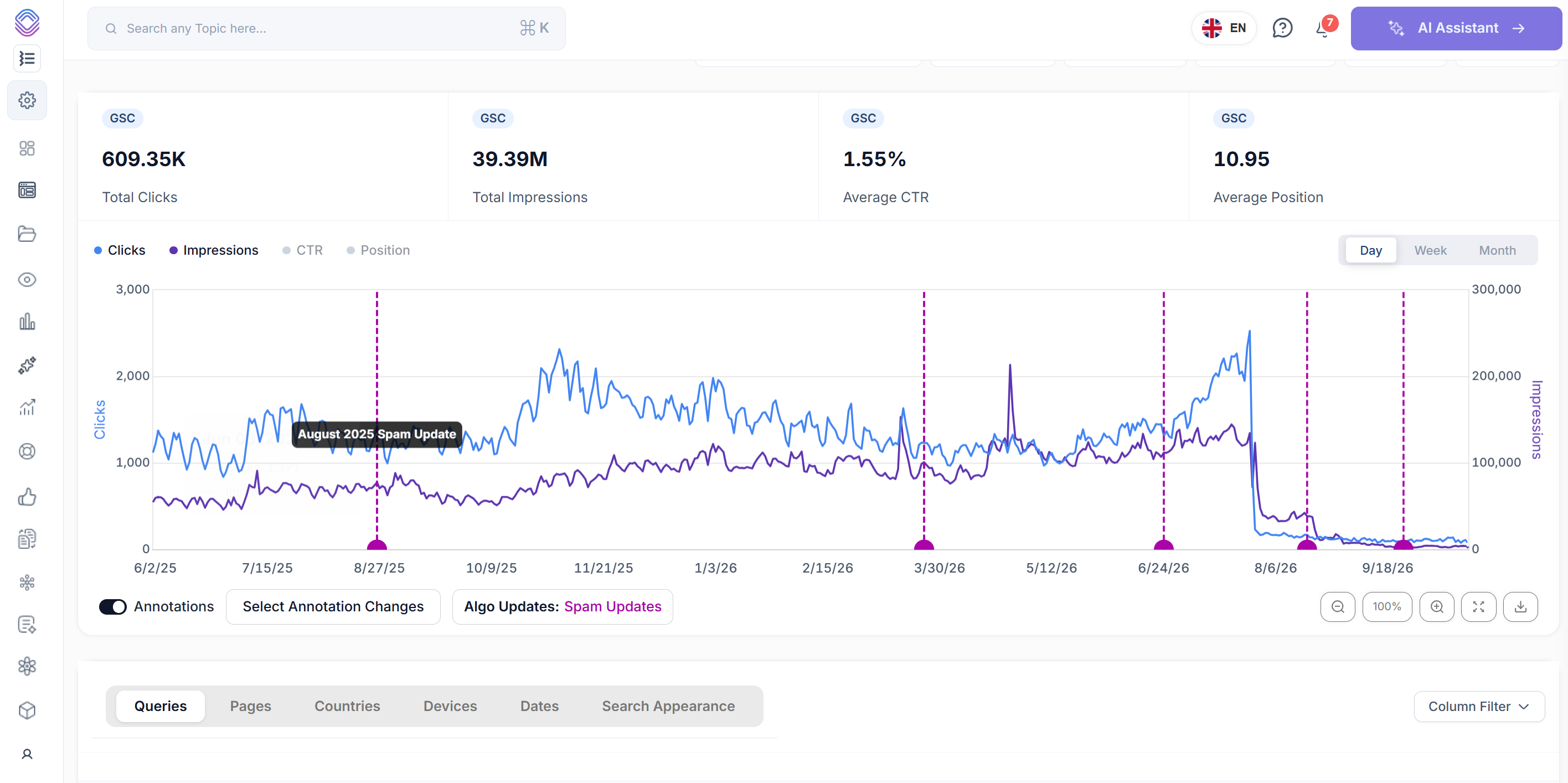
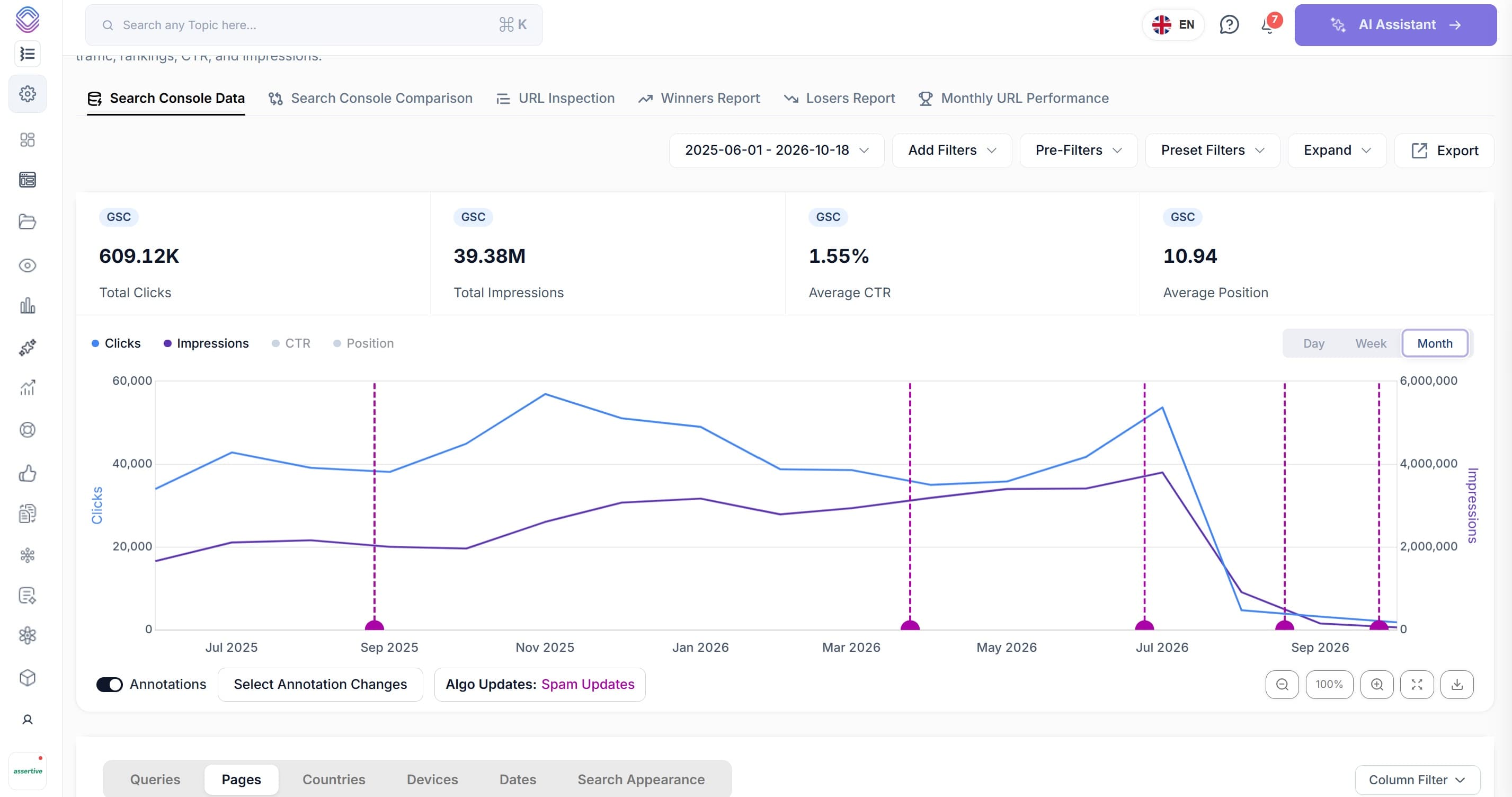
This site lost traffic / impressions ABRUPTLY between 2 spam updates but not in close enough proximity of either for it to be a result of a spam update. The snapshot above is for a website that was hit by a manual action.
Key things to remember:
IF an abrupt traffic loss happens a few weeks either side of a Google core / spam update, it's highly unlikely to be an algo related loss
IF an abrupt traffic loss happens away from a Google update, it's either a manual action OR an indexing issue - you can rule out manual actions in GSC as above, so if traffic does abruptly drop out and it's away from a Google core update roll out and there's no manual action then its more likely to be an indexing issue which could be down to host issues, crawl issues, access issues, directives etc.
IF an abrupt traffic loss happens between when Google announces the roll out of a core update and when it announces the update is complete AND there is no manual action then its most likely algo related - you can check their core/spam update deployment dates and durations here - https://status.search.google.com/products/rGHU1u87FJnkP6W2GwMi/history
IF an abrupt loss happens randomly and you get a notification in search console for a manual action then it's self explanatory
IF however your websites traffic looks more like this >
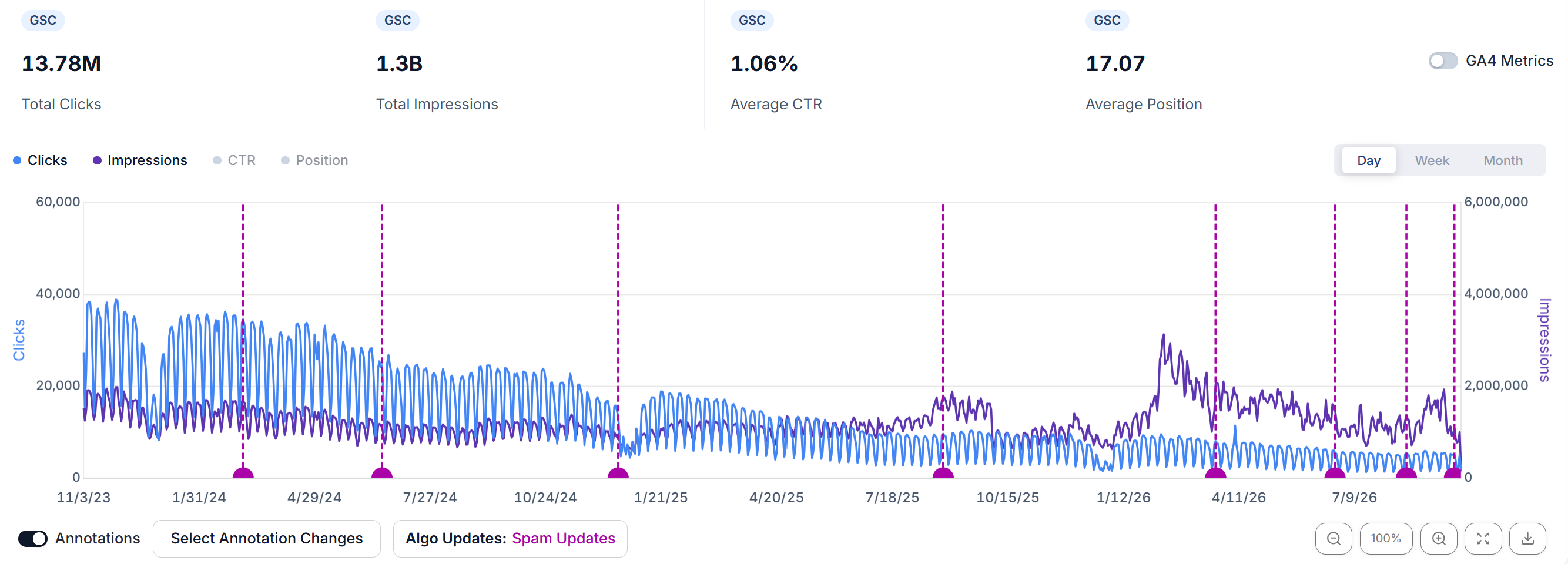
Then it's usually a result of:
Progressive losses over time because of ranking slippage / ranking losses OR
Progressive losses as a result of Google's AI Overviews (which steal clicks from publishers etc)
Or it can be a mix of both of the above
SUDDEN losses (BIG losses) are more often than not, a manual action.
FAIRLY SUDDEN LOSSES within an announced google update rollout are usually algo related - although declines in general are NOT as prominent as those we see with a google penalty.
Google’s automated ranking and spam systems can reassess pages as the web changes, a site can also lose visibility because its content no longer satisfies the query as well as competing results, because Google has recrawled a changed page, because pages became inaccessible or non-indexable, or because demand has shifted. Google’s traffic-drop troubleshooting guide lists manual actions alongside other possible causes and recommends checking which pages are affected - this is why SEO audits are important, because generally, when a site has lost traffic, it's rarely down to 1 thing, it tends to be a culmination of things that lead to ranking losses, namely:
Content quality issues or stagnancy
Excessive content that doesn't meet end user needs, intent or exhibits unhelpful engagement
Loss of trust in the domain (devaluation of links, loss of links, loss of trust in the domain by activities)
Excessive indexing issues or lack of high quality content coupled with retained legacy content
Poor user engagement (high pogo, bounce, low engagement time across content)
Manipulative SEO practices
Lack of positive brand mentions, growth, new links
General stagnancy across the board
Competitor displacement (your brand is displaced over time)
If GSC says there are no manual actions, that is useful evidence, but it does not tell you why traffic fell, why rankings were lost etc. it tells you this particular diagnosis is not shown there (duh). So, we would naturally continue the investigation through Search Console’s Performance and Page indexing reports, your release history, server logs, analytics, and Google’s published ranking updates. A reconsideration request can not repair an algorithmic decline, a broken or misconfigured canonical, bot-blocking changes, or a site migration issue.
If your site has lost ground because of an algorithm update - generally there's a lot more auditing and analysis required, because you have to look at the type of update that hit i.e. spam vs core update vs helpful content, then you have to work backwards to understand why the losses may of happened and then to build a resolution and testing hypothesis to find a way to recover.
Manual actions tend to be clearer - Google has specified a concern, you have to review it, deal with it and then submit the reconsideration request once you believe the issues have been corrected.
Why do manual actions happen?
Manual actions happen when Google concludes that a site or part of it is violating its policies - which usually happens when people have taken blatant short-cuts or employ blackhat/dodgy SEO techniques, think auto-pilot "SEO content" or mass link building schemes etc. The common thread is usually an attempt to manipulate what appears in search, mislead users, or let spam take over a section of a site - there's absolutely tonnes of reasons as to why some businesses / SEOs / digital marketers take shortcuts, the biggest ones being TIME + MONEY. Some businesses want SEO and they want quick results, you get some SEOs who also want to minimise effort and maximise profit (be they consultant or agency) and so, they employ tactics that can and do lead to manual actions.
Some common things include paid links intended to pass ranking signals, mass generated content with no thought as to content quality or fact checking, keyword-stuffed pages, doorway pages, cloaking, or markup that describes things users cannot actually see. It can also happen through poor controls or someone else’s work. A previous agency may have built a network of paid links a compromised WordPress plugin may inject redirects or hidden link spam/hack spam, a forum may be flooded with spam profiles, a publisher may allow 3rd-party pages onto a trusted domain without proper editorial control.
The MOST COMMON things to get website owners a manual action are:
LINK SPAM
Surprisingly, link spam manual actions HAVE come down over the years, primarily because when Google was penalising websites for dodgy links it fueled an explosion in negative SEO, I think since, Google has really dialed back how they interpret links to a domain, link penalties are still possible but harder.
Seeing substantial referring domain growth IS mainly an indicator of "uncommanded" spam or aggregate spam usually NOT initiated by a client/SEO or agency - but, there are times when sudden growth IS an indicator of spammy tactics.
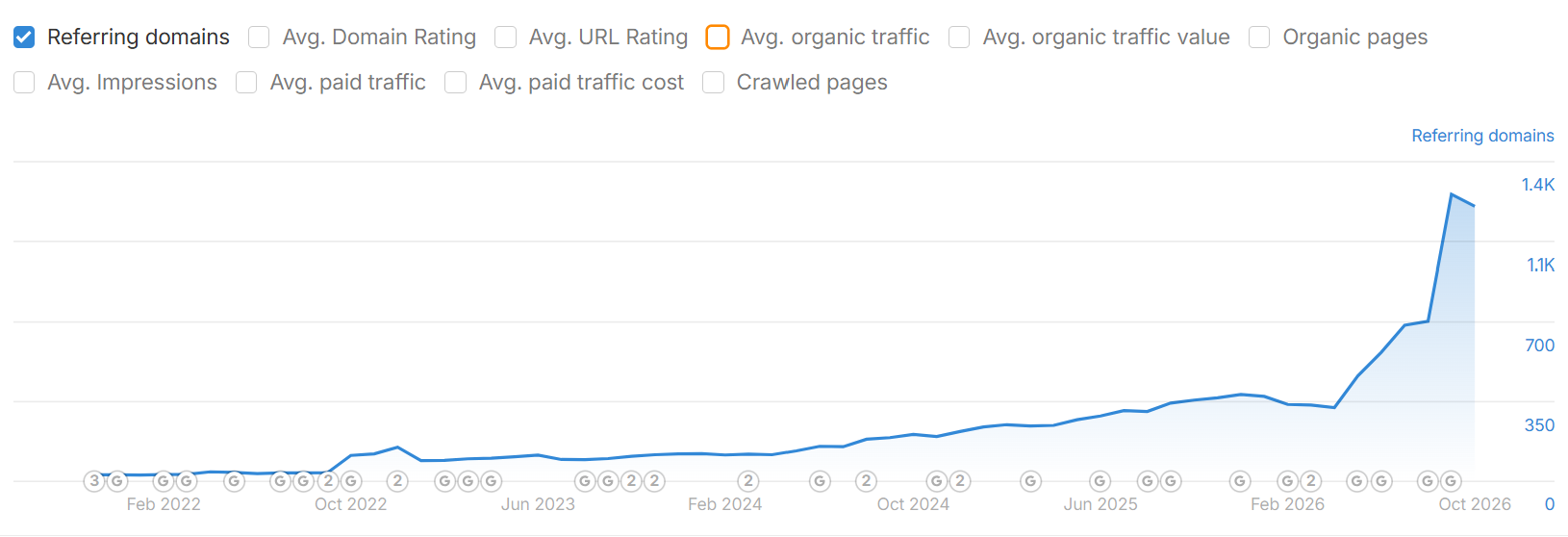
A lot of sites see referring domain growth like this - most of it does NOT lead to a manual action. But, over time link penalties have been more prominent which is why I've listed it.
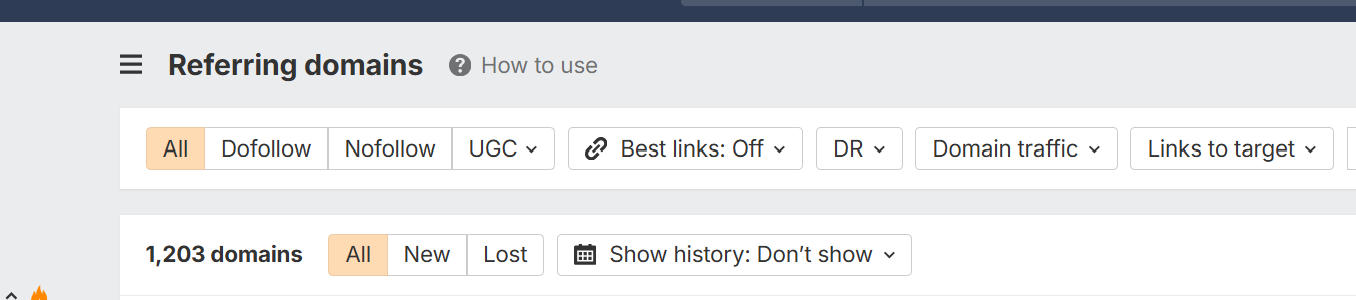
Here's a quick SEO tip for you, in AHREFS you can inspect a domain, go to REFERRING DOMAINS like so >
Apply a domain traffic filter like so >
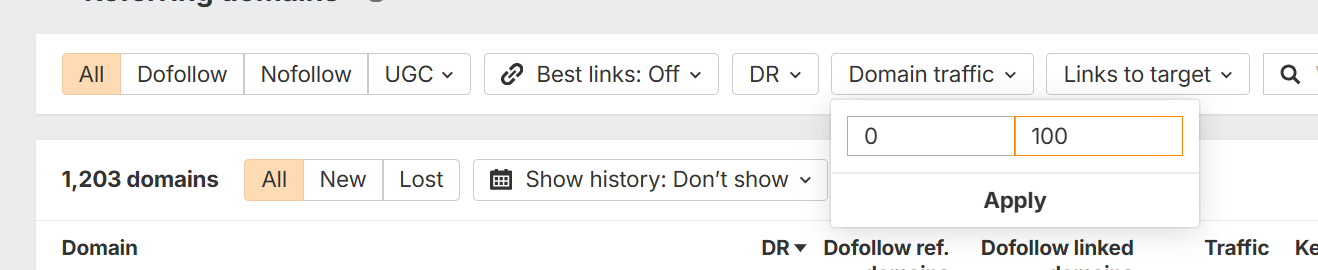
and then apply, we can see JUST how many low quality / spam / dead domains exist amongst the total referring domain count >
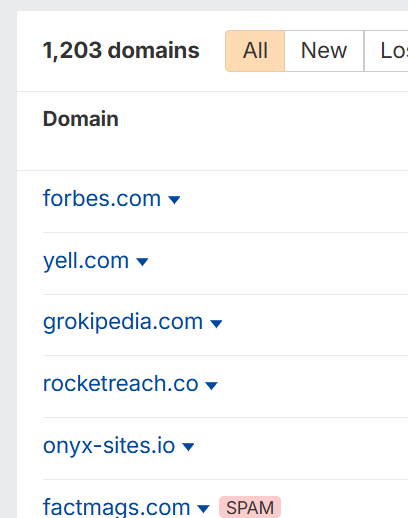
So of the 1203 doains, we see below 1159 are basically spam / dead etc.
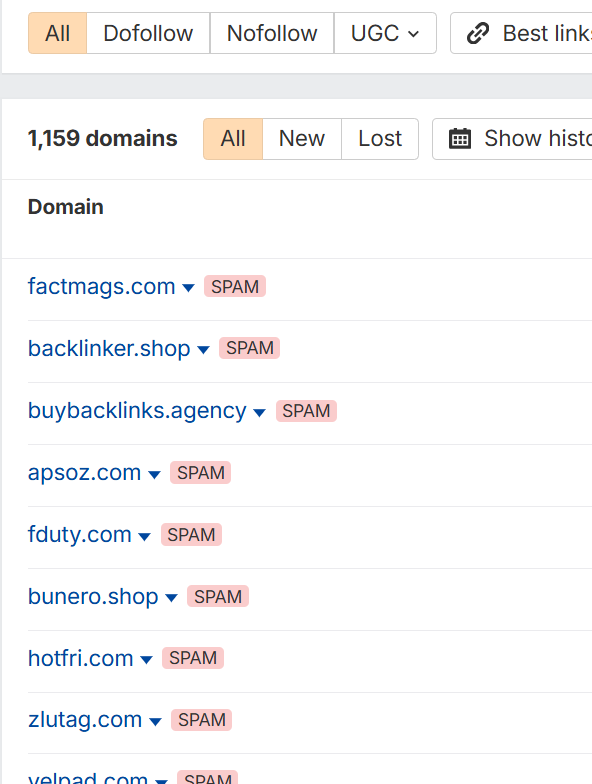
Anyhow, crappy links HAVE been over the years a great way to get a manual action. Things Google specifically doesn't like:
Links that have been paid for - although it's extremely hard if not impossible in many cases for them to differentiate
Links obtained via domain consolidations (when you buy other domains with links and redirect them in) - abusing it obviously
Links via PBNs (private blog networks)
Tiered links (when you build links to the pages linking to your site - artificially inflating link equity)
Link farms / aggregate links
Unnatural links - forum spam, UGC spam, hack spam, link injection or compromised links
Things like this - at sufficient scale can trigger a manual review which can lead to a manual action for deceptive / spammy link building practices.
PROGRAMMATIC CONTENT GENERATION / SCALED CONTENT ABUSE
So this is a hot potato right now, since Google has been getting hammered by site owners churning out AI content at scale, Google's had to start fighting back, they've changed their ruels and guidance on AI content numerous times this year. To make it clearn, it's NOT AI content that's the problem but more the quality and deployment profile of content.
AI content is generally fine IF there has been a human in the middle and if the content has been properly reviewed and where unique added value is added - although Google doesn't discriminate, there's too many variables. A pre-existing brand or domain trust will dictate how well a programmatic content strategy lasts, established brands in theory could get away with programmatic content at scale probably for longer, but, ultimately the act of just deploying content at scale presents a risk because:
Content that hasn't taken effort to create is more likely to be perceived as "low value"
Content that's just been spat out with no thought or checks is more likely to contain factually incorrect data / hallucinations
Content spat out from LLMs is more likely a rehash of content that already exists
Content spat out just to answer insidious amounts of long-tail is not a quality approach or strategy
There's SO much to programmatic content generation and scaled content abuse for manual actions, but if I wrote it all out it would take you a day to read it, so let me condense it:
AI content is not the issue per se, but uncommanded, unregulated or unmanaged scaled content deployment is bad for SEO because its bad for end users
AI content or human generated content is a problem if its being deployed at scale and where it's clearly designed to manipulate search or gain rankings without effort
Google isn't looking to re-serve the same content over and over again across different sites where there's no good reason to do so, this is why Google stipulates adding value to content, add something unique beyond what already exists
It's not just the quality of the content, it's the deployment model, content being published at scale can see sites pushing out hundreds of new articles a day, which isn't generally a normal behaviour, especially if the site/domain/brand is small or weak / not trusted
Google clearly doesn't want to serve content thats effectively created on auto-pilot, because usually that content isn't overly unique, of value or the formatting, media embeddings are not condusive to something engaging
Anyway - back to Google's spam policies and manual actions.
Google’s current spam policies describe practices including link spam, scaled content abuse, scraping, cloaking, doorway abuse, hacked content, malicious practices and site-reputation abuse. Google’s wording on scaled content abuse is worth understanding, the issue is producing many pages primarily to manipulate rankings rather than help users (as per my points above), regardless of whether they were produced by AI, copied, stitched together or generated another way. “AI wrote it” is not, by itself, the policy test. Google’s spam policies explain the distinction, so definitely worth a read over a coffee.
The site owner may not have approved the practice, or may not even know it is happening - this can and does happen when you get unscrupulous SEOs looking for quick and easy traffic that's low cost. That can matter when explaining the history in a reconsideration request, but it does not remove the need to fix the affected pages or links.
How does Google detect and apply a manual action?
Google says it detects policy violations with automated systems and, when needed, human review - no doubt prominent SERPS are checked every so often and sites exhibiting "abnormal gains" are most likely the ones to fall into the firing line. A manual action is the recorded outcome of a human review - thus why its called a manual action, because someone took the time to manually review the site and determine what action should be applied.
Google does not publish the exact thresholds, internal signals or review queue logic, so anyone claiming to know the precise trigger for a particular action is probably guessing with confidence.
A review may find a problem through Google’s own systems or information brought to its attention, the important part for a site owner is the result and that's if Google applies a manual action, Search Console’s Manual actions report and message centre should identify the issue. Google may also send a notification by email, or, you see a panicing email from a client or notice rankings have dropped (outside of the current round of rank tracker issues.
The manaul action typically tells you:
The action type and a short description of the problem.
Whether the action affects the whole site or a pattern of URLs.
Links to Google’s guidance for that specific issue.
The route to request a review after the work is complete.
The affected-page pattern deserves close attention. Google says the pattern can cover a subset of the site or the entire site, and that not every URL matching a reported pattern is necessarily affected. Treat the examples as clues to the affected template or directory, then investigate the underlying system instead of fixing only the handful of URLs shown. Google’s report guidance explains how to expand the action and inspect the affected-page patterns.
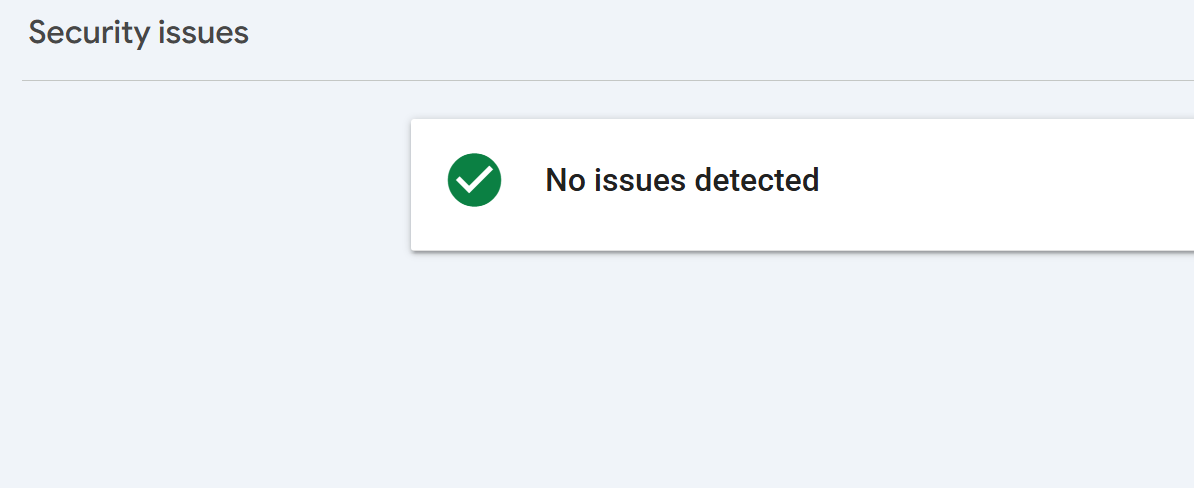
A manual action report is different from the Security Issues report, the Security Issues report concerns problems such as hacking, phishing or malware that could harm visitors. A hacked site can create spam and can be connected to a manual action, so check both reports if suspicious redirects, injected pages or unfamiliar content appear, ideally you woukld see this >
What types of manual actions can Google apply?
Google’s published list changes as its policies and reporting evolve, at the time of writing, its Search Console help page includes the following action categories, ive worded it simply. The practical effect depends on the action and the affected URLs; the table below is a guide only and can be subject to change!
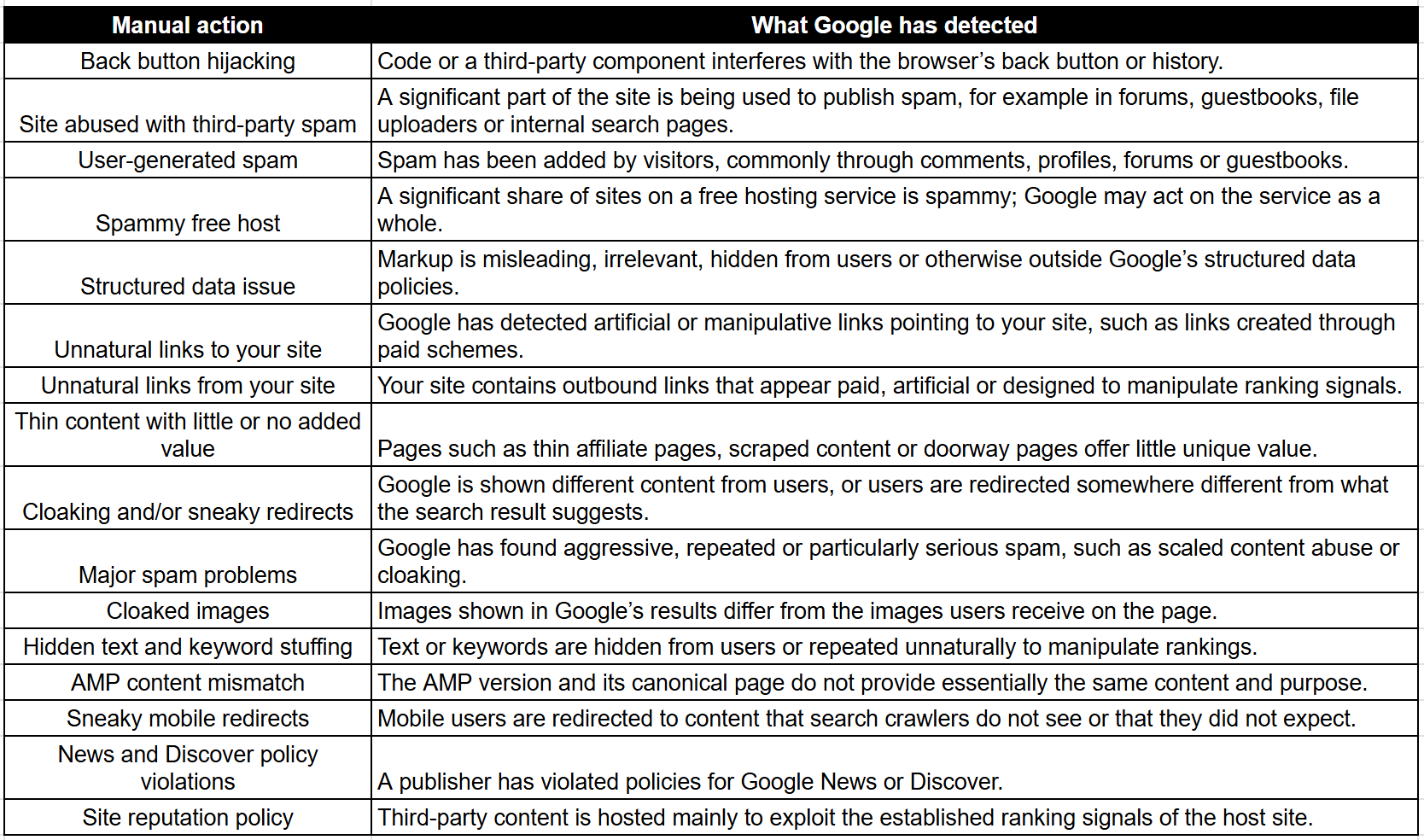
As the above is an image, here it is in writing:
Back button hijacking
Code or a third-party component interferes with the browser’s back button or history.
Site abused with third-party spam
A significant part of the site is being used to publish spam, for example in forums, guestbooks, file uploaders or internal search pages.
User-generated spam
Spam has been added by visitors, commonly through comments, profiles, forums or guestbooks.
Spammy free host
A significant share of sites on a free hosting service is spammy; Google may act on the service as a whole.
Structured data issue
Markup is misleading, irrelevant, hidden from users or otherwise outside Google’s structured data policies.
Unnatural links to your site
Google has detected artificial or manipulative links pointing to your site, such as links created through paid schemes.
Unnatural links from your site
Your site contains outbound links that appear paid, artificial or designed to manipulate ranking signals.
Thin content with little or no added value
Pages such as thin affiliate pages, scraped content or doorway pages offer little unique value.
Cloaking and/or sneaky redirects
Google is shown different content from users, or users are redirected somewhere different from what the search result suggests.
Major spam problems
Google has found aggressive, repeated or particularly serious spam, such as scaled content abuse or cloaking.
Cloaked images
Images shown in Google’s results differ from the images users receive on the page.
Hidden text and keyword stuffing
Text or keywords are hidden from users or repeated unnaturally to manipulate rankings.
AMP content mismatch
The AMP version and its canonical page do not provide essentially the same content and purpose.
Sneaky mobile redirects
Mobile users are redirected to content that search crawlers do not see or that they did not expect.
News and Discover policy violations
A publisher has violated policies for Google News or Discover.
Site reputation policy
Third-party content is hosted mainly to exploit the established ranking signals of the host site.
Google’s News and Discover category covers several policy areas: dangerous content, coordinated deceptive practices, impersonation, misrepresentation of affiliation or location, harassment, hate, manipulated media, medical content, misleading content, sexually explicit content, terrorist content, transparency, violence and gore, and gratuitous profanity. These are relevant to publishers seeking News or Discover visibility, rather than a standard checklist for every business website, the full, current detail is in Google’s Manual actions report documentation.
There are two areas that deserve a little more explanation.
Structured data actions are not necessarily ranking penalties
Google says a structured data manual action removes the page’s eligibility for a rich result, it does not affect the page’s ranking in ordinary Google web search, a page can remain indexed and rank while losing a review snippet, job listing appearance or another rich result. Passing the Rich Results Test does not guarantee that markup complies with quality policies. The visible page still has to support what the markup claims. Google’s structured data policies set this out.
Site-reputation abuse is not simply “any third-party content”
A publisher is not automatically in breach because it hosts freelance writing, affiliate links, syndicated news, user comments or advertising. Google’s policy focuses on third-party content placed on an established host mainly to benefit from that host’s ranking signals. Editorial oversight, integration with the publication and real value to readers matter. The current report also describes different treatment for results shown inside and outside the European Economic Area, so publishers should check the live Google guidance rather than rely on an old penalty list.
Which manual actions are the most common?
Google does not publish a frequency table ranking manual actions by how often they are issued. Any article claiming that one action is definitively “number one” should show the data behind that claim.
When I’m putting together a real report / audit, I would start by checking the issues that are most plausible for the site’s history and structure:
Unnatural links to the site, especially where an agency, contractor or previous owner bought links or used large-scale guest-post placements.
Thin content or doorway pages, including location pages, affiliate pages or scaled pages that are near-duplicates and do not give a user a meaningful reason to visit each one.
User-generated or third-party spam, particularly on sites with forums, comments, profile pages, free hosting or user submissions.
Structured data issues, where review, product, job or event markup claims something the visible page does not support.
Cloaking, hidden text or redirects, including malicious code and third-party scripts the site owner did not knowingly add.
Major spam problems, where several of the above practices appear at scale or form part of a broader scheme.
That is a practical audit order, but its not static, the work I do varies depending on what clients present issues as. The action named in Search Console should take priority over any general list - but again, I have to do groundwork / analysis to establish OK, this is what the manual action is saying, I have some idea as to whether its specific URLS or the full site - then I have to go from there.
How hard is it to recover from a manual action?
It depends on what was done, how widely it was done, whether the root cause is still active, and whether the site can show that the problem has been fixed across all affected pages. It's impossible to say yes it's easy to recover or no it's not it ALL depends on the type of manual action, the scale and how long it has been going on for.
IN GENERAL - MOST manual actions can be recovered from within 4-6 weeks, some much sooner, some can take longer. It all depends on the manual action and scale.
A narrow structured data issue may be relatively straightforward if the markup is generated by one template and the visible content is accurate - generally stuff like this is easily remedied before a reconsideration request is submitted.
However, at the other end of the penalty spectrum, a large unnatural-link action can take considerably more work: tracing historic placements, contacting webmasters, documenting removal attempts, and preparing a careful staged disavow file for links that cannot be removed. Generally a staged disavow can take weeks to months because you wouldn't disavow everything, you would do it in batches until the reconsideration is successful, primarily because disavowing huge swathes of links can mean even when the manual action is lifted, the loss of link equity can mean traffic doesn't go back to what it was before the manual action.
A thin-content action across hundreds of doorway pages is not solved by rewriting a few introductions and adding a stock photo, the underlying page strategy has to change - this can mean mass content deletion or complete overhauls to pre-existing content.
There is no magic paragraph for the reconsideration request that compensates for incomplete remediation. Google asks site owners to fix all affected pages, make sure Google can access the fixed pages, and describe the issue, the steps taken and the outcome. If several manual actions are listed, resolve all of them before asking for review. Google’s fix and review guidance is unusually direct on this point.
Recovery is possible, but it is not automatic or guaranteed, getting the manual action revoked means Google has accepted that the reported violation has been addressed. It does not promise the site will return to its previous rankings or traffic, those positions may have changed for other reasons, and the site still has to compete under Google’s current systems.
How to fix a manual action
Use the report as the starting point, then work through the cause rather than treating it as a checklist of isolated URLs. Again, these are BROAD/generalised fixes, many manual actions DO require someone with at least fair to strong SEO knowledge to handle. I've seen clients try and fix themselves and do even more damage, one client had came to us after they disavowed nearly ALL of their domains links even with no manual action, because their site got hit on a spam update, they naturally assumed links and disavowed nearly everything.
1. Confirm the action and its scope
Open the correct Search Console property and check the Manual actions report, then expand each listed issue. Note the action name, the date, any affected-page pattern, and whether the report says “all pages” or names a section. Check the message centre and email too - get a full scope of the issues.
If the site changed hands, inherited an old domain or changed agencies, do not assume the current team created the issue, Google’s report guidance specifically allows owners of recently acquired sites to explain that history in the reconsideration request, after fixing the problem. Manual actions can often come from historic work as well as anything recent that might have been undertaken.
2. Find the common cause
Export the affected URLs if possible and look for patterns between the "affected pages" and what the manual action is - this is easy to say but harder to do, especially for link spam and content spam issues, because Google will give a manual action and sample of URLS / URLS affected, but, it's up to you to decypher how they've applied it in order to undo or remediate the issue.
If you've had a manual action for spammy or thin content - then I would:
Crawl the website with screaming frog SEO spider
Set up AI in screaming frog and use prompts to poll the content for depth, quality, E-E-A-T/YMYL checks
Set up GSC / GA4 in screaming frog for the site to be crawled so you can extract indexing and engagement metrics
Export the crawl, then start segmenting the content
Look for low or thin word counts (anything sub 500 words is likely very thin, anything sub 1k is thin but maybe more viable)
Look at the content word count vs engagement time from the GA4 metrics
I would then start looking at the content, what does the content look like, readability, vocab use, writing style, perspective, tone of voice
Look at the content visually - is it just slabs of text, is it broken down, structured properly, formatted properly?
Look at the E-E-A-T / so authors - are the authors real, identifiable and connectable i.e. socials? are facts cited? sources correct?
How does the content compare to the SERPS, does it look like the content serves a genuine purpose
What about media embeds in the content - images, videos, content blocks, quotes, internal links etc?
You really need to think out of the box - generally LOW EFFORT content is content produced at scale, Google can consider this THIN or LOW value if it just looks to have been generated by an automated content tool or just down to someone deploying content from chatGPT/Claude/Gemini straight to a site in bulk.
Sometimes, it can be easier to delete stuff at scale where it's been auto-generated/auto-pilot and to start again with a proper content strategy. Also consider that:
Churn and burn domains are LESS likely to get through a reconsideration request unless they FULLY deal with all the content issues
Domains that started out and quickly published lots of content where there's no brand establishment are more likely to suffer from more difficult reconsideration requests and lag after the requests are lifted
More trustworthy domains are more likely to get through a reconsideration request as long as you can demonstrate the things you did to clean up / improve content.
For other manual action issues such as cloaking or redirects, compare what a user sees with what Google can fetch using URL Inspection, and test on mobile as well as desktop. Check server rules, JavaScript, tag managers, ad scripts and plugins. With 3rd party spam, inspect comments, profiles, file uploads, internal search results and other user-generated areas. A website can be “hacked” without the homepage looking like it has been taken over.
If you've had a manual action for spammy or manipulative links - then I would:
Firstly export all of your referring domains from AHREFS & GSC Links
I would filter the links down and segment out those from domains with little to no traffic
I would then create a staged disavow that would segment out
- Spam - clear spam from domains with no traffic and artificially inflated metrics
- Obvious guest post sites - so find low quality guest post sites that have lots of content but almost no traffic
- Links where the anchor texts are obviously influenced from previous link building campaigns
- Links from PBNs or known IP ranges / blacklisted
- Any hack spam linksI would then submit disavows 1 at a time, file a reconsideration request and I would repeat until they go through, I would not advise submitting large disavow files
I would write Google's manual review team an overview of what I had done to clean up the links, even if extended to marking links as rel sponsored etc.
3. Fix every affected instance
The correct repair depends on the action:- so again, don't apply this as absolute, this is general
Unnatural links to your site: identify links created through paid or manipulative schemes; make a genuine effort to have them removed or qualified; document the work; disavow only the links you cannot get removed and that belong in the disavow file.
Unnatural links from your site: remove paid or manipulative outbound links, or qualify them with an appropriate link attribute such as sponsored or nofollow where relevant.
Thin or scaled content: improve pages with original, useful information; consolidate pages that serve the same intent; remove pages that have no useful purpose. Do not just add 300 words of filler and call it editorial quality.
User-generated and third-party spam: remove the spam, close or moderate vulnerable areas, add protections against repeat submissions, and monitor the same paths after the fix.
Structured data: ensure the markup describes content that is visible and accurate on that page; remove misleading markup; validate the implementation, then check policy compliance as well as syntax.
Cloaking, redirects, mobile redirects or back-button hijacking: remove the code or third-party component causing the behavior, check for a compromise, and test the affected experiences on real devices and crawler fetches.
AMP mismatch: make sure the AMP and canonical pages have the same essential content and let users complete the same task on both.
Site-reputation or News and Discover issues: remove or revise the content that violates the policy and fix the editorial controls that allowed it to happen.
If the cause came from an agency or supplier, stop the work that created it and retain the evidence. That means invoices, placement lists, emails, change logs, removed URLs and the new process you have put in place. “Our SEO company did it” is context; it is not a remediation plan.
4. Check that Google can review the fix
Do not block the affected pages from Google with robots.txt, a login wall or a noindex directive and then expect Google to verify their new content. Google’s guidance says it must be able to reach the fixed pages. Use URL Inspection to confirm what Google can fetch, and make sure changes are live on the canonical URLs.
5. Request review only when the work is done
Once the full affected area is fixed, submit a reconsideration request from the Manual actions report. Keep it factual. Explain what Google identified, what you found, what you changed, and how you know the fix is complete. If a problem affected 800 pages, say how you checked all 800 rather than listing three examples and hoping the reviewer is in a generous mood.
A useful request normally includes:
The exact manual action named in the report.
The cause you found and how it arose, where known.
The scope of the review: URLs, templates, link groups or systems checked.
The corrective actions and evidence, including links removed or disavowed if relevant.
The changes made to prevent the same issue recurring.
Do not send several requests while one is still pending. Google says it will email when a request is received and when the review is complete; it asks site owners to wait for the final decision before resubmitting.
What is a disavow, and can it help with a spam manual action?
A disavow file tells Google to ignore specified incoming links when assessing your site. It does not delete those links from the web, and the links can remain visible in Search Console’s Links report.
The tool can help with an unnatural links to your site manual action when the links are part of a substantial spammy or artificial link pattern and you cannot get them removed. Google’s guidance is to try to remove the links first, make a good-faith effort, then disavow the remaining offending URLs or domains and document what you did. Google explicitly warns that blindly disavowing every backlink, without attempting removal, can lead to a rejected reconsideration request. Google’s disavow guidance says most sites do not need this tool, and that using it incorrectly can harm search performance.
A disavow does not fix:
Paid links you placed on your own website.
Thin content, doorway pages or scaled content abuse.
Misleading structured data.
Cloaking, redirects or hacked pages.
Every random, low-quality backlink that happens to appear in a backlink tool.
If there is no manual action and no substantial manipulative link scheme that you or a supplier created, do not treat a scary-looking backlink export as a reason to disavow half the internet. Google says it works to prevent actions on third-party sites from negatively affecting a site and that most sites do not need to use the tool.
What is a reconsideration request?
A reconsideration request is a request for Google to review a site after the problems named in a manual action have been fixed. It is not a request to restore old rankings, and it is not a way to appeal an algorithmic ranking change. Google also uses reconsideration requests for certain security issues, but in this article we are talking about manual actions. Google’s reconsideration request guidance gives the formal definition.
A good request reads like a short audit trail. It should be honest about what happened, specific about what was changed, and supported by evidence that the fix covers the reported scope. If a former agency built the links, say so, but do not make the entire request about blame. Google needs to understand the current state of the site and whether the violation has been corrected.
For example:
We received the “Unnatural links to your site” manual action on [date]. We reviewed the affected pages and our historical link-building records, identifying [brief description of the scheme]. We contacted the site owners for removal or link qualification and documented the responses. We removed [number / examples] and disavowed the remaining links we could not remove. We have stopped the activity, reviewed the rest of the link profile for the same pattern, and introduced [specific approval or supplier controls] to prevent recurrence. Supporting evidence: [spreadsheet or documentation]. We request a review of the action.
Use that as a structure, not a script to paste without checking the facts. A generic “we have fixed everything, please reconsider” says almost nothing.
How long does recovery take?
There are two separate clocks: Google’s review of your request, and the site’s recovery in Search.
Google says most reconsideration reviews take several days or weeks. Link-related requests may take longer than usual. Google sends a confirmation when the request is active and an email when the review is complete. The disavow tool itself can take a few weeks to incorporate an uploaded list as Google recrawls and reprocesses linking pages. Google’s Manual actions report and disavow documentation give those timeframes.
There is no official timetable promising that rankings or traffic will return a certain number of days after a manual action is revoked. Google’s review confirms whether the reported issue has been fixed; it does not guarantee a position. Google may need to recrawl changed pages or links, and the site still has to earn visibility against competitors and current ranking systems. If the action is removed but traffic stays down, go back to the evidence: there may have been more than one cause.
In practical terms, expect the remediation itself to take as long as the problem takes to investigate and correct. Then allow for Google’s review, and do not plan a business recovery forecast around a guessed date.
How can you prevent manual actions?
Prevention is mostly about controlling the work that goes onto the site and the work done on its behalf.
Keep control of SEO suppliers. Ask exactly how links are earned, where content is published and how placements are paid for. “Authority links” is not an explanation. Keep records and reserve the right to review what was done.
Do not buy ranking signals. Sponsorship and advertising are normal parts of the web when links are qualified appropriately. Paying for links to pass ranking credit is a different matter.
Review content at the template level. If a programme creates hundreds of pages, check whether each page answers a genuinely distinct need. Scale does not turn repetition into value.
Keep structured data honest. Mark up what is visible and accurate on the page, not what would be convenient to display in a rich result.
Moderate user-generated areas. Set spam controls, review comments and profiles, limit automated submissions, and periodically inspect directories where users can publish.
Secure the site and its third-party code. Keep plugins, CMS software and access credentials managed. Audit scripts, ad units and redirects, especially when behavior changes only on mobile or for visitors arriving from Search.
Keep Search Console access and notifications current. Make sure a responsible owner can see the Manual actions and Security Issues reports and receive messages.
Check a site before buying it. Review its manual action history, backlink profile, indexation and content patterns. Google’s report includes action history, and inherited problems do not disappear just because the domain has a new invoice.
How are manual actions applied: a URL, a section or a whole domain?
All three are possible, depending on the issue. Google’s report may show a URL pattern such as a directory, say that all pages are affected, or identify a search feature. Its documentation says an action may affect a subset or the whole site, and warns that not every page matching a reported pattern is necessarily affected.
A few examples make the scope clearer:
An action for unnatural links can affect some or all of a site.
A user-generated spam action may apply to pages containing the spam, such as profiles or forum threads.
A structured data action can remove rich-result eligibility while ordinary web rankings remain unaffected.
An AMP mismatch action affects the AMP version; Google says the canonical page can be shown instead.
A News or Discover policy action applies to those surfaces and the relevant content.
The site reputation action is scoped to pages Google considers inconsistent with that policy, with current Google guidance distinguishing results inside and outside the EEA.
Older SEO articles may describe actions as “site-wide” or “partial match”. Those terms are still useful shorthand, but the current report’s affected-page pattern is the thing to follow. Do not assume a URL sample is the full extent of the problem.
Common signs of a manual action
The clearest sign is a notification in Search Console’s Manual actions report or message centre. A manual action may also arrive by email. Depending on scope, the site may lose rankings for affected pages, lose eligibility for a search feature, or disappear from some or all Google results.
A traffic decline, a sudden drop in rankings, or fewer indexed pages can be a reason to investigate. None of those symptoms proves that a manual action exists. Google’s own troubleshooting guide lists multiple causes for search declines and recommends checking the Manual actions and Security Issues reports when a site appears to be missing.
If you need a quick triage:
Check the Manual actions report for the right Search Console property.
Check the Security Issues report.
Compare affected pages, queries and dates in the Performance report.
Inspect recent site, template, plugin, migration and supplier changes.
If the manual actions report is clear, investigate the other causes instead of submitting a reconsideration request.
The main thing to remember
A manual action is serious, but it is diagnosable. Search Console tells you whether Google has recorded one, what policy area it concerns, and which part of the site appears to be involved. Fix the cause across the affected scope, make the evidence clear, and request a review when the work is complete.
What you should not do is treat every traffic loss as a penalty, or treat “disavow everything” as a recovery strategy. Check the report first. Then fix the actual problem.