









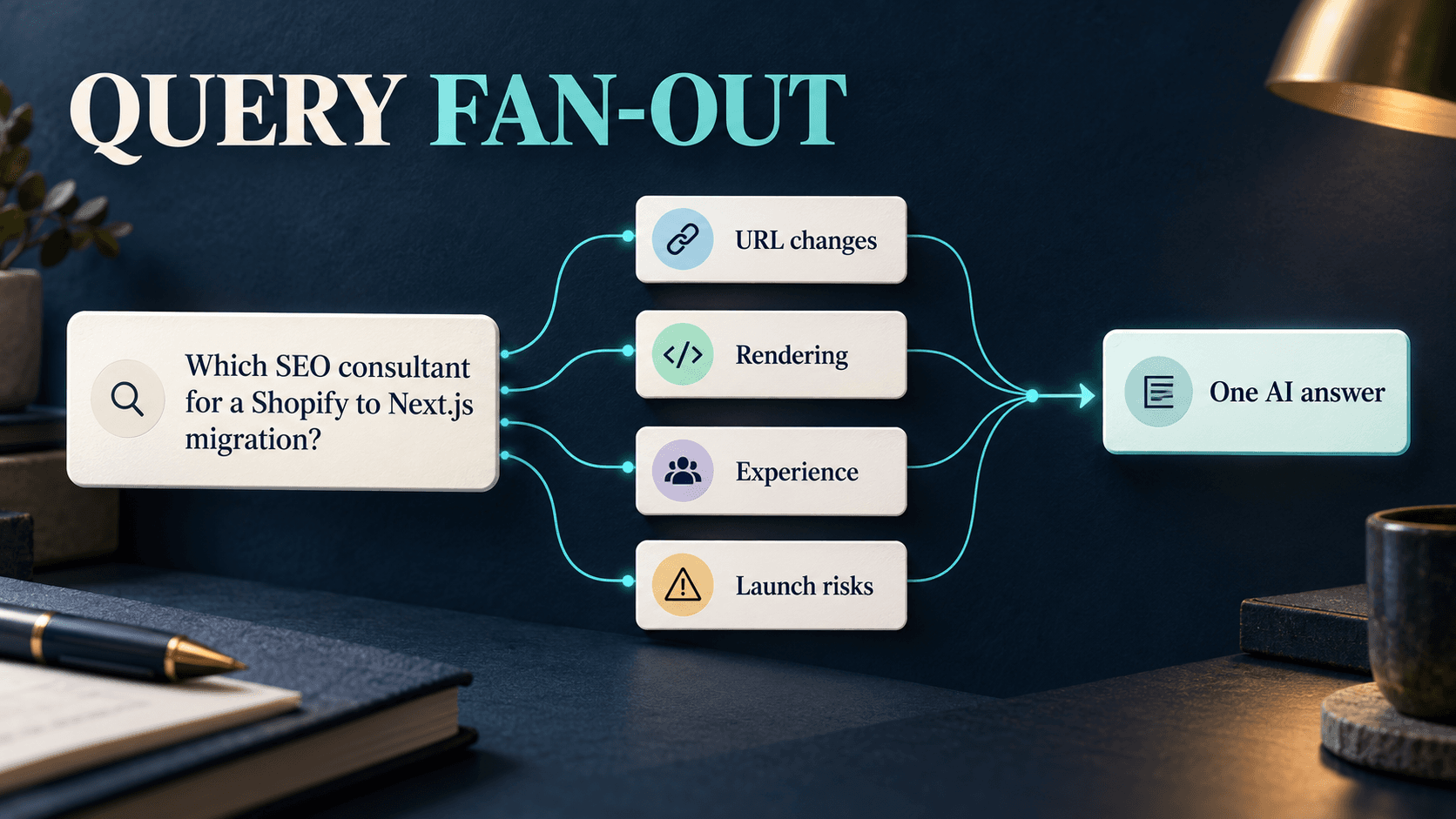

Query fan-out is a useful explanation for why AI search can answer one long question by drawing on several different searches at once. If someone asks which SEO consultant can handle a large Shopify to Next.js migration, they may also need to know what can go wrong with URLs, whether category pages will render properly, how the launch should be checked and whether the consultant has done similar work before. Google says AI Mode can break a question into subtopics and issue related searches concurrently; its current guidance says AI Overviews and AI Mode may use the same technique. For GEO, this gives us a practical clue about how sources may be found, though Google has not exposed the full query plan or said that matching every branch is a ranking factor.
What is query fan-out?
Google Search Central defines query fan-out as related queries generated by a model at the same time, to find more information and additional results that help answer the original question. Its example begins with “how to fix a lawn that’s full of weeds”; the follow-up searches might look at herbicides, removing weeds without chemicals and preventing them from growing back.
So, one question becomes a broader retrieval job, the system identifies what the person is trying to do, searches across relevant subtopics, retrieves supporting pages and then uses what it finds to construct a response. Google describes this as part of retrieval-augmented generation (sometimes known as RAG): its systems retrieve pages from the Search index and review information from those pages to produce a response with links to sources that support it.
Snapshot 1. A crop from Google Search Central’s definition of query fan-out; the full definition and its lawn example are summarised above. The page was last updated on 10 July 2026. Source: Google Search Central.
The term is most useful when we keep its scope clear. Google documents query fan-out for AI Overviews and AI Mode; other answer engines can have their own search and query-rewriting workflows, but we should not assume that every product uses Google’s process or exposes the same controls. We know each LLM will have its own techniques and approaches to query fan out.
To elaborate - more in the context of chatGPT:
Query fan-out is a technique where ChatGPT takes a single user prompt and automatically splits it into multiple parallel sub-queries to gather comprehensive data before writing a response.
How the Process Works (at least for chatGPT)
Deconstruction & Intent Analysis
ChatGPT reads your prompt and analyzes the core intent, missing details, and potential anglesSub-Query Expansion
Instead of searching your exact words, it generates several longer, more specific sub-queries (often adding qualifiers like years, brands, "best," or comparison words)Parallel Retrieval
It runs these multiple searches at the same time across web sourcesSynthesis & Ranking
It uses an algorithm like Reciprocal Rank Fusion (RRF) to combine, score, and filter the retrieved data, favoring sources that show up across multiple sub-queries. Finally, it stitches everything into a single, clean answer
Key Details
Number of Searches
A simple prompt might trigger 2 to 3 sub-queries, while complex or deep research prompts can trigger dozens.Hidden Additions
ChatGPT frequently injects words like "best", "top", "reviews", or "comparison" into its background searches even if you did not type them.
How does query fan-out work?
We do not get to see Google’s internal query tree, so any diagram of the hidden searches is an illustration rather than a transcript. At a high level, the process is easier to understand as a sequence: the system interprets the request, works out which subtopics and constraints need more information, retrieves relevant pages for those angles, and combines the evidence into a response. Google has also described AI Mode as making a plan, conducting searches and adjusting that plan in light of what it finds, which means the process can involve more than a single fixed list of expansions.
Take a question from a business considering a major platform change:
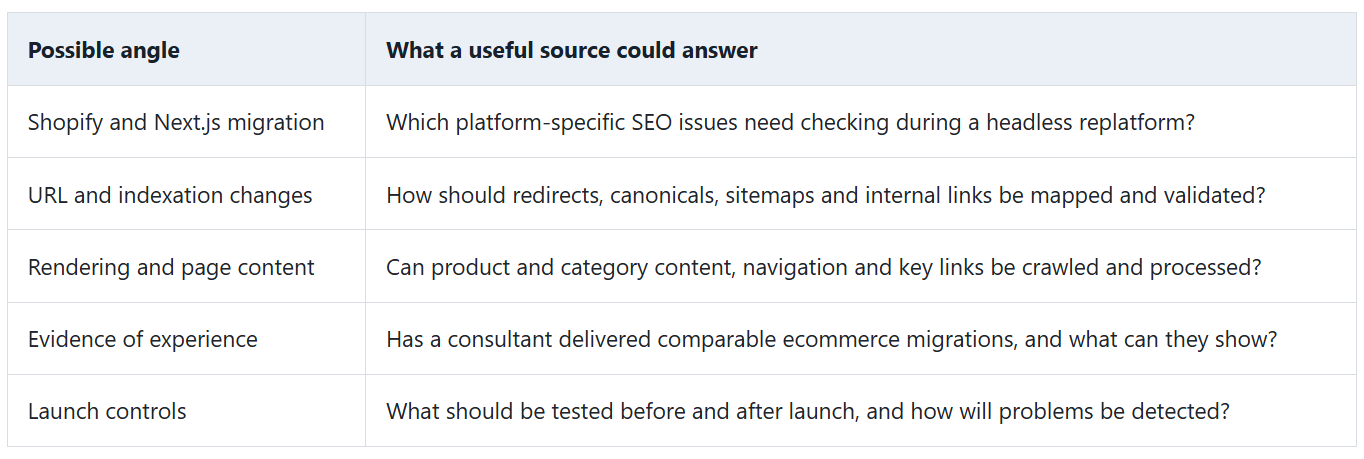
Original question: “We have a 4,000-product Shopify store and want to move to Next.js. What SEO risks should we plan for, and how do we choose the right consultant?”
A search system could sensibly explore different parts of that decision. The branches below are plausible research angles, not Google’s reported fan-out for this exact prompt:
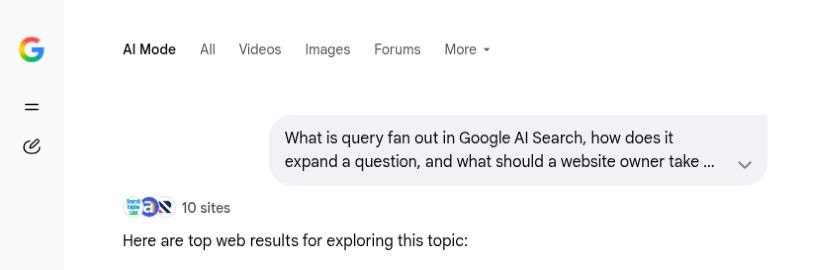
Google’s visible result page gives us the answer and some of the sites it has surfaced; it does not give website owners a report of the background queries that produced those results. The “10 sites” label in the next snapshot is the number of sites shown in that interface, not a count of fan-out queries. That distinction matters because screenshots of an AI answer are useful evidence of what the system displayed, but they cannot reveal precisely how its retrieval plan was constructed.
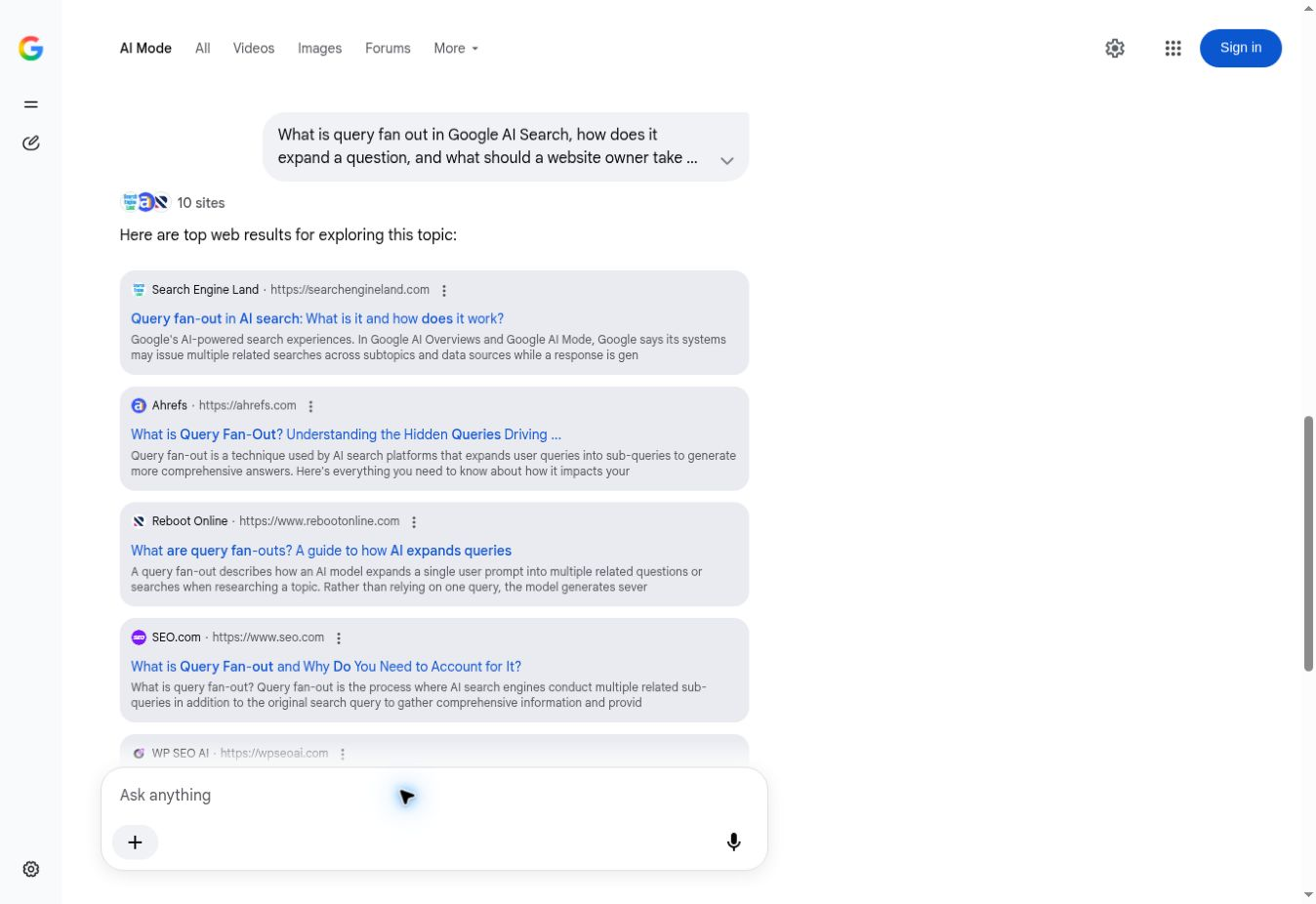
Snapshot 2. A live Google AI Mode result captured on 3 October 2026. The visible interface shows the question and source results, while the hidden query branches remain undisclosed. The “10 sites” label is a displayed source count, not evidence that Google ran ten fan-out queries.
What part does query fan-out play in GEO optimisation?
Now, this is the part that matters for GEO: query fan-out widens the set of searches that may contribute information to a generated answer. That means a page can be relevant to one supporting part of the user’s problem, even when it does not repeat the full wording of the original prompt. If a business asks how to choose a consultant for a migration, a well-evidenced page about JavaScript rendering, a case study about a comparable migration and a detailed technical checklist may each support a different part of the final response. That is a practical inference from Google’s description of related searches and source retrieval, not a published formula for getting cited.
When I map a GEO brief, I start with what the person is trying to decide, what they need to compare, which constraints matter and what evidence would let them trust the answer. A page that handles those needs clearly gives the search system something useful to retrieve; a page that merely repeats the prompt in headings gives it very little to work with.
Google’s guidance says generative AI features rely on core Search ranking and quality systems. Pages still need to be indexed and eligible to appear with a snippet, and Google’s current documentation also says a site must be included in Search generative AI features in Search Console to be eligible for those experiences. Fan-out cannot retrieve information from a page that is inaccessible to the system, nor can it turn unsupported claims into reliable evidence.
Why does query fan-out matter?
It matters because the visible prompt is not always the whole information need. A person asking for a recommendation may also need a comparison, a cost range, compatibility details, limitations and proof that the recommended option works in their situation. Traditional keyword research still helps us understand demand and competing pages, but query fan-out is a reminder to inspect the decision behind the query as well as the phrase itself.
There is also a meaningful difference between covering a topic and publishing a separate URL for every possible branch. Google explicitly warns against creating pages for each variation of a query or fan-out search primarily to manipulate visibility. Its current guide says there is no requirement to break content into tiny “chunks” or write in a special style for AI systems; Google says its systems can understand related meaning without an exact wording match
The better use of fan-out is to find holes in the customer journey. If your main page explains what a service is but says nothing about migration risks, implementation evidence or how success is measured, you may have missed questions that are part of the same real-world decision. Sometimes those details belong in the same page; sometimes they deserve their own page because they serve a separate intent. That is an editorial decision, not a mechanical rule derived from a hidden query list.
How I would use query fan-out in a GEO strategy
Start with real questions. Use Search Console queries, sales conversations, support tickets, site search and customer interviews to understand what people ask before they choose a product or service. Those are better foundations than invented prompt volumes.
Map the connected questions. For each important problem, list the genuine comparison, constraint, implementation, evidence and risk questions that help someone reach a decision. Treat the list as a research map for your content, not as a set of compulsory landing pages.
Audit what you already have. Identify pages that answer each part well, pages that make claims without evidence and gaps where you have no useful material. Consolidate overlapping pages when they serve the same need; create new content when the audience or task is meaningfully different.
Add something worth citing. Use firsthand experience, original data, a clear methodology, examples, qualified claims and relevant sources. Google’s guide specifically favours content with a useful point of view and information that adds more than a restatement of common knowledge.
Check eligibility and delivery. Confirm that priority pages are crawlable, indexable and eligible for snippets, and that your site has not been excluded from Google’s generative AI features. For JavaScript-heavy websites, verify the rendered page and the content Google can process instead of assuming that a visible interactive element has been fetched and understood.
How do we measure it?
Google’s Generative AI performance report in Search Console now covers impressions from AI Overviews and AI Mode. Google says its report can be grouped by page, country, date and device; the insights were rolled out to all websites worldwide as of 31 August 2026, although a property may not show the report if it has not received enough generative AI impressions. Those fields are useful for understanding which pages are being shown and how visibility changes over time, but Google does not document a dimension that exposes the hidden fan-out questions themselves.
For the prompt-level view, build a small, stable test set around real customer decisions. Include different phrasings, locations and constraints, then record the date, tool, answer, cited URLs, brand mentions and whether the information is accurate. Repeat the tests over time; a single response can change with wording, market, model updates and available sources, so a one-off screenshot is not enough to establish a trend.
Third-party visibility trackers can help with repeatable observation, but treat their output as a record of what happened for their particular prompts and settings, not as access to Google’s internal search logs. Google cautions that no third-party tool can access its internal ranking or AI systems; it recommends evaluating outside advice against official guidance.
What does the research tell us?
The foundational GEO research is useful, but it is easy to overstate. Aggarwal and co-authors tested generative-engine optimisation strategies against a benchmark of 10,000 queries and reported visibility improvements of up to 40% in their experiments. That headline result comes from their experimental setup; it is not a forecast for a live website, and the study does not establish that targeting Google’s hidden fan-out queries produces a similar gain.
For practical work, the most solid evidence is still Google’s own description of its Search features and the eligibility and content guidance it publishes. We know fan-out can be used to retrieve more related information; we know Google may link to pages that support its AI responses; and we know Google says useful, original content and foundational SEO remain important. The exact query tree, its weight in any individual answer and the probability that a retrieved page will be cited remain outside what website owners can directly inspect.
The takeaway
Query fan-out matters for GEO because it helps explain how one detailed question can be answered using information from several related searches. It should change how we research the user’s problem and audit our coverage, while keeping the work tied to real needs, credible evidence and technically accessible pages. Use it to understand the wider decision your content needs to support; do not treat it as a hidden keyword report or a reason to manufacture a page for every possible search variation.