









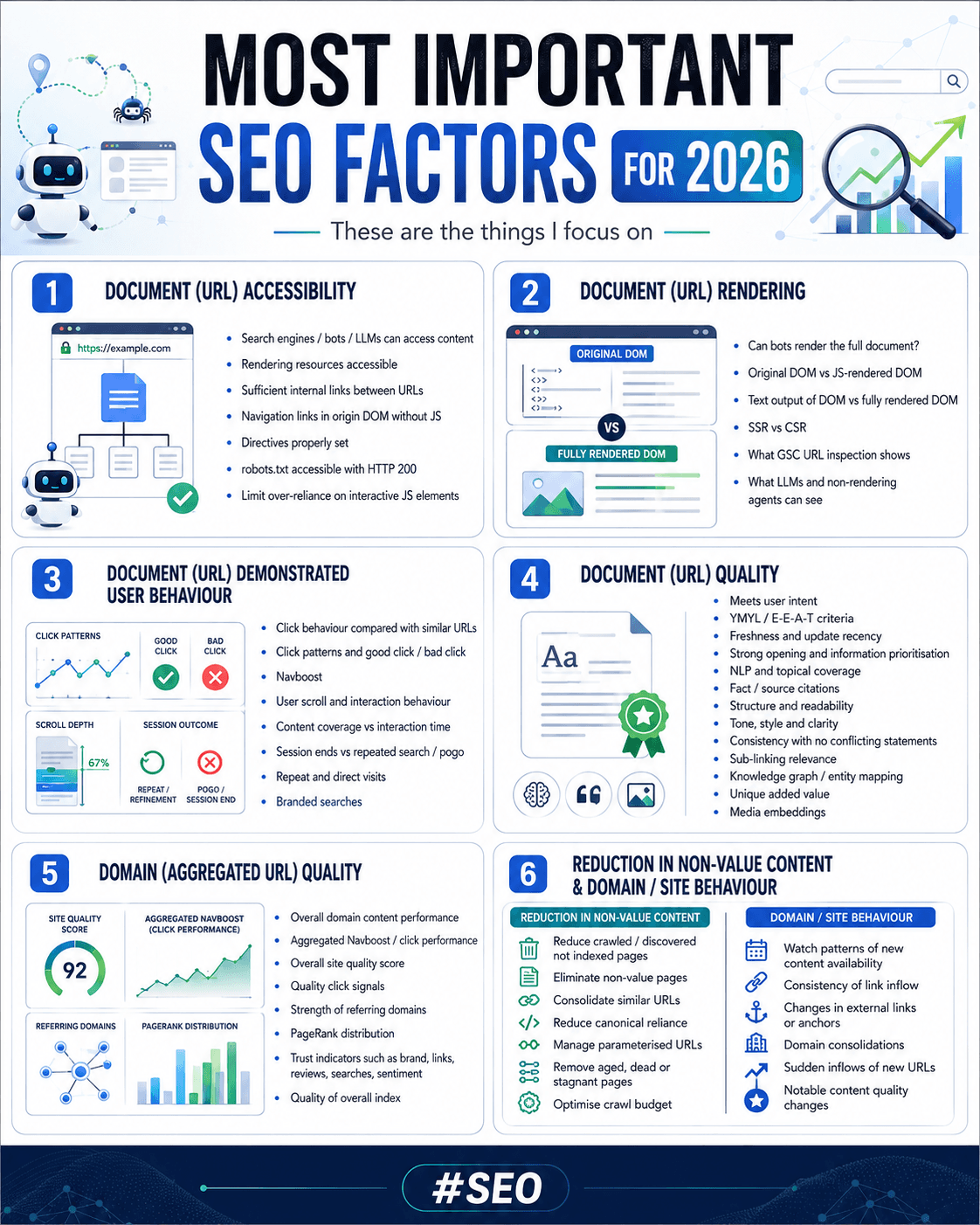

Most Important SEO Ranking Factors for 2026
So, we're half way through the year already so it seems a bit counter productive to be writing about the most important SEO factors for this year, but, hear me out. You see, many of the ranking factors that are important now will remain important for a long time to come.
Think of this list as more of a "refresh" for your own SEO knowledge.
Now, what I have to make absolutely clear here before we get stuck in, these ranking factors are not all "ranking" factors per se but have an affinity or connection to ranking in some way, for example E-E-A-T is not specifically a ranking factors but what makes E-E-A-T can help towards rank because of the usual things (experience, expertise, authority, trust etc.).
There are caveats, these are my own opinions and the weighting of them is in no specific order, but, from my own SEO testing, these are the ranking factors that I would say are "cornerstone" in helping a site to rank better in Google and in organic search in general.
One thing I am and have always been big on and that's SEO testing, SEO testing is fundamental to finding out what works for your brand/domain.
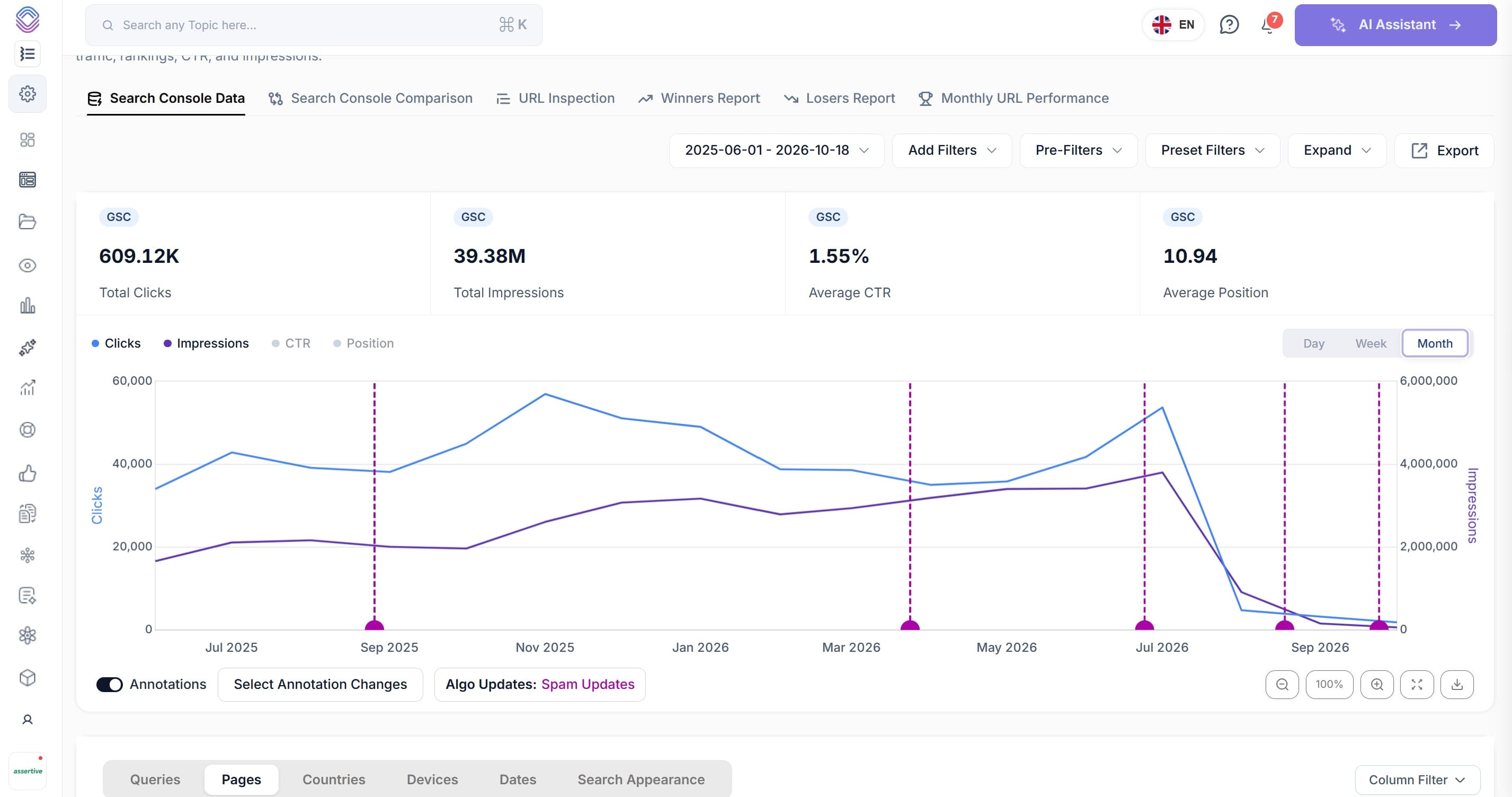
I mean, SEO testing is EXACTLY how I got this >
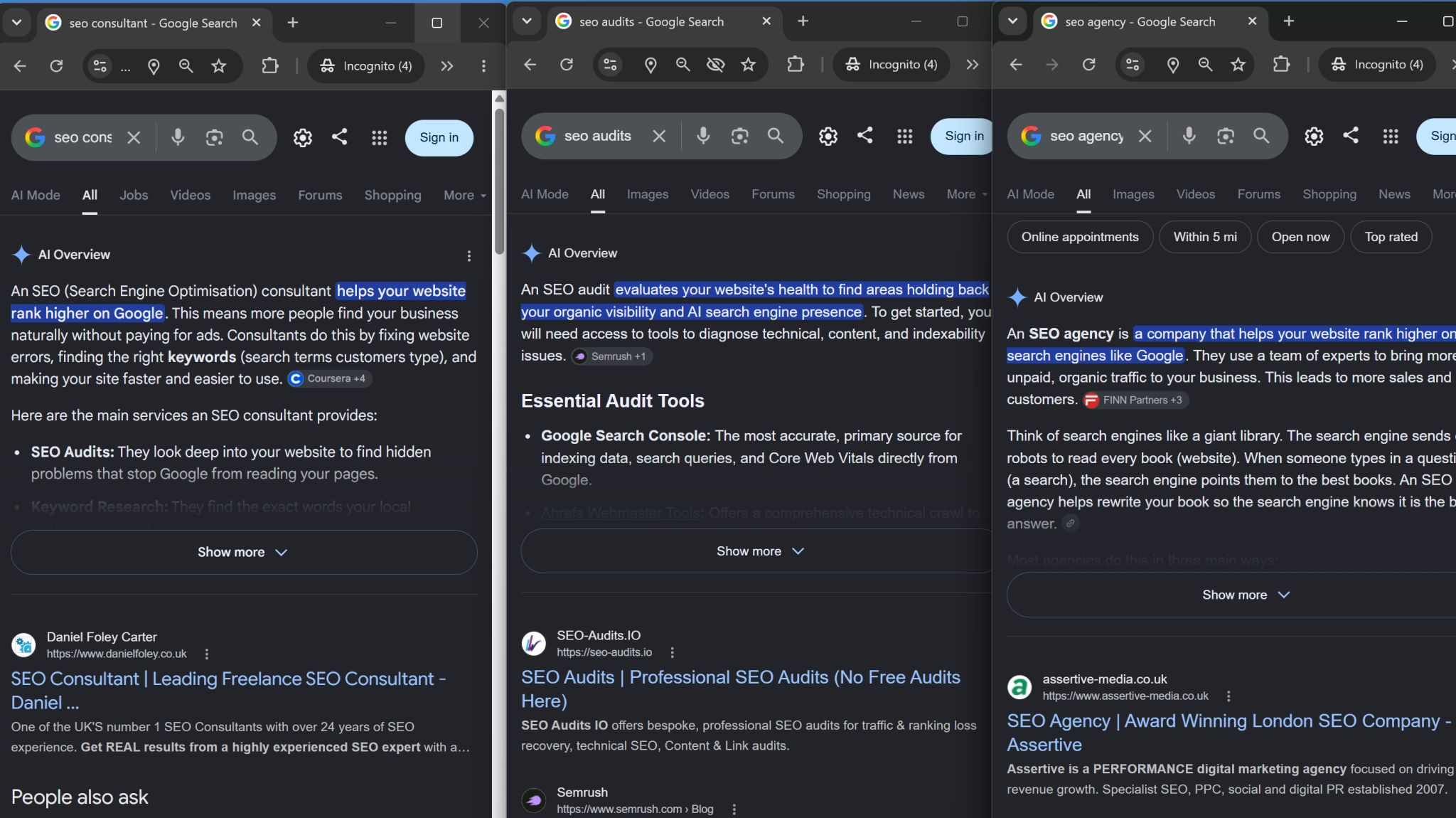
When I write articles about SEO be it ranking factors, SEO experiments, news, insights - I do everything through a data lens, I look at data and draw my own conclusions from the data.
That's what makes us SEOs - apply common sense, best practice and logic, build authority, test and repeat until you rank.
OK enough about my back story and rankings, let's get stuck in. First, i'll list all of the items by their type - we refer to document as a webpage or "URL". So, I've listed them by type i.e. Accessibility, Rendering, User Behaviour, Quality etc.
I must make it clear here that there are SIGNIFICANTLY more ranking factors, thousands of them and how they are applied is anyones best guess, we'll never know and that's the whole point. I wrote an article unpicking Google's NavBoost which gives more depth and insight around the Google data warehouse leak years ago that exposed a lot of factors that Google looks at.
So, if I were considering SEO factors that are MOST important now (2026) and moving forwards into 2027 I would prioritise the following:
➪ DOCUMENT (URL) ACCESSIBILITY
→ Can search engines / bots / llms access your content
→ Can the resources for the document rendering be accessed
→ Are there sufficient internal links between URLS
→ Are navigation links in origin DOM without JS
→ Are directives properly set
→ Is robots.txt HTTP 200 and accessible?
→ How much of the page content is interactive with JS i.e BTN elements
→ HTTP status consistency & redirect chain depth
→ Canonical declared vs canonical selected consistency
→ Crawl frequency / crawl demand vs URL importance
→ Server response reliability & hostload capacity
→ Content available to non-Googlebot agents (GPTBot, ClaudeBot, PerplexityBot)
➪ DOCUMENT (URL) RENDERING
→ Can search engines / bots render the full document
→ What is in the original rendered DOM vs JS rendered DOM
→ What is the text output of DOM vs fully rendered DOM
→ Is the output rendered server side (SSR) or client side (CSR)
→ What does the output look like in GSC URL inspection
→ What does the output look like to LLMS or non-rendering agents
→ Key content above the token truncation threshold (leak: docs truncated, top-of-page prioritised)
→ Above-the-fold content vs ad/clutter density (clutterScore)
→ Layout & term weighting signals (font size, emphasis, avgTermWeight)
→ Render parity across mobile vs desktop
➪ DOCUMENT (URL) DEMONSTRATED USER BEHAVIOUR
→ What does click behaviour look like in comparison to similar URLS
→ What is the typical click pattern (good click/bad click)
→ Navboost (C-R-A-P-S)
→ User scroll & interaction behaviour
→ Content coverage vs interaction time
→ Session ends vs repeated search or POGO
→ Repeat & direct visits
→ Branded searches
→ lastLongestClicks (final satisfied click ending the search journey)
→ Squashed vs unsquashed click data (fraud vetting, IP priors, voter tokens)
→ 13-month rolling click data window
→ Query-document pair performance sliced by country, device & language
→ Chrome browser data (chromeInTotal, site visit frequency)
→ directFrac (proportion of direct traffic to the host)
→ Host/topic level impressions vs clicks
➪ DOCUMENT (URL) QUALITY
→ Does the content meet end user needs (intent)
→ Does the content meet criteria for YMYL/E-E-A-T
→ How fresh is the content & when was it last updated
→ Content initial opening - clearly stating what's on offer
→ Content information prioritisation
→ Content NLP & topical coverage
→ Content fact / source citations
→ Content structuring & readability
→ Content tone of voice, writing style, perspective, sentiment
→ Content consistency i.e. no conflicting statements
→ Content clarity
→ Content sub-linking & sub link relevance
→ Knowledgegraph / Entity mapping
→ E-E-A-T sub-criteria (author, byline, citations, sources, establishment)
→ YMYL sub-criteria (regulatory, compliance, safety etc)
→ Content unique added value (beyond what exists)
→ Content media embeddings (engagement)
→ Content effort estimation (contentEffort — LLM-scored: original data, visuals, expert input)
→ OriginalContentScore / information gain vs what already ranks
→ Title-query alignment (titlematchScore)
→ Page embedding vs site embedding fit (does this page belong on this site)
→ Keyword stuffing / gibberish scoring
→ Meaningful updates vs cosmetic date changes (lastSignificantUpdate)
→ Date agreement (bylineDate vs syntacticDate vs semanticDate)
→ Page version history (last ~20 versions stored)
→ UGC & discussion quality/effort (ugcDiscussionEffortScore)
➪ DOMAIN (AGGRRGATED URL) QUALITY
→ Sum of overall domain content performance
→ Sum of aggregated NAVBOOST / click performance data
→ Sum of overall site quality score
→ Sum of quality click signals
→ Strength of external referring domains
→ Distribution of PageRank to URLS on domain
→ Overall trust indicators (brand, links, reviews, searches, sentiment)
→ Quality of overall index
→ siteAuthority & NSR framework (predictedDefaultNsr baseline, versioned trajectory over time)
→ Site topical focus & drift (siteFocusScore, siteRadius)
→ Site-level embeddings (site2vec) & topical identity
→ Quality consistency across URLs (siteQualityStddev, chard variance)
→ Homepage PageRank & homepage trust inherited by new/unranked pages
→ Host age & fresh-spam sandboxing (hostAge)
→ smallPersonalSite classification (potential boost/demotion via twiddler)
→ Site-level media scores (videoScore, imageQualityClickSignals, shoppingScore)
➪ REDUCTION IN NON-VALUE CONTENT
→ Reduction in Crawled / Discovered currently not indexed
→ Management and elimination of non value pages
→ Consolidation of similar URLS
→ Reduction & elimination of canonical reliance
→ Proper management of parameterised URLS
→ Reduction of aged dead pages / stagnant pages
→ Optimisation of crawl budget
➪ DOMAIN/SITE BEHAVIOUR
→ Patterns of new content availability i.e. mass content production
→ Consistency of new link inflow
→ Changes in external links or anchors
→ Domain consolidations
→ Sudden inflows of new URLS
→ Notable content quality changes
➪ DOCUMENT (URL) RELEVANCE & QUERY MATCHING
→ Query intent classification (informational, transactional, navigational, local)
→ Topicality scoring (T*) — term matching, salience, synonyms
→ Semantic embedding similarity (page embedding vs query embedding)
→ Anchor text as an external relevance statement
→ Passage-level relevance & retrievability (chunk-level indexing)
→ Snippet extractability — can Google lift a clean answer
→ Query deserves freshness (QDF) classification for the topic
→ Historical query-URL association (has this URL satisfied this query before)
➪ LINKS & PAGERANK (URL LEVEL)
→ Anchor text relevance to target content (anchorMismatchDemotion)
→ trustedAnchors — links from vetted trusted sources
→ Link source index tier (fresh/flash tier links worth more than disk-tier — Alexandria/TeraGoogle)
→ Link velocity patterns & spam spike detection
→ Link value weighted by linking site's homepage trust
→ Internal link weighting, placement & dropped anchor handling
→ Link relevance — topical alignment between source and target
→ Outbound link quality — who you cite and link to
➪ DEMOTIONS, SPAM & SUPPRESSION SIGNALS
→ pandaDemotion / babyPandaDemotion — persistent site-wide thin content debt
→ navDemotion — poor navigation & UX experience
→ SERP demotion — dissatisfaction signals observed in the results page
→ exactMatchDomainDemotion
→ scamness & unauthoritativeScore
→ lowQuality & VLQ (very low quality) model scores
→ Product review demotions/promotions (productReviewPDemoteSite / PPromoteSite)
→ Location demotions ("global" pages demoted where local intent exists)
→ SpamBrain / link spam neutralisation
→ Expired domain abuse, site reputation abuse & scaled content abuse policies
➪ ENTITY, AUTHOR & BRAND SIGNALS
→ Author as a recognised entity — tracked across the web and within the site
→ Author bio, credentials & verifiable footprint
→ Person / Organization schema & Knowledge Graph presence
→ Publisher entity establishment (about, contact, ownership transparency)
→ Brand search demand as a trust proxy
→ Entity association with topic (is this brand known for this subject)
→ Sentiment & reputation off-site (reviews, mentions, forum discussion)
→ Consistency of NAP / entity data across the web
➪ SERP CONTEXT & RE-RANKING (TWIDDLERS)
→ Twiddler re-rankers applied post-scoring (freshness boost, click boost, official page boost)
→ Result diversity constraints (host crowding limits)
→ SERP feature eligibility (featured snippets, PAA, AIO inclusion)
→ Whitelists / exception lists for sensitive verticals (elections, health crises)
→ Personalisation & locale-based re-ranking
→ Gold standard / golden documents flags
➪ PAGE EXPERIENCE & UX
→ Core Web Vitals (LCP ≤2.5s, INP ≤200ms, CLS ≤0.1) — lightweight in Mustang, but experience feeds NavBoost
→ Mobile usability & render parity
→ HTTPS & security state
→ Intrusive interstitials & ad density (clutterScore)
→ Monetisation balance — ads not displacing main content
→ Ease of task completion (drives the good click / long click outcome)
➪ LOCALE & SERVING CONTEXT
→ Country & language relevance (click data sliced per locale)
→ Hreflang implementation & international duplication handling
→ Local relevance signals (localityScore)
→ Geo-appropriate content, currency, contact & compliance signals
➪ AI SEARCH / LLM VISIBILITY (GEO/AEO)
→ AI Overview inclusion & citation frequency
→ Chunk-level answer extractability (clear, self-contained passages)
→ Brand presence in LLM training & grounding data (mentions, citations)
→ Consistency of factual claims about your entity across the web
→ Structured data supporting machine understanding
→ Content accessible to AI crawlers without JS dependence
→ Share of voice in AI-generated answers vs competitors
So, the above is where I would put most of my focus, but what kind of an article would this be if I didn't explain each of these in a bit more detail. But, as we know it's very easy to take a top level set of ranking factors and to turn it into a huge detailed set of explanations, so I'll keep it summarised and to the point.
Before I do, I want to explain a few things.
RANKING ALGORITMS & THEIR APPLICATION
Google doesn't have a single unified algorithm, it has multple algorithms that deal with different things, everything is semi-compartmentalised and for good reason. How Google applies ranking factors is where the real mystery is and why SEO will always have a great degree of obscurity to it, that's what makes it special as a service - because a lot of what makes SEO work isn't the surface level stuff.
The reality is, SEO has changed significantly as AI has advanced, Google has significantly more to work with than it did years ago - writing in keywords to titles and H1s is so early 2000s.
Whilst Google explicitly stated in the DOJ that it doesn't understand documents, we fake it (remember this?)
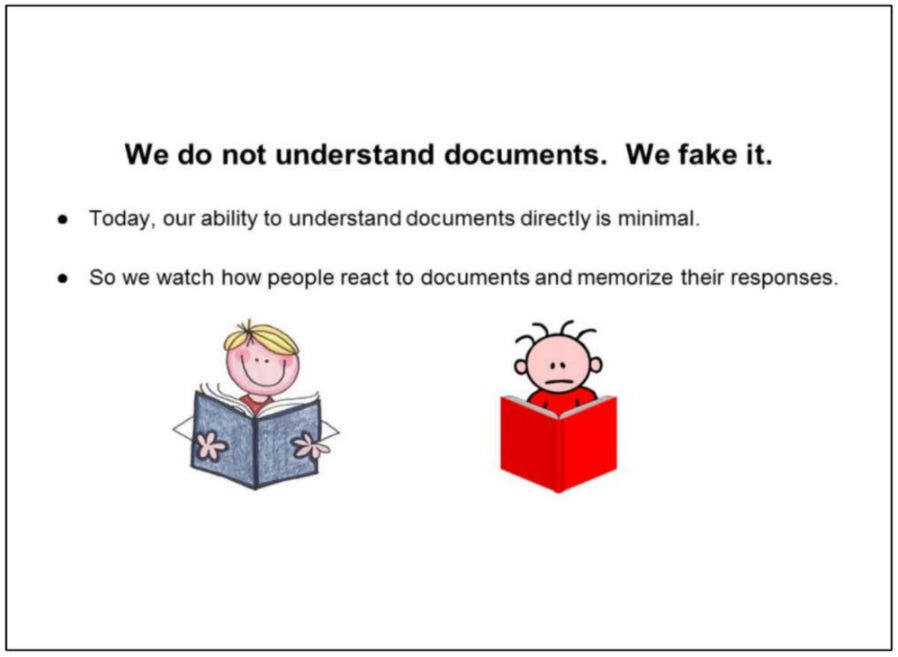
Well, that might have been semi-true but not fully. Google has RankBrain, BERT, MUM, and whilst that doesn't explicitly mean they can understand a document, it also sort of means that they don't nessescarily need to.
There's also a lot we COULD unpack here to muddy the waters with AI and how AI could be used for document interpretation the biggest thing we have to go by is that Google can look at SO many factors around other facets of SEO from user behaviour to links etc.
The long and thick of it is - it doesn't really matter what Google says because we know that there are plenty of ways to skin a cat or to "bend the truth" which Google has done countless times!
The thing that SEOs should be mindful of are:
There is no single unified Google algorithm
The application of algorithm ranking factors and weighting is NOT linear
Doing the "right" things doesn't guarantee rank or that you'll see growth
The interplay of ranking factors is massively complex and is non-reversible, we can't reverse engineer why a site ranks (knowing exactly what lead to rank, we can speculate or guess or asssume)
So the best thing in SEO is to TRULY focus on the end user - because ultimately alongside good technical SEO compliance, good content, good on site, strong links one of the most powerful indicators of whether something is good is user behaviour.
As we know, it's been Google's focus to get SEO's to focus on end users rather than SEO, making good content for people basically.
The MAIN things I would urge SEO's to keep in mind:
Google chrome was a trojan horse for user behaviour data - this likely played a big role in how helpful content was determined - by user performance/behaviour data
Google has blended helpful content into it's broad core algo - be mindful of this
Google is forever chopping, changing and tweaking different algo's - refining link spam and spam, rankbrain, BERT, MUM etc.
So, when you are focusing on ranking, try to focus MORE on document quality, suitability and performance over worrying about jamming keywords into titles or H1s.
Now, I will explain EACH of the items above in a bit more detail, here goes:
SEO RANKING FACTORS, THE COMPLETE ANNOTATED LIST
Grounded in the Google Content Warehouse API leak (May 2024), NavBoost / DOJ trial disclosures, the Helpful Content system (now folded into core), E-E-A-T / YMYL and the Search Quality Rater Guidelines (Sept 2025 version).
➪ DOCUMENT (URL) ACCESSIBILITY
→ Can search engines / bots / LLMs access your content
The absolute prerequisite, If Googlebot, Bingbot or AI crawlers such as (GPTBot, ClaudeBot, PerplexityBot) are blocked at the firewall, CDN, robots level or via bot-management rules, nothing downstream matters, no scoring system ever sees the document. Common silent killers include Cloudflare bot-fight modes which can cause untold issues, WAF rules that challenge unknown user agents are also a pain, and geo-blocking that happens to cover crawler datacentre IP ranges. Verify with log files, not assumptions: the crawl log is the only source of truth for what actually had a successful request. I would advocate using Google’s live URL inspection tools here as well as using Google Chrome to test console output for raw text with Javascript disabled.
→ Can the resources for the document rendering be accessed
Googlebot needs the CSS, JS, fonts and API endpoints that construct the page, not just the HTML shell. If a critical JS bundle or an XHR endpoint is robots-blocked, on a disallowed subdomain, or requires authentication, the Web Rendering Service produces a broken or empty render and scores that instead of your real page. Audit blocked resources in GSC URL Inspection and check that third-party dependencies (tag managers, personalisation scripts, headless CMS APIs) don't gate the main content. This happens a lot more than you would think.
→ Are there sufficient internal links between URLs
Internal links make the web what it is and are simultaneously the discovery mechanism for crawlers, the PageRank distribution, and a relevance statement (via anchors). Orphaned or thinly-linked URLs get crawled less, accumulate less internal PageRank, and are more likely to sit in "Discovered, currently not indexed". The leak confirms internal anchors carry weight (with mechanisms like droppedLocalAnchorCount suggesting some internal links get discounted), so link density needs to be meaningful, contextual and proportionate to a page's importance, not boilerplate footer spam. All pages should have at least 5 internal unique links or more - this is why running a crawl and finding low internal link count pages is key.
→ Are navigation links in origin DOM without JS
Navigation delivered only after JS execution creates a 2-tier reality: the initial HTML fetch shows a site with no architecture, and only the (delayed, sometimes failed) render reveals the link graph. That degrades crawl discovery, delays PageRank flow, and leaves non-rendering agents, including most LLM crawlers, seeing a site with no navigation at all. Primary nav, breadcrumbs and key contextual links should exist as <a href> elements in the raw HTML response.
→ Are directives properly set
Meta robots, X-Robots-Tag headers, canonicals, hreflang and rel attributes are instructions for indexing pipeline, & conflicting instructions produce unpredictable outcomes, e.g. noindex plus canonical to another URL, or a canonical pointing at a redirecting/blocked target. Directives must be consistent between HTTP headers and HTML, consistent pre- and post-render (JS that injects or flips a robots meta is a classic disaster), and must express a single coherent intent per URL. Incorrectly configured directives can cause a large volume of SEO issues.
→ Is robots.txt HTTP 200 and accessible?
Robots.txt behaviour is asymmetric and unforgiving: a 200 is a must, a 404 is treated as "no restrictions", but a 5xx or timeout can cause Google to throttle or pause crawling of the entire host because it can't confirm what it's allowed to fetch. Intermittent robots.txt failures show up as sitewide crawl volatility. It must return a stable 200, be under size limits, and not be blocked by the CDN or bot protection itself. You can check the crawl stats and robots.txt accessibility from within Google search console under Settings > Crawl Stats, there you can see the fetch request status for robots.txt files.
→ How much of the page content is interactive with JS i.e. BTN elements
Content locked behind <button> elements, onclick handlers, tabs, accordions or "load more" interactions may never enter the indexed representation of the page, because crawlers don't click, they don’t interact like people do. Buttons are not links: they pass no PageRank, expose no destination URL, and hide whatever they reveal. Anything that must rank, and any link that must be followed, needs to be present in the DOM as real content and real <a href> elements, with interactivity layered on top as progressive enhancement. A lot of vibe coded websites are built as “apps” and therefore, a lot of what looks to be accessible content actually ends up being inaccessible content.
→ HTTP status consistency & redirect chain depth
URLs that bounce between 200/302/404/503 send unstable signals into the index and can trigger de-prioritised crawling. Redirect chains dilute signal consolidation and waste crawl budget, each redirect hop adds latency and another point of failure risk, and Google historically caps how many hops it follows. Every canonical URL should return a clean, stable 200; every retired URL should reach its destination in a single 301 hop.
→ Canonical declared vs canonical selected consistency
Your declared canonical is a hint, not a command, so effectively Google can ignore it if it wants to, Google selects its own canonical based on redirects, internal linking, sitemaps, HTTPS, and content similarity. When declared and selected diverge (visible in GSC as "Duplicate, Google chose different canonical"), your signals are consolidating somewhere you didn't intend. The fix is alignment: make every signal, links, sitemap entries, hreflang, redirects and the canonical tag, agree on one URL.
→ Crawl frequency / crawl demand vs URL importance
Crawl rate per URL is a revealed-preference metric: Google recrawls what it considers important and profitable. If your money pages get hit weekly while faceted junk gets hit hourly, your internal signals of importance are miscalibrated. Log file analysis mapping crawl frequency against business value is one of the most honest audits available, crawl demand tends to correlate with (and precede) indexing and ranking priority.
→ Server response reliability & hostload capacity
Google calibrates crawl to what your infrastructure can bear (hostload); slow TTFB, timeouts and 5xx spikes cause it to back off, which slows discovery, refresh and reindexing sitewide. Consistent sub-second server response at crawl scale is a precondition for large sites getting fully and freshly indexed, and infrastructure wobble during migrations is a common cause of prolonged ranking limbo.
→ Content available to non-Googlebot agents (GPTBot, ClaudeBot, PerplexityBot)
AI assistants and answer engines are now a discovery surface in their own right, and most of their crawlers execute little or no JavaScript. If your content requires rendering, sits behind aggressive bot protection, or blocks these agents in robots.txt, you're absent from AI answers, citations and grounded search results. A deliberate policy decision is required: which agents you allow, what they can reach server-side rendered, and whether your monetisation model tolerates or embraces AI retrieval.
➪ DOCUMENT (URL) RENDERING
→ Can search engines / bots render the full document
Indexing operates on the rendered result, so rendering failures are indexing failures. Render-blocking errors, JS exceptions, missing polyfills, timeouts on slow API calls, resources blocked from fetch, can leave Google indexing a partial page or an empty application shell. The rendered output, not your source code, is your ranking document; it must be verified, not assumed.
→ What is in the original rendered DOM vs JS rendered DOM
Diffing raw HTML against the post-JS DOM reveals exactly which content, links and metadata depend on client-side execution, your rendering risk surface. Anything that only exists post-JS is subject to render delays, render failures, and invisibility to non-rendering agents. The goal is that everything ranking-critical (main content, headings, canonical, meta robots, internal links, structured data) exists in the origin response, with JS only enhancing.
→ What is the text output of DOM vs fully rendered DOM
Beyond structure, compare the extractable text itself, search engines and LLMs ultimately consume a text serialisation of the page. Text injected, reordered, expanded or replaced by JS may differ materially from what the raw response contains, and truncated or duplicate text in the render can corrupt what gets indexed. Run text-level diffs, not just DOM diffs: the words are the ranking substrate.
→ Is the output rendered server side (SSR) or client side (CSR)
SSR (or static generation) delivers complete content in the initial response, instantly indexable, visible to every agent, fastest to first byte of meaning. CSR defers content to the browser, introducing a second render dependency, potential indexing delay, and total invisibility to non-rendering crawlers. Hybrid patterns (SSR with hydration, edge rendering, dynamic rendering fallbacks) exist precisely to close this gap; pure CSR remains the highest-risk architecture for organic visibility.
→ What does the output look like in GSC URL inspection
URL Inspection's rendered HTML and screenshot is Google's own testimony about what it sees, the closest thing to ground truth available. Systematically compare inspected renders against the live page for template types across the site: missing content blocks, unrendered components, blocked resources and stripped structured data show up here first. If it isn't in the inspected render, it isn't ranking you.
→ What does the output look like to LLMs or non-rendering agents
Curl the page with no JS and read what remains, that's roughly what most AI crawlers and lightweight agents ingest. If the answer is a loading spinner and a cookie banner, you don't exist in AI-mediated discovery. As AI Overviews and assistant citations become a real traffic channel, "what does my page look like as plain fetched HTML" is a first-class audit question, not an afterthought.
→ Key content above the token truncation threshold
The leak indicates documents are tokenised with a threshold beyond which content is truncated from consideration, a hard argument for front-loading. On very long pages, material buried deep may simply never be scored. Put the answer, the value proposition and the primary entities early; treat page depth as a budget, and spin genuinely distinct deep sections into their own URLs rather than stacking everything on one.
→ Above-the-fold content vs ad/clutter density (clutterScore)
The leaked clutterScore attribute suggests Google quantifies how much of the experience is obstruction, ads, interstitials, oversized headers, cookie walls, versus content. Pages where the main content starts below a wall of monetisation echo the old Page Layout algorithm and correlate with bad-click behaviour. The first viewport should deliver the thing the user clicked for.
→ Layout & term weighting signals (font size, emphasis, avgTermWeight)
The leak shows Google records the average weighted font size of terms and of anchor text, visual prominence is treated as an editorial signal of importance. Headings, emphasis and typographic hierarchy tell the parser what the page is about; a flat wall of uniform text gives it nothing. Semantic HTML plus genuine visual hierarchy aligns what users see as important with what the algorithm weighs as important.
→ Render parity across mobile vs desktop
Under mobile-first indexing, the mobile render is the document of record. Content, links, structured data or navigation present on desktop but collapsed, removed or unrendered on mobile effectively doesn't exist. Parity audits should compare mobile rendered output against desktop, not for pixel equality, but for content, link and markup equivalence.
➪ DOCUMENT (URL) DEMONSTRATED USER BEHAVIOUR
→ What does click behaviour look like in comparison to similar URLs
NavBoost is fundamentally comparative: your CTR and satisfaction metrics are evaluated against expected behaviour for that position, query class and result type, not in a vacuum. A result at position 4 consistently out-clicking positional expectation is a promotion candidate; one under-clicking it is a demotion candidate. This is why CTR benchmarking against your own query-position curves (the kind of thing GSC data warehousing exposes) is diagnostic gold.
→ What is the typical click pattern (good click / bad click)
The leaked CRAPS click signals distinguish goodClicks, clicks followed by apparent satisfaction, from badClicks, where the user rapidly returns to the SERP (pogo-sticking) and continues searching. The ratio of good to bad clicks per query-document pair is the behavioural verdict on whether the page delivered on the promise of its snippet. Winning the click but losing the visit is a net negative.
→ Navboost (C-R-A-P-S)
NavBoost is the re-ranking system that applies aggregated user click data on top of Mustang's initial scoring, described in the leak as one of Google's strongest signals, referenced 84 times across the documentation, and confirmed at the DOJ trial. The Craps module stores its click and impression signals: good, bad, last-longest and unsquashed clicks, sliced per query, URL, country and device. In practice: baseline relevance gets you into contention; NavBoost decides whether you stay there.
→ User scroll & interaction behaviour
Beyond the click itself, engagement depth, scrolling, interacting, time engaging with content versus bouncing off the first viewport, feeds the picture of satisfaction, with Chrome telemetry (chromeInTotal) providing a plausible collection path beyond the SERP. A page that earns the click but loses the reader in seconds produces the same downstream signal as a bad click.
→ Content coverage vs interaction time
Dwell time is only meaningful relative to what the content demands: thirty seconds is success for a concise answer and abject failure for a 4,000-word guide. The realistic model is expected-engagement-for-content-type versus observed engagement. This also cuts against padding: inflating word count raises the engagement bar your users must clear for the page to look satisfying.
→ Session ends vs repeated search or POGO
The strongest satisfaction signal is the search journey ending on your page, no return to the SERP, no reformulated query. Pogo-sticking back and query refinement after visiting you are the clearest dissatisfaction markers. The leaked lastLongestClicks attribute captures exactly this: being the result that terminated the task is the outcome NavBoost most rewards.
→ Repeat & direct visits
Users returning directly to a site, bypassing search entirely, indicate real-world utility and brand preference. The leaked directFrac attribute (fraction of direct traffic at host level) and Chrome-derived visit data suggest this is measured and used as a site-quality input. Sites people bookmark and revisit look fundamentally different in the data from sites that only ever intercept strangers.
→ Branded searches
Query volume for your brand, and brand-plus-topic queries ("seo stack gsc export"), is demand evidence Google observes natively in its own logs. Branded search is arguably the hardest signal to fake at scale and correlates strongly with resilience through core updates. Building search demand for the brand, not just rankings for keywords, is the long-game behavioural moat.
→ lastLongestClicks (final satisfied click)
Explicitly named in the leak: the last result a user clicked and dwelt on in a search session, the page that ended the journey. It's weighted as a particularly strong success signal because it's hard to misinterpret: the user stopped looking. Optimising for it means fully resolving the intent on-page rather than winning a superficial click.
→ Squashed vs unsquashed click data (fraud vetting, IP priors, voter tokens)
NavBoost maintains parallel views of click data: squashed (dampened, normalised, resistant to sudden anomalies) and unsquashed (raw, preserving spikes so fraud systems can inspect them). Combined with IP-based priors and voter tokens representing individual users, this is the anti-manipulation architecture, a sudden burst of clicks doesn't move rankings directly; it gets flagged and evaluated first. Click manipulation can work in narrow tests, but the system is explicitly built to catch it.
→ 13-month rolling click data window
NavBoost operates on roughly 13 months of click history, long enough to smooth seasonality (the extra month allows year-over-year comparison), short enough that reputations can be rebuilt. Two implications: behavioural improvements take sustained time to outweigh accumulated history, and a legacy of bad engagement doesn't haunt you forever. Patience is a mechanical requirement, not a platitude.
→ Query-document pair performance sliced by country, device & language
NavBoost doesn't score pages; it scores page-query pairs, further segmented by geography, device and language. Your URL can carry strong click equity for one query in one market and none elsewhere, which explains why rankings for the "same" page diverge across countries and devices, and why behavioural analysis must be done at the query level, not the URL level.
→ Chrome browser data (chromeInTotal, site visit frequency)
The chromeInTotal attribute confirms aggregated Chrome data feeds site-level quality assessment, total views and visit patterns observed directly from the browser, independent of the SERP. This closes the loop Google long denied: real-world usage of your site, not just search behaviour toward it, is in the model. Popular, habitually-used sites benefit from evidence no crawler could collect.
→ directFrac (proportion of direct traffic to the host)
A leaked NSR-module attribute measuring what share of a host's traffic arrives directly. A high direct fraction is a brand-strength proxy: people know the site exists and choose it deliberately. Sites wholly dependent on search interception, with negligible direct demand, present a weaker quality profile at the domain level.
→ Host/topic level impressions vs clicks
The leak references site-level and topic-level impression and click aggregates, your behavioural performance rolled up across the domain and across topical clusters. This means every page contributes to (and inherits from) a shared behavioural reputation: a cluster of pages that consistently underperforms its impressions drags on its siblings, and vice versa.
➪ DOCUMENT (URL) QUALITY
→ Does the content meet end user needs (intent)
The master question every other quality factor serves. Google classifies the dominant intent behind a query, informational, commercial, transactional, navigational, local, and the format expectation that goes with it (guide, comparison, tool, product page, video). Content mismatched to intent loses regardless of its craft: a beautifully written essay cannot rank for a query that wants a calculator. Intent analysis of what currently ranks is the design brief.
→ Does the content meet criteria for YMYL / E-E-A-T
E-E-A-T (Experience, Expertise, Authoritativeness, Trust) is the Quality Rater framework whose judgements train the ranking models, not a direct score, but the target the algorithms are optimised to reproduce. Trust is the foundation; the other three feed it. YMYL topics (health, finance, safety, legal, and since Sept 2025 explicitly government/civics/elections) are held to a dramatically higher evidentiary bar, where content quality alone cannot compensate for missing credibility infrastructure.
→ How fresh is the content & when was it last updated
Freshness matters proportionally to whether the query deserves it: news and fast-moving topics demand recency; evergreen topics reward stability and accumulated signals. The leak shows Google resolves multiple date signals per document and tracks meaningful update history, so freshness must be real. Stale content in a moving topic decays; genuine substantive refreshes restore competitiveness.
→ Content initial opening, clearly stating what's on offer
The opening does triple duty: it confirms to the arriving user that the click was right (suppressing pogo-sticking), gives the parser an immediate topical declaration, and, with token truncation in play, ensures the core answer is inside the scored window. Delayed, throat-clearing intros are a behavioural and algorithmic tax. State what the page delivers in the first viewport, then earn the scroll.
→ Content information prioritisation
Inverted-pyramid architecture: highest-value information first, supporting depth after. This aligns with truncation thresholds, with snippet and passage extraction (Google lifts answers from wherever they sit, but favours cleanly stated ones), and with how impatient real users read. Prioritisation is also a per-section discipline, each H2 block should lead with its conclusion.
→ Content NLP & topical coverage
Modern relevance is measured in embedding space: does the document's semantic footprint cover the concepts, entities and sub-questions the query space expects? Thin coverage reads as superficial; comprehensive, well-structured coverage of the topic's natural neighbourhood reads as authoritative. This is coverage of meaning, not keyword density, synonyms, related entities, and the questions a genuine expert would anticipate.
→ Content fact / source citations
Citing verifiable sources is a trust behaviour raters are explicitly told to check and models learn to associate with reliability, particularly on YMYL. Outbound citations to primary, authoritative sources situate your document in the credible neighbourhood of the web graph. Uncited claims, especially statistical ones, are the hallmark of scaled low-effort content.
→ Content structuring & readability
Clean heading hierarchy, scannable sections, sensible paragraph length and semantic HTML serve users and machines identically: they make the document parseable. Structure determines passage-level indexing quality, snippet eligibility, and how well LLMs can chunk and cite you. Readability failures inflate cognitive load, which surfaces as engagement failure, which surfaces in NavBoost.
→ Content tone of voice, writing style, perspective, sentiment
Style is a quality fingerprint: generic, hedging, voiceless prose is now statistically associated with scaled AI output, while distinctive perspective and first-person experience are the "second E" the QRG added in 2022 precisely because they're hard to fake. Perspective is also differentiation, a hundred pages can carry the same facts; only yours carries your position on them.
→ Content consistency i.e. no conflicting statements
Internal contradictions, figures that disagree between sections, advice that reverses itself, dates that conflict, are the residue of careless updates and stitched-together production, and they undermine both reader trust and machine confidence in the document's claims. Consistency also operates sitewide: your pages shouldn't contradict each other on facts about your own entity, products or positions, especially now LLMs cross-reference claims when deciding what to trust.
→ Content clarity
Clarity is compression of reader effort: precise language, defined terms, one idea per sentence where it matters. Ambiguous writing produces ambiguous embeddings and unextractable answers; clear writing produces confident retrieval, better snippets, and users who got what they came for. If a passage can't be quoted standalone and still make sense, it's under-clear.
→ Content sub-linking & sub-link relevance
The contextual links a document makes, internally and externally, define its position in the topic graph. Relevant sub-links deepen the user journey (good for engagement), distribute PageRank along semantic lines, and provide anchor-text relevance statements about targets. Irrelevant or manipulative sub-linking does the opposite; the leak's anchor-mismatch machinery applies to what you link out to as much as what links in.
→ Knowledge graph / entity mapping
Google resolves documents into entities and relationships, not just strings. Content that clearly establishes which entities it discusses, through unambiguous naming, structured data, and consistency with the Knowledge Graph, gets understood rather than merely matched. Entity clarity is also the currency of AI answers: assistants cite sources they can confidently map to known things.
→ E-E-A-T sub-criteria (author, byline, citations, sources, establishment)
The visible credibility apparatus: named authors with real credentials, bylines linked to substantial bios, cited sources, editorial standards, contact and ownership transparency, and evidence the organisation actually exists and practices what it publishes. The leak shows author tracking exists in the system, and raters are instructed to research the reputation of both site and creator. This apparatus doesn't rank you by itself, it's the substrate that lets everything else be believed.
→ YMYL sub-criteria (regulatory, compliance, safety etc)
For money-or-life topics the bar becomes formal: regulatory alignment (FCA, MHRA, medical review processes), professional credentials on record, safety-consistent advice, and consensus alignment on settled matters. The QRG instructs raters to rate Lowest any YMYL content that could cause harm regardless of how well-produced it is, and whitelist mechanisms in the leak (elections, health crises) show Google will simply override normal ranking in the highest-stakes verticals.
→ Content unique added value (beyond what exists)
Information gain: what does this document contribute that the current SERP doesn't already contain? Original data, proprietary research, first-hand testing, novel synthesis, tools. Google's information-gain patent describes scoring content for what it adds beyond documents already seen, and post-2024 updates have visibly rewarded original-data content while paraphrase-of-the-SERP content collapsed. "As good as what ranks" is not a publishable standard; the bar is additive.
→ Content media embeddings (engagement)
Purposeful images, video, diagrams and interactive elements extend engagement, serve visual search intents, and open additional surfaces (image search, video results). The leak includes media-quality signals, imageQualityClickSignals, videoScore, meaning media performance is measured, not just presence. Decorative stock imagery adds weight without value; original, informative media adds both engagement and differentiation.
→ Content effort estimation (contentEffort)
A leaked attribute described as an LLM-based estimate of the human effort invested in a page, looking for original data, custom visuals, expert quotes, depth of work that can't be trivially regenerated. This is Google's scalable answer to AI content flooding: not "was this AI-written?" but "could this have been produced with negligible effort?" The practical test: if a competitor could replicate your page with one prompt, its effort score is indefensible.
→ OriginalContentScore / information gain vs what already ranks
The leak names an OriginalContentScore applied notably to shorter content, and duplicate-detection machinery (shingling) that identifies recycled text. Combined with the information-gain concept, originality is measured at both the text level (is this literally duplicated?) and the semantic level (does this say anything new?). Consolidation beats proliferation: one original document outperforms five derivative ones.
→ Title-query alignment (titlematchScore)
A leaked attribute measuring how well titles match queries, with a sitewide variant, implying title craft is assessed as a domain-level habit, not just per-page. Titles remain the single densest relevance-plus-CTR lever: they set the click expectation NavBoost then measures you against. Overclaiming in titles wins clicks and loses them as bad clicks; the optimum is accurate ambition.
→ Page embedding vs site embedding fit
The leak describes per-page embeddings compared against the site-level embedding, literally measuring whether a page belongs on this site. Pages far from your site's semantic centre (the payday-loans post on a bakery blog) are detectably off-topic and dilute site focus. This is the mathematical basis for "topical authority": publish within your radius, or accept that outliers underperform and drag.
→ Keyword stuffing / gibberish scoring
Explicit spam-side scores in the leak detect term-frequency manipulation and machine-generated nonsense, legacy defences that still gate the modern system. Their relevance today is mostly as a floor: unnatural repetition and template-generated filler text don't just fail to help, they actively classify the document toward the spam side of the quality distribution.
→ Meaningful updates vs cosmetic date changes (lastSignificantUpdate)
Google distinguishes a real content revision from a republished timestamp: lastSignificantUpdate tracks when the document substantively changed, and cosmetic date-swapping is discounted or worse. Freshness credit requires genuine deltas, new information, revised sections, updated data. Refresh programmes should be measured in changed substance, not changed bylines.
→ Date agreement (bylineDate vs syntacticDate vs semanticDate)
The leak shows three date extractions per document: the displayed byline date, dates in the URL/markup, and dates inferred from the content itself. When these disagree, a "2026" title on content discussing 2022 events, confidence in the document's freshness collapses. Date honesty across all three layers is the requirement.
→ Page version history (last ~20 versions stored)
Google retains a rolling history of a page's previous versions, meaning the current document is evaluated with memory of what it used to be. A page's past, its spam era, its thin-content era, travels with it for a meaningful period. This explains slow recoveries after cleanups: you're not just being re-scored, you're outliving your own history.
→ UGC & discussion quality (ugcDiscussionEffortScore)
A leaked attribute scoring the effort level of user-generated discussion, high-quality community content (substantive comments, genuine forum threads) is a measurable asset, while spammy, thin or unmoderated UGC is a measurable liability attached to your document. The forum-content boom in SERPs runs through exactly this kind of assessment: discussion ranks when the discussion is real.
➪ DOMAIN (AGGREGATED URL) QUALITY
→ Sum of overall domain content performance
The domain is scored as a portfolio: aggregate quality across everything indexed, not just your best work. This was Panda's founding insight, low-quality content on part of a site drags the whole, and it survives in the leak as persistent sitewide demotion signals. Every thin page you host is a withdrawal from a shared account your best pages draw on.
→ Sum of aggregated NavBoost / click performance data
Click satisfaction rolls up from query-document pairs to host level: a domain whose results habitually satisfy earns behavioural trust that benefits new and marginal pages; one that habitually disappoints faces headwinds everywhere. This is why site sections, or entire domains, rise and fall together through updates: the behavioural ledger is shared.
→ Sum of overall site quality score
The leak confirms composite sitewide quality scoring through the NSR (Normalised Site Rank) framework, a baseline quality prior applied to the domain, versioned over time so Google tracks trajectory, not just state. New pages inherit this prior before earning their own signals. Site quality is therefore both a level and a direction: consistent long-term investment compounds; consistent neglect compounds too.
→ Sum of quality click signals
Distinct from raw click volume: the quality-weighted behavioural aggregate, good clicks, last-longest clicks, unsquashed genuine engagement, summed across the domain. A site can have traffic and still have poor quality-click aggregates if that traffic bounces. It's the satisfaction ledger, not the visits ledger, that feeds domain trust.
→ Strength of external referring domains
The authority, relevance and diversity of domains linking to you remains a load-bearing wall of the system. The leak's link-side machinery (trustedAnchors, PageRank variants, homepage trust) confirms that who links matters far more than how many, links from vetted, topically-relevant, high-trust sources move the needle; commodity links from weak neighbourhoods are discounted toward zero.
→ Distribution of PageRank to URLs on domain
Internal architecture decides how externally-earned authority flows: hoarded on the homepage, leaked into parameter junk, or deliberately channelled to money pages. Flat, semantically-organised structures with strong internal linking put PageRank where revenue lives. Regular internal-PageRank modelling (crawl-based) frequently reveals that a site's most-linked internal URLs are its least commercially important.
→ Overall trust indicators (brand, links, reviews, searches, sentiment)
Trust is assembled from converging independent evidence: branded search demand, review profiles, unlinked mentions, sentiment in discussions, credible link sources, entity establishment. No single indicator is decisive; their agreement is. This convergence is deliberately hard to fabricate, which is why genuine brand-building has become the most durable SEO strategy and why raters are explicitly sent to research off-site reputation.
→ Quality of overall index
The composition of what you have indexed is your quality distribution: a domain where 90% of indexed URLs are substantive looks categorically different from one where value pages float in an ocean of tags, facets and near-duplicates. Index hygiene, deliberately controlling what enters and remains in Google's index, directly shapes every aggregate score computed over it.
→ siteAuthority & NSR framework (predictedDefaultNsr, versioned trajectory)
The leak's headline confirmation: siteAuthority exists as a named, domain-level authority metric, after years of public denial, sitting within NSR, where predictedDefaultNsr provides the baseline and versioned signals track your quality over time. The trajectory aspect matters most operationally: Google observes momentum, so sustained improvement is rewarded with compounding benefit and sustained decay with compounding drag.
→ Site topical focus & drift (siteFocusScore, siteRadius)
siteFocusScore measures how concentrated the site is on its topic; siteRadius measures how far individual documents stray from the site's semantic centroid. Together they are the algorithmic definition of topical authority: focused sites earn deference within their focus, and off-radius content underperforms while widening the radius for everything else. Expansion into new topics should be deliberate, clustered and substantial, not scattered.
→ Site-level embeddings (site2vec) & topical identity
The site itself is represented as a vector, a compressed statement of what the domain fundamentally is. Every page contributes to this identity and is evaluated against it. Practical consequence: your site has a semantic reputation that precedes each new page, which is why established topical players rank new content in hours while generalists grind for months on the same topic.
→ Quality consistency across URLs (siteQualityStddev, chard variance)
Google measures not just your mean quality but your variance: a site oscillating between excellent and awful is scored differently from a uniformly good one, and the leak's stddev/variance attributes prove consistency itself is a signal. High variance implies unreliable editorial control. Pruning the bottom of your distribution can raise your profile as much as improving the top.
→ Homepage PageRank & homepage trust inherited by new pages
The leak indicates homepage PageRank and trust act as a prior for pages that haven't yet earned their own signals, new content on a trusted domain starts from that inheritance. This is the mechanics behind the observation that strong domains rank fresh content near-instantly, and it makes homepage link equity and homepage trust a shared resource worth defending.
→ Host age & fresh-spam sandboxing (hostAge)
The leaked hostAge attribute is annotated as sandboxing "fresh spam in serving time", confirming new hosts face a probationary damping period, something publicly denied for years. It's spam defence rather than an old-domain bonus, but the practical effect for legitimate new sites is the same: expect suppressed performance early, and plan for trust-building runway rather than launch-day rankings.
→ smallPersonalSite classification (potential boost/demotion via twiddler)
A leaked flag identifying small personal sites and blogs, presumably so re-ranking systems can treat them as a class, plausibly connected to Google's periodic public commitments to surface independent voices. Whether currently boosted or not, the classification's existence confirms Google segments the web by site archetype and can tune visibility per segment.
→ Site-level media scores (videoScore, shoppingScore, iageQualityClickSignals)
Domains carry aggregate scores for their media and commerce competence, how their video content performs, how their images earn engagement in visual search, how their shopping surfaces convert attention. These vertical-specific reputations gate vertical-specific visibility: image SEO, video SEO and merchant feed quality accrue to domain-level scores, not just individual assets.
➪ REDUCTION IN NON-VALUE CONTENT
→ Reduction in Crawled / Discovered currently not indexed
These GSC buckets are Google's quality verdict rendered as inaction: it found the URLs and declined to spend index space on them. Large volumes signal that your site generates more URLs than it generates value, a ratio that feeds crawl prioritisation and site-quality perception. The fix is rarely "force indexing"; it's making fewer, better URLs so the ratio inverts.
→ Management and elimination of non-value pages
The operational response to Panda-style sitewide debt: inventory everything indexed, classify by value (traffic, links, conversions, strategic purpose), then improve, consolidate or remove the residue with proper redirects. Because pandaDemotion-class signals aggregate over the whole domain, deleting genuinely valueless content is one of the few SEO actions that improves rankings by subtraction.
→ Consolidation of similar URLs
Multiple pages competing for the same intent split links, clicks and behavioural history across weaker candidates, and force Google to arbitrate which to show, often inconsistently (keyword cannibalisation). Merging overlapping documents into one authoritative URL, with 301s consolidating the accumulated signals, typically outperforms the sum of the parts. One intent, one URL.
→ Reduction & elimination of canonical reliance
Canonicals are a mitigation, not an architecture. A site generating thousands of duplicate variants and papering over them with rel=canonical still spends crawl budget on the duplicates, still risks Google disagreeing with the hint, and still projects an untidy URL space. The stronger position is preventing duplicate URL generation at source, keeping canonicals as a safety net rather than a load-bearing system.
→ Proper management of parameterised URLs
Faceted navigation, sorts, filters, tracking and session parameters are the classic infinite-URL-space generators, capable of consuming entire crawl budgets on permutations of the same content. Management means a deliberate matrix per parameter: crawlable and indexable (valuable facets), crawlable but canonicalised, or blocked outright, enforced consistently through internal linking so you don't link into spaces you've excluded.
→ Reduction of aged dead pages / stagnant pages
Content that no longer earns impressions, clicks or links, expired products, dated announcements, abandoned posts, accumulates as index dead weight, dragging the domain's aggregate performance metrics and freshness profile. Systematic lifecycle policy (refresh, consolidate, redirect, or 410) keeps the indexed footprint aligned with the living site. Decay is a process; so must be its management.
→ Optimisation of crawl budget
Crawl capacity spent on junk is capacity not spent discovering and refreshing what matters, on large sites this directly delays indexing of new and updated priority content. Optimisation is mostly elimination: fewer redirect chains, no crawlable infinite spaces, fast responses, clean sitemaps, and internal linking that concentrates crawler attention on value. The metric of success: crawl frequency of money pages rising relative to everything else.
➪ DOMAIN/SITE BEHAVIOUR
→ Patterns of new content availability i.e. mass content production
Publication velocity is itself a monitored pattern, and sudden mass production, hundreds of URLs appearing at rates implying negligible per-page effort, matches the scaled content abuse profile Google's March 2024 policies explicitly target. Legitimate scale (news operations, marketplaces) has established rhythm and matching engagement; anomalous bursts on quiet domains invite classification, not celebration.
→ Consistency of new link inflow
Natural link profiles grow with organic irregularity around a stable trend; manufactured profiles show step-functions, bursts and stops that pattern-detection systems flag. Link velocity analysis works on the timeline, not just the totals, a spike of low-diversity links followed by silence is a signature. Sustainable acquisition beats campaigns that light up the graph and vanish.
→ Changes in external links or anchors
Shifts in anchor text distribution, particularly toward commercial exact-match, and changes in the character of linking domains are classic manipulation tells that Penguin-lineage systems monitor. Equally, sudden loss of links (expired placements, cleaned-up networks) reveals rented authority. Anchor distribution should stay dominated by brand and natural phrases; commercial anchors are safest as the minority they'd naturally be.
→ Domain consolidations
Migrations and mergers transfer accumulated history, good and bad. The leak's versioned, trajectory-tracking signals explain why consolidations take months to settle: Google re-learns the combined entity while inherited demotions, link liabilities and behavioural records carry over. Due diligence on any acquired domain's history is mandatory, and consolidation into a stronger domain works best when the merged content genuinely belongs there.
→ Sudden inflows of new URLs
An abrupt explosion in a site's URL count, new sections, programmatic pages, unleashed parameters, is a behavioural anomaly at the host level that triggers recalibration of crawl and quality assessment. Combined with hostAge-style fresh-spam defences, sudden URL mass without matching quality evidence gets damped. Large launches benefit from staged rollout with quality signals establishing per tranche.
→ Notable content quality changes
Because site quality is versioned, Google observes deltas: a trusted domain pivoting to thin affiliate content, a sold site repurposed for its authority (site reputation abuse, parasite SEO, now explicitly policed), or conversely a low-quality site undergoing genuine reform. Trajectory cuts both ways: decline is detected faster than reputation was built, and recovery requires sustained evidence, not a single cleanup sprint.
➪ DOCUMENT (URL) RELEVANCE & QUERY MATCHING
→ Query intent classification (informational, transactional, navigational, local)
Before ranking anything, Google classifies what the query wants, including format expectations and SERP composition (how many product pages vs guides vs videos the results should contain). Your page competes only within its intent class: the ceiling for a mismatched page isn't position ten, it's exclusion. Reading the current SERP as an intent verdict is step zero of targeting any query.
→ Topicality scoring (T), term matching, salience, synonyms*
The DOJ trial revealed topicality ("T*") as a core hand-tuned relevance component blending term matches, salience and semantic expansion. It's the modern descendant of keywod relevance: the query's concepts should appear naturally in the title, headings and body, in the places prominence-weighting rewards. Embeddings didn't replace term relevance; they sit alongside it.
→ Semantic embedding similarity (page embedding vs query embedding)
Queries and documents are projected into shared vector space, and proximity there is relevance, enabling matches with zero term overlap and penalising pages whose overall meaning drifts from their nominal target. Practical discipline: keep each page semantically coherent around one intent cluster, because a page that's "about" three things is near nothing in embedding space.
→ Anchor text as an external relevance statement
Every link's anchor is a third-party description of your page, aggregated into the query-space Google associates you with, historically powerful enough to rank pages for terms they never contained. Internal anchors give you direct control of the same mechanism. The system rewards descriptive, varied, honest anchors and, per anchor-mismatch machinery, penalises anchors that misdescribe their targets.
→ Passage-level relevance & retrievability (chunk-level indexing)
Google ranks passages, not just pages: a well-structured section deep in a document can rank independently for its sub-topic. This makes section craft, self-contained blocks with descriptive headings that state their conclusion, a distinct optimisation layer, and it's doubly relevant now that LLM retrieval works on chunks. Every H2 block should survive being read alone.
→ Snippet extractability, can Google lift a clean answer
Featured snippets, PAA answers and AI Overview citations all depend on the same property: a passage that answers a question completely, concisely and standalone. Definitional sentences, tight steps, clean tables. Pages that are extractable win the SERP real estate above position one; pages whose answers are smeared across paragraphs don't, regardless of ranking.
→ Query deserves freshness (QDF) classification
Freshness weighting is per-query, not universal: breaking topics reorder results around recency within hours, while stable topics let aged authority stand. Knowing which regime each target query lives under dictates strategy, publishing speed and update cadence for QDF queries; depth, links and accumulated behavioural signals for evergreen ones.
→ Historical query-URL association (has this URL satisfied this query before)
NavBoost's memory means a URL that has historically satisfied a query holds earned equity for it, an incumbency advantage rivals must overcome with demonstrably better satisfaction, not merely comparable content. It also means URL changes are expensive: redirects transfer link signals well, but rebuilding query-level behavioural history takes time. Preserve URLs that hold behavioural equity.
➪ LINKS & PAGERANK (URL LEVEL)
→ Anchor text relevance to target content (anchorMismatchDemotion)
A named demotion in the leak for links whose anchors don't match the target's content, the algorithmic backstop against anchor manipulation. When incoming anchors describe something a page isn't, the link's value is degraded or turned negative. Directionally: earn anchors by being accurately describable, and build internal anchors that say what the target actually is.
→ trustedAnchors, links from vetted trusted sources
The leak distinguishes anchors from trusted sources as a separate signal class, a smaller set of vetted domains whose links function as endorsements rather than mere votes. This formalises what link builders observe: one link from a genuinely authoritative, topically relevant source outweighs hundreds from the commodity web. Link strategy should be a trust-acquisition strategy.
→ Link source index tier (fresh/flash tier vs disk tier, Alexandria/TeraGoogle)
The leak indicates the index is tiered by storage, important, fresh, frequently-served documents on fast storage; the long tail on disk (TeraGoogle), and that a link's value reflects the tier of the page casting it. Links from pages Google itself treats as important carry more weight than links from pages consigned to the archive tier. Placement quality means the page's standing, not just the domain's.
→ Link velocity patterns & spam spike detection
The temporal signature of link acquisition is analysed for manufactured patterns, bursts, uniformity, network footprints, with Penguin-lineage systems and SpamBrain neutralising what they identify rather than always penalising it (bought links increasingly just do nothing). The defence and the offence are the same: acquisition patterns only a real brand doing real things would produce.
→ Link value weighted by linking site's homepage trust
Leak evidence suggests a link is valued partly by the trust of the linking site's homepage, the credibility of the source institution, not just the source URL. A deep page on a highly trusted domain confers more than a homepage of a trustless one. This collapses the value of private blog networks structurally: their homepages have no earned trust to confer.
→ Internal link weighting, placement & dropped anchor handling
Internal links are weighted by context and prominence, in-content contextual links outrank boilerplate navigation repetition, font-size and placement matter, and droppedLocalAnchorCount implies some internal links are simply discounted. Sculpting therefore happens through editorial linking: the links you place inside content, with descriptive anchors, are the ones doing the work.
→ Link relevance, topical alignment between source and target
A link's power scales with the semantic proximity of source and target: topically aligned links transfer relevance along with authority, while off-topic links (however strong the domain) transfer far less and, in patterns, resemble link schemes. Digital PR that earns coverage within your topic's press beats general-interest coverage for ranking impact, whatever the DR numbers say.
→ Outbound link quality, who you cite and link to
Your outbound graph is part of your quality profile: linking to authoritative, relevant sources is a trust behaviour associated with well-researched content; linking into bad neighbourhoods, or selling followed links, associates you with them. Outbound linking should be generous and genuinely useful, link hoarding helps nothing, but curated, with sponsored/UGC attributes where honesty requires.
➪ DEMOTIONS, SPAM & SUPPRESSION SIGNALS
→ pandaDemotion / babyPandaDemotion, persistent sitewide thin-content debt
Panda survives in the leak as named, persistent demotion signals applied at site level for prevalent thin, duplicate or low-value content, algorithmic debt that suppresses everything until the underlying quality distribution changes. The babyPanda variants suggest continuous, granular reapplication. The remediation is inventory-wide: improve, consolidate or remove, then wait for reassessment cycles.
→ navDemotion, poor navigation & UX experience
A named demotion for sites whose navigation and user experience frustrate task completion, confusing architecture, obstructed journeys, dead ends. It confirms UX quality isn't just an indirect factor via engagement; there's a direct suppression path for structurally hostile sites. Findability of content is a ranking asset in itself.
→ SERP demotion, dissatisfaction signals observed in the results page
A demotion driven by behaviour observed at the SERP itself: patterns of skips, short clicks and returns against your listing for its queries. It's NavBoost's punitive edge, sustained evidence that users presented with your result don't choose it, or regret choosing it, actively pushes you down rather than merely failing to push you up. Snippet honesty and landing-page delivery are the levers.
→ exactMatchDomainDemotion
A named suppression of the ranking advantage exact-match domains once conferred, keyworddomain.com no longer ranks because of its name, and low-quality EMDs face active discounting. Domain selection should be a brand decision; an EMD is fine if it's a genuine brand, and a liability if it's the entire strategy.
→ scamness & unauthoritativeScore
Paired negative scores: scamness modelling the probability a page/site is deceptive or fraudulent, unauthoritativeScore penalising content asserting authority it can't evidence, the algorithmic teeth behind QRG "Lowest" classifications for deceptive and untrustworthy pages. On YMYL these effectively function as eligibility gates: past a threshold, quality elsewhere is irrelevant.
→ lowQuality & VLQ (very low quality) model scores
General low-quality classifiers, with VLQ as the floor tier, model-scored identification of content with negligible value, feeding both indexing decisions (why thin pages don't get indexed) and ranking suppression. These are trained on rater judgements, meaning the QRG's Lowest-quality descriptions are, functionally, the model's training spec.
→ Product review demotions/promotions (productReviewPDemoteSite / PPromoteSite)
The Reviews system in leaked form: paired site-level demotion and promotion signals, plus UHQ (ultra-high-quality) page flags, separating reviews demonstrating hands-on testing and evidence from spec-sheet rewrites and affiliate templating. It's explicitly bidirectional, genuine testing effort is boosted, not just spared, and site-level, so a review section's character affects the whole domain.
→ Location demotions ("global" pages demoted where local intent exists)
Leaked demotions for pages that are globally generic when the query carries local intent, the mechanism preferring geo-relevant results over one-size-fits-all pages. For multi-market sites this makes genuine localisation (content, currency, contacts, compliance, not just translated templates) a ranking requirement, and it explains why "global" pages lose to weaker local competitors in local SERPs.
→ SpamBrain / link spam neutralisation
Google's AI spam platform identifies spam content and link schemes, with the modern posture on links being neutralisation, detected paid/scheme links are simply voided, so their absence of effect is invisible until you notice nothing moved. Content-side, SpamBrain classifications feed manual actions and algorithmic suppression. The economics have shifted: spam mostly wastes budget rather than triggering dramatic penalties.
→ Expired domain abuse, site reputation abuse & scaled content abuse policies
The March 2024 spam-policy trio codifying the modern abuse landscape: reviving expired domains for their residual authority; parasite publishing on trusted third-party domains; and mass-producing low-value content at scale (AI or human). All three are policed algorithmically and manually, and all three target the same exploit, borrowing or manufacturing authority without earning it. Sites hosting third-party content now own responsibility for its quality.
➪ ENTITY, AUTHOR & BRAND SIGNALS
→ Author as a recognised entity, tracked across the web and within the site
The leak confirms author tracking: Google identifies who wrote content and connects that identity across documents and domains. An author's accumulated body of work becomes portable reputation, bylines from recognised topic experts carry evidence a pseudonym cannot. Building genuine author entities (consistent names, cross-publication presence, real credentials) is infrastructure work with compounding returns.
→ Author bio, credentials & verifiable footprint
The on-page half of author trust: substantive bios stating relevant qualifications and experience, linked to verifiable external presence, publications, professional registrations, conference talks, social profiles. Raters are instructed to research creators; unverifiable authors on YMYL content cap the achievable quality rating. The test is falsifiability: could a sceptical rater confirm this person is who the byline claims?
→ Person / Organization schema & Knowledge Graph presence
Structured data (Person, Organization, sameAs) explicitly declares your entities and their relationships, aiding disambiguation and Knowledge Graph reconciliation. KG presence, a panel, a confirmed entity record, is the strongest machine-readable proof you exist as a thing, not just a website, and increasingly gates entity-level features in both classic search and AI surfaces.
→ Publisher entity establishment (about, contact, ownership transparency)
The QRG sends raters looking for who's responsible for a site: clear about pages, real contact details, ownership disclosure, editorial policies, physical existence where relevant. Anonymity is rated as a trust deficit, fatal on YMYL. Establishment signals are cheap to implement and expensive to fake convincingly, which is precisely why they're weighted.
→ Brand search demand as a trust proxy
People searching for your brand by name is demand Google observes directly in its own query logs, unfakeable at scale and strongly correlated with update resilience. Navigational queries for you effectively vote that you're a destination. Marketing that generates branded search (PR, community, product quality, offline presence) is doing SEO whether or not it builds a single link.
→ Entity association with topic (is this brand known for this subject)
Beyond being known, being known for something: the strength of association between your entity and your topic in the co-occurrence patterns of the web, mentions alongside topic terms, presence in topical lists and discussions, links from topical neighbourhoods. This association is what lets a specialist outrank a stronger generalist, and it's built by sustained visible activity in the topic's ecosystem, not just on your own domain.
→ Sentiment & reputation off-site (reviews, mentions, forum discussion)
Raters explicitly research external reputation, review platforms, news coverage, forum discussion, and rate down sites with convincing negative reputations regardless of on-site polish. Algorithmically, review signals and sentiment-bearing mentions feed trust assessment, and LLMs now synthesise reputation when deciding how to describe you. Reputation management is a ranking discipline: what Reddit says about you is part of your quality profile.
→ Consistency of NAP / entity data across the web
Name, address, phone and core entity facts agreeing everywhere they appear, site, GBP, directories, social, data aggregators, is foundational for local rankings and for entity confidence generally. Contradictory records fragment your identity into competing candidates and erode the confidence with which systems (and AI assistants) make claims about you. One canonical fact set, enforced everywhere.
➪ SERP CONTEXT & RE-RANKING (TWIDDLERS)
→ Twiddler re-rankers applied post-scoring (freshness boost, click boost, official page boost)
Twiddlers are the adjustment layer between initial scoring and the final SERP, dozens of specialised re-rankers that boost or demote for freshness, click performance, officialness, quality flags and policy. They explain much observed volatility: your base score can be unchanged while a twiddler's threshold or weight shifts. Rankings are the output of a pipeline of opinions, not one number.
→ Result diversity constraints (host crowding limits)
Diversity rules cap how many results one host takes and push variety in content types and perspectives, meaning you can be "outranked" by weaker pages serving a diversity requirement, and indiscriminately targeting every variant of a query hits a ceiling. The counter-strategies: consolidate to your strongest candidate per intent, and occupy different result types (organic, video, image, shopping) rather than more blue links.
→ SERP feature eligibility (featured snippets, PAA, AIO inclusion)
Each SERP feature has its own eligibility layer, extractable answer passages for snippets, question-structured content for PAA, citation-worthy chunks for AI Overviews, valid feeds and markup for rich results. Feature occupancy is a parallel competition to ranking with its own optimisation surface, and in AIO-heavy SERPs, being the cited source increasingly is the visibility, whatever position the classic link holds.
→ Whitelists / exception lists for sensitive verticals (elections, health crises)
The leak revealed explicit whitelist flags, isElectionAuthority, isCovidLocalAuthority, confirming that in the highest-stakes verticals Google curates eligible sources directly, overriding normal ranking competition. The generalisable lesson: in YMYL territory, institutional legitimacy can be a hard gate, and the path to visibility runs through becoming a recognisably authoritative source, not through optimisation.
→ Personalisation & locale-based re-ranking
The final SERP is adjusted per searcher: location, language, device, and search history all re-order results, meaning there is no single objective ranking, only distributions across contexts. Operationally this demands measuring visibility as an aggregate across geographies and devices (GSC's sliced data, not one rank check), and accepting that "position 3" is a statistical statement.
→ Gold standard / golden documents flags
The leak references "golden" document markers, flags identifying exemplary or human-vetted documents, plausibly tied to rater-labelled training data or protected reference results. Their existence underlines that some documents receive special handling outside pure algorithmic scoring, and that the training-data economy (what raters exemplify as excellent) shapes what the system reproduces at scale.
➪ PAGE EXPERIENCE & UX
→ Core Web Vitals (LCP ≤2.5s, INP ≤200ms, CLS ≤0.1)
The direct CWV ranking input is modest, a lightweight factor in initial scoring, tie-breaker territory, but the experience CWV measures feeds the systems that aren't modest: slow, unstable, unresponsive pages generate abandonment and bad clicks that NavBoost converts into demotion. Optimise CWV for the behavioural chain, not the checkbox, and the ranking benefit follows from the satisfaction benefit.
→ Mobile usability & render parity
With mobile-first indexing, the mobile experience is both the indexed document and the majority behavioural surface. Unusable mobile UX, tiny targets, broken layouts, hidden content, simultaneously degrades what Google indexes and what users signal. Mobile is not a viewport variant; it is the primary artefact.
→ HTTPS & security state
HTTPS is a baseline trust requirement: a minor positive signal, a major negative when absent (browser warnings destroy click-through and trust before ranking even matters). Mixed content, expired certificates and security warnings are experience failures with behavioural consequences. Table stakes, but tables have collapsed over less during migrations.
→ Intrusive interstitials & ad density (clutterScore)
Interstitials that block content on arrival and layouts dominated by ads are measured, clutterScore at site level in the leak, and punished both directly (page-experience policy, layout demotions) and behaviourally (immediate returns to the SERP). Monetisation that ambushes the visitor converts your own traffic into dissatisfaction data.
→ Monetisation balance, ads not displacing main content
The QRG has raters explicitly judge whether ads and monetisation interfere with the main content, pages existing primarily as ad-delivery vehicles rate Low regardless of the content nominally present. Sustainable balance keeps the main content dominant in the viewport hierarchy, with monetisation as accompaniment. Revenue per visit and rankings optimise together over any horizon longer than a quarter.
→ Ease of task completion (drives the good click / long click outcome)
The synthesis metric of all UX: can the user do the thing they came for, read the answer, compare, buy, contact, without friction? Every obstacle between arrival and completion leaks users back to the SERP as bad clicks. Designing for task completion is designing for NavBoost; the behavioural signals are downstream of whether the page works as a tool for the visitor's intent.
➪ LOCALE & SERVING CONTEXT
→ Country & language relevance (click data sliced per locale)
NavBoost data is stored per country and language, so your behavioural equity is market-specific: dominance in the UK confers nothing automatic in Australia serving the "same" English page. Market-level performance must be built and measured market by market, and weak engagement in a locale is a locale problem (relevance, expectations, competitors) requiring locale-level diagnosis.
→ Hreflang implementation & international duplication handling
Hreflang tells Google which language/region variant to serve where, preventing variants from competing or being collapsed as duplicates, and it's notoriously fragile: missing return tags, wrong codes, conflicts with canonicals. Correct implementation is the difference between each market getting its intended page and Google guessing, usually in favour of the strongest variant everywhere.
→ Local relevance signals (localityScore)
The leaked localityScore reflects assessment of how locally relevant a document is, feeding the preference for geo-appropriate results where queries carry local intent. For businesses, this connects to the local stack (GBP, citations, local links, geo-specific content); for publishers, to genuinely localised coverage. Locality is scored, not assumed from a country-code domain.
→ Geo-appropriate content, currency, contact & compliance signals
The on-page evidence of genuine market presence: correct currency and units, local contact details, regionally accurate information, regulatory compliance for that jurisdiction, idiomatic rather than machine-translated language. These signals separate authentic localisation from templated duplication, and they're what location demotions check against when deciding whether your page deserves to serve a local market.
➪ AI SEARCH / LLM VISIBILITY (GEO/AEO)
→ AI Overview inclusion & citation frequency
AI Overviews now front a substantial share of informational SERPs, absorbing clicks that once flowed to blue links, being a cited source within them is the new position zero. Citation selection favours retrievable, extractable, trusted content, correlating with (but not identical to) classic rankings. Tracking your citation share across your query space is now core visibility measurement, not a novelty metric.
→ Chunk-level answer extractability (clear, self-contained passages)
RAG pipelines retrieve passages, not pages: content wins AI citations when its chunks independently answer questions, clean claims, definitions, steps and data that survive being lifted out of context. This is snippet optimisation generalised into an architecture principle: write documents as assemblies of self-sufficient, quotable blocks under descriptive headings.
→ Brand presence in LLM training & grounding data (mentions, citations)
What models "know" about you comes from your footprint in training corpora and live grounding sources, Wikipedia, news, forums, documentation, reviews. Brands richly and accurately represented there get recommended and described correctly; sparse or misrepresented brands get omissions and hallucinations. Earning substantive coverage in the sources LLMs learn from and retrieve from is the training-data layer of brand marketing.
→ Consistency of factual claims about your entity across the web
LLMs synthesise across sources and hedge or err when sources disagree, inconsistent claims about what you do, pricing, features or facts fragment your machine-readable identity. The discipline is a canonical fact set propagated everywhere: your site, profiles, directories, PR. Contradiction is the enemy of confident citation; consistency is what lets an assistant state things about you as fact.
→ Structured data supporting machine understanding
Schema markup (Organization, Product, FAQ, Article, HowTo) converts prose into asserted facts machines can consume without inference, feeding rich results today and grounding pipelines increasingly. It doesn't rank you directly; it removes ambiguity about what you are and what your content claims, which is exactly the property retrieval systems reward when choosing what to trust and cite.
→ Content accessible to AI crawlers without JS dependence
Nearly every AI crawler reads raw HTML only, CSR content, bot-walled pages and blocked user agents simply don't exist to them. The rendering discipline from earlier in this list becomes binary here: server-side rendered, crawler-permitted content is retrievable; everything else is invisible. An explicit AI-agent access policy (who's allowed, what they see) is now part of technical SEO scope.
→ Share of voice in AI-generated answers vs competitors
The aggregate GEO metric: across the prompts and questions your market asks assistants, how often are you the answer, recommended, cited, mentioned, versus competitors? It's the AI-era analogue of rank tracking, measurable by systematically querying the major assistants across your topic space. Movements here reflect the whole stack: retrievability, entity strength, reputation, and coverage in grounding sources.