












Local projects are the bread and butter of construction companies, but high competition and evolving online behaviour mean simply being findable online is no longer enough.
A hyper-targeted local SEO strategy gives your construction company the foundation it needs to attract more clients and achieve stability, while also providing a platform for future expansion into new locations and sectors.
Read on for a full breakdown of why SEO for construction companies is a vital investment and how the right strategy can help you directly attract clients instead of relying on tenders and third-party lead platforms.
TL;DR
Construction companies and SEO are more similar than most people realise. Both require extensive planning, laying the foundations, and building upon them to ensure stability.
Construction companies that invest in SEO generate more direct enquiries and reduce their reliance on tenders and third-party lead platforms.
A fully optimised Google Business Profile helps you rank in local searches, attract more calls and build trust through reviews.
Technical SEO and fast, mobile-friendly websites improve your visibility in Google and prevent potential customers from leaving your site.
Service pages, location pages and helpful content make it easier for local customers to find the right services and choose your business.
Local backlinks, citations and AI optimisation strengthen your online authority and future-proof your marketing strategy.
SEO is a long-term investment that creates a sustainable pipeline of high-quality leads and supports business growth.
An Overview of the Residential and Commercial Construction Sector in 2026
The UK construction sector is one of the pillars of the UK economy, valued at £350 billion to £390 billion and employing 2.8 million people (ONS).
Despite the market's sheer size, intense competition, a complex market structure and evolving lead-generation dynamics make construction one of the most challenging industries to grow in:
Market Saturation: With over 370,000 VAT/PAYE-registered construction businesses and 270,000+ sub-contractors and sole traders, the market is highly saturated. With over 98% of firms operating as micro-businesses (with 10 or fewer employees), local competition is fierce for each project.
Sector Split: Residential construction has the largest market share, at 38-40%, attributable to housing shortages and high demand for domestic services. Commercial construction accounts for an estimated 28% share, though this is expected to increase due to eco-friendly energy initiatives and the growing need for data centres (Freemont).
Tender Reliance: Securing large commercial projects often relies on formal bidding, but construction companies face an average of 8-15 competing bids per public sector procurement tender. SMEs have win rates of 15-25%, meaning firms invest unbillable time in bidding for products but typically lose 3 out of 4 proposals.
Lead Platform Dominance: Lower-tier contractors and residential firms rely on third-party platforms such as MyBuilder and Checkatrade to attract customers. With the average quote submission connecting the customer with 3-5 contractors, success on these platforms often involves undercutting on price and lower profit margins.
What we can clearly see from these numbers is that traditional tenders and third-party platforms can often feel like a race to the bottom. Every construction firm - regardless of its size or market - should focus on securing direct leads for sustainable growth.
And the best way to continuously attract more clients is through SEO.
84% of Homeowners Use Google to Find Contractors
The 2025 BrightLocal Consumer Review Survey reveals that Google is the primary channel for people to find contractors. Even word-of-mouth referrals lead to a Google search, highlighting the importance of an organic presence.
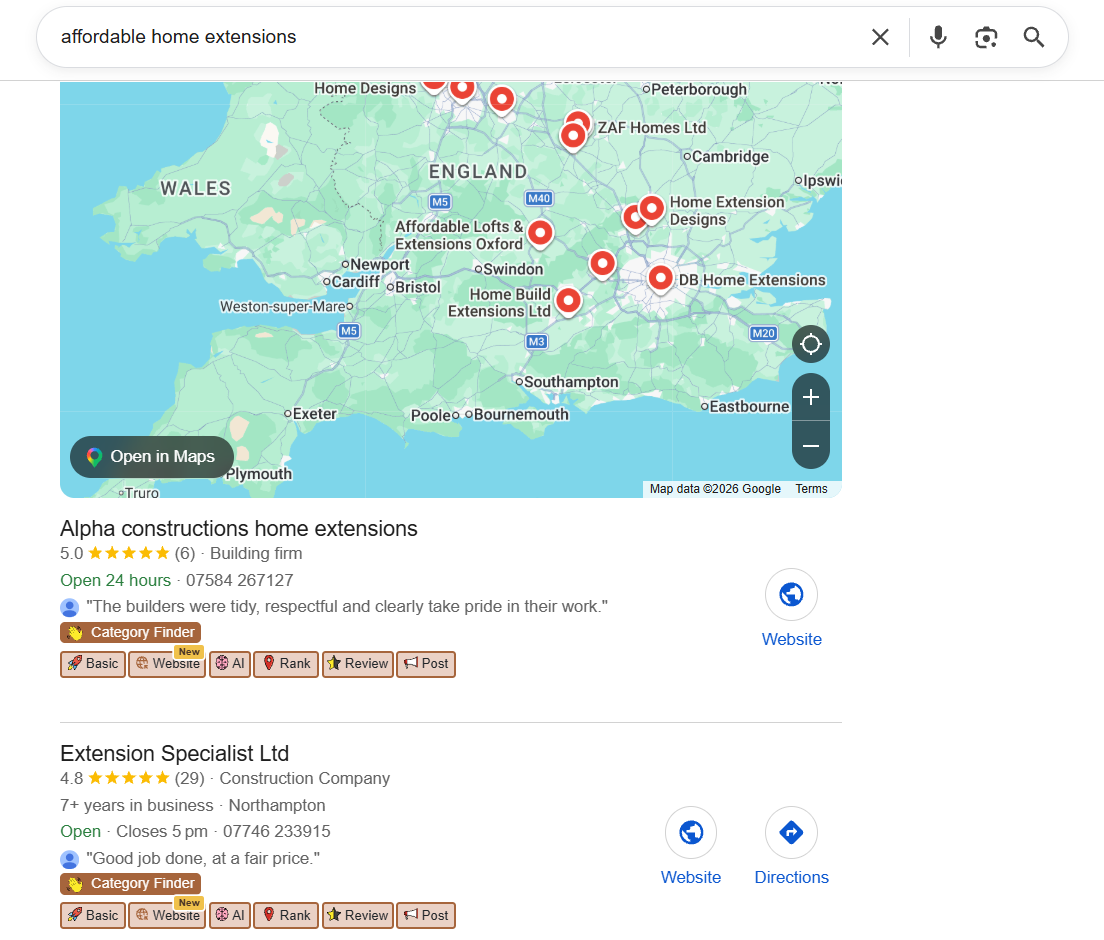
Someone's planning an extension, so they type "affordable home extensions" into a search engine. Or, they have an emergency and perform a "near me" search. The contractors that appear in the first three local results will receive the majority of clicks, while lower-positioned firms struggle for visibility.
"Near Me" Searches Continue to Increase
Since 2023, "near me" searches for home services have nearly tripled, demonstrating the commercial value for construction companies (Amra & Elma). These searches are always high intent and mobile-driven, which means potential clients are actively searching for and comparing companies.
Again, the firms that dominate Google's Map Pack results will see the highest clicks and enquiries.
Google Business Profile is the Most Important Element of Local SEO for Construction Companies
Google Business Profile (formerly Google My Business) is the foundation of a successful local SEO strategy. A construction firm with a complete profile that includes accurate information and full optimisation will show up in 340% more discovery searches than those with incomplete profiles.
Your posting habits also matter. Companies that regularly post updates on their profile are 2.8 times more likely to appear in 3-pack results (Birdeye).
GBP Cements Visibility
When you treat Google Business Profile as a marketing asset, instead of a static profile, you can direct traffic to your website and secure direct enquiries from the profile.
Choosing the right primary and secondary categories ensures the right people can find your business, while name, address, and phone number (NAP) consistency contributes to your discoverability across multiple touchpoints.
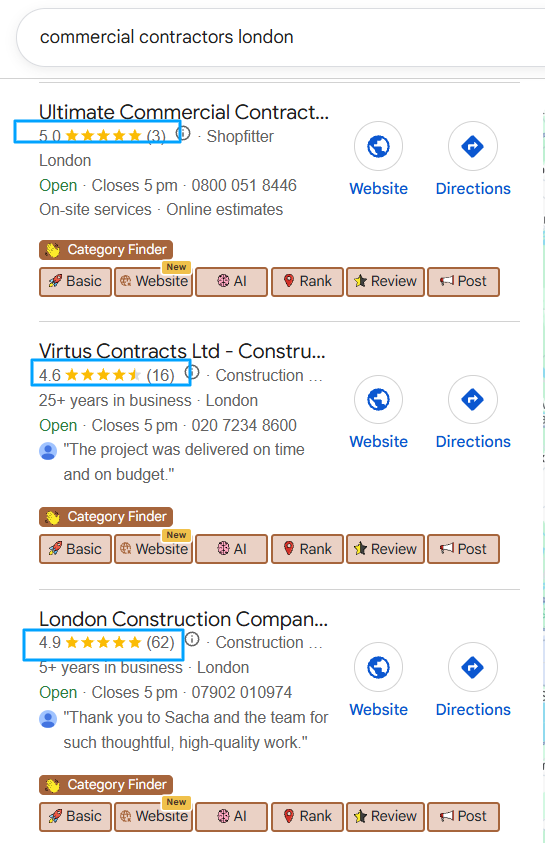
Testimonials can give potential clients an idea of your work, but the reality is this: verified GBP and third-party review platforms hold more weight.
Responding to Reviews Enhances Your Reputation
It doesn't matter whether a review is positive or negative; you should always reply to them. Thanking people for positive reviews shows that you care about customer and client experience, while negative reviews are an opportunity to recover trust and address concerns.
A common pattern among construction companies is to ignore positive GBP reviews and respond only to negative ones.
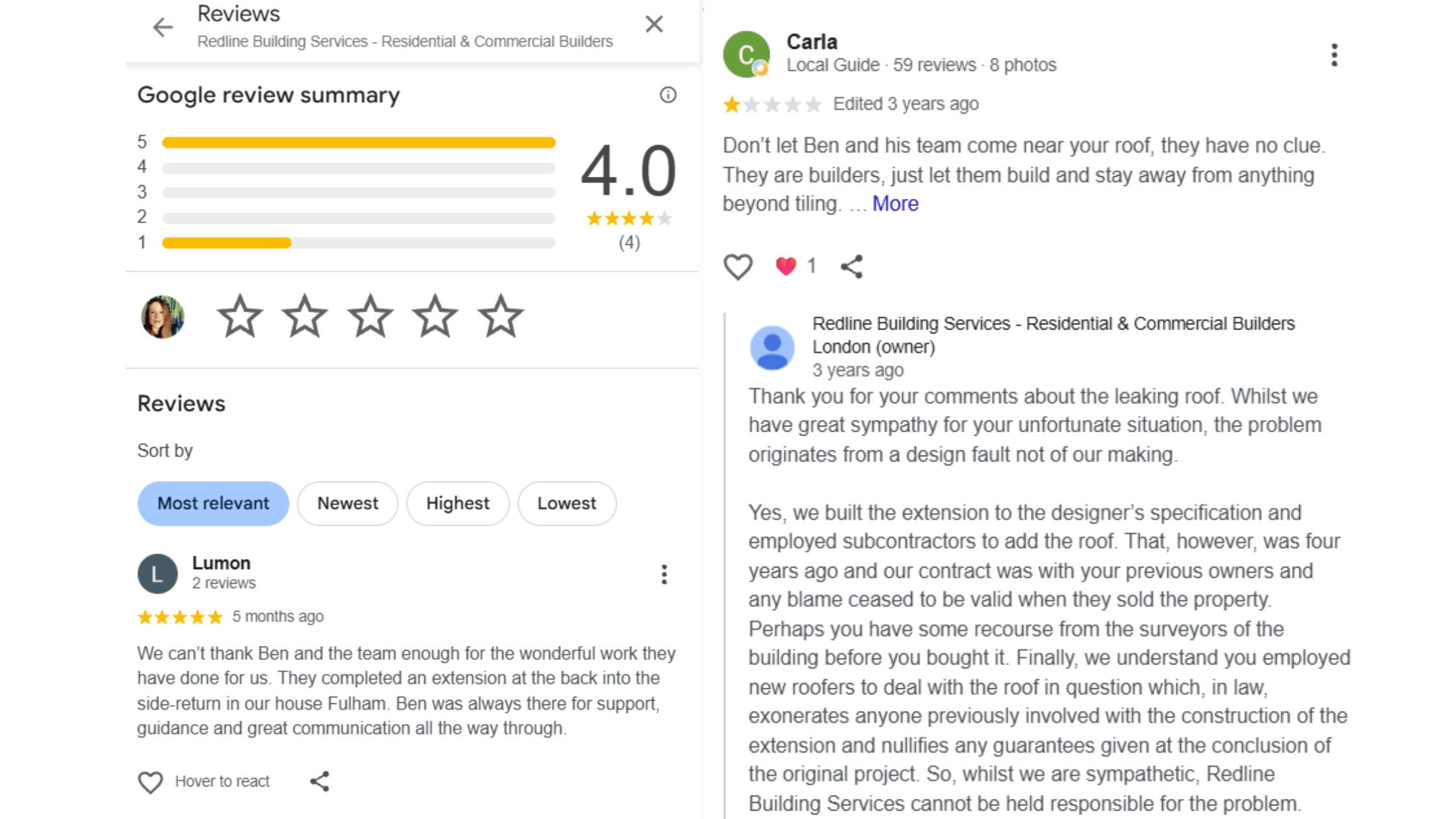
A 4+ star review might speak for itself, but the local contractor who replies to each review sets themselves apart as someone who genuinely cares about the service they deliver.
Technical SEO is Vital for Discoverability and User Experience
You can implement a range of strategies to enhance your online presence, but technical SEO is the backbone for your website's discoverability and growth.
Construction companies rely on local customers being able to find their website, but an underperforming site can impact everything from their organic presence to their ability to convert visitors into clients.
Search Engines Need to Crawl and Index Your Site
Potential clients can find your website online only if search engines can crawl it and deem it worthy of indexing. Automated crawlers rely on your technical architecture to crawl and understand your website, with technical SEO essentially guiding them through the pages.
Implementing structured data helps crawlers understand key information about your business, while addressing duplicate pages and broken links preserves your crawl budget.
Think of it like this: you've built a stunning new show home, but you forgot to build the connecting roads, lay down a driveway, or register the address. No matter how perfect the interior is, buyers actively looking for a home cannot physically reach it.
That's why so many construction companies choose to get support for their technical SEO needs.
Potential Clients Aren't Giving You the Benefit of the Doubt
So your website takes slightly longer to load... the content's great, and you've got a massive portfolio of projects. People will wait, right? Wrong. Research on bounce rates is solid, and 53% of users will leave a website if it doesn't load within 3 seconds.
These rates increase for mobile users, with websites exceeding 1-second load times experiencing up to 126% higher bounce rates (Tooltester).
Aside from poor loading times, mobile responsiveness is a significant factor in whether local leads become clients.
With over 65% of construction leads originating from mobile devices, your website should display seamlessly across each. Despite the importance of mobile-friendly websites, around 60% of construction firm websites aren't optimised for responsiveness (Marketing LTB).
On-Page SEO Gets the Click, Content Gets the Business
When someone's searching for a construction business in their local area, they're looking for three things:
Relevance
Clarity
A reason to click
On-page SEO starts with understanding the intent behind each search and choosing the right keywords to ensure your website appears in relevant search results. Then it's about securing that click, moving people through your website, and finally getting them to take action.
Service and Location-Based Landing Pages
Google rewards relevance and clarity, which is why websites with clear location-based landing pages and separate service pages tend to have a stronger search presence. Hyper-local intent can also give sole traders and microbusinesses a chance to compete against the larger construction companies.
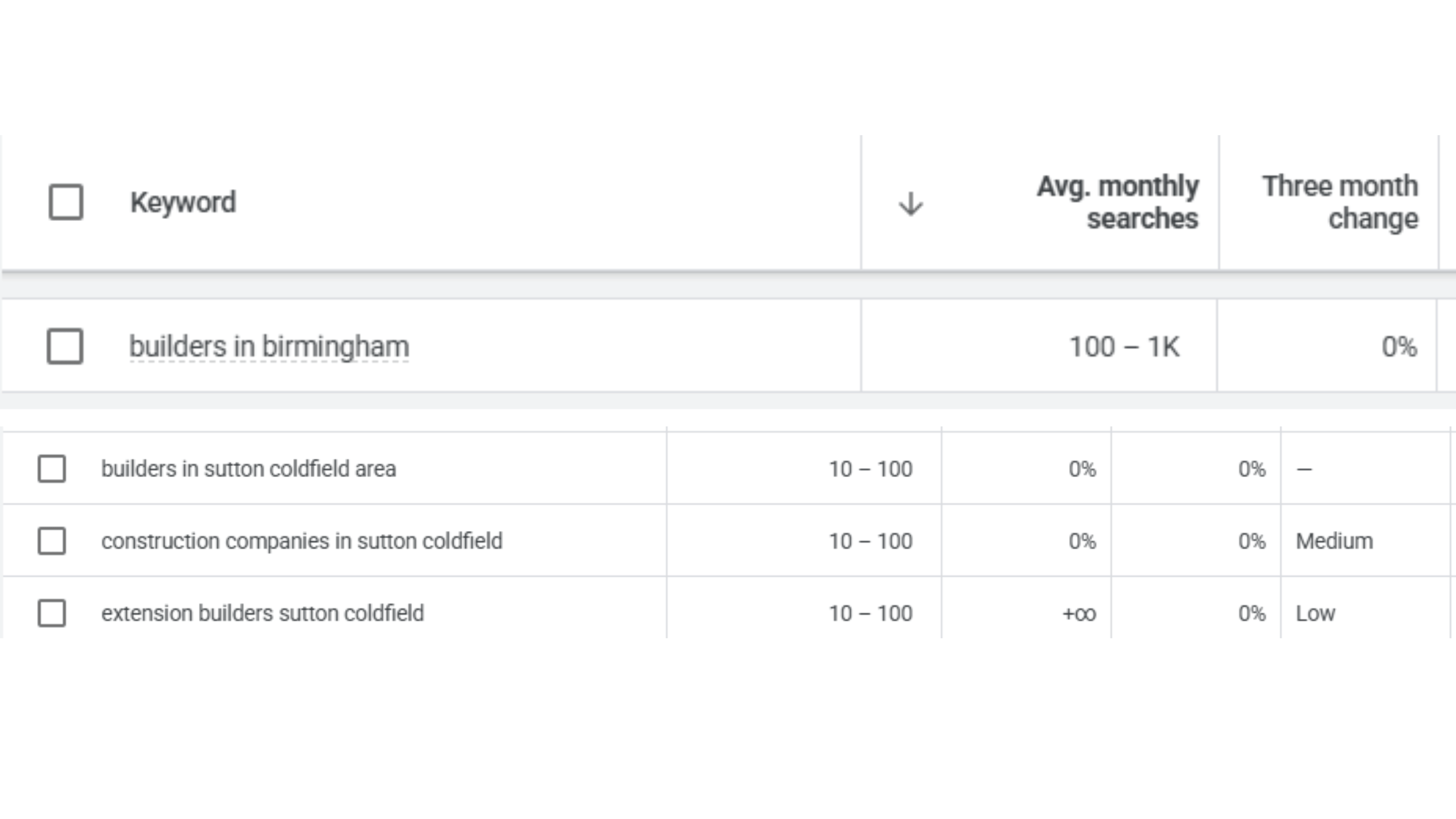
For example, local keyword research shows that "builders in Birmingham" has medium-to-high competition and high search volume. If you're a smaller company, your chances of ranking on Google's first page are slim.
But when you target Birmingham suburbs like Sutton Coldfield, you can rank higher and attract local customers.
AI optimisation is becoming a must-have for any construction SEO strategy, and you can learn more about what it involves in our complete LLM Optimisation vs Traditional SEO Guide.
Implementing an SEO Strategy for Your Construction Business
With the high competition and price undercutting on third-party platforms, and the high-effort but low-reward nature of tender bids, construction companies that invest in SEO have the opportunity to build a stable online presence that continues to grow over time.
SEO isn't a strategy that will generate instant results, but consistency will compound over time. Our specialists support all stages of your online presence, from an initial audit to creating a custom SEO strategy and priming your website for conversions.
Please contact us today for a free proposal.