











B2B SEO
Most B2B SEO advice still describes a world that no longer exists: 1 buyer, 1 Google search, 1 linear funnel. The mechanics of ranking haven't changed, there's no separate "B2B algorithm for search engines" What's changed is who is searching, how many of them there are, and where they look first. Get the strategy right & SEO becomes the most durable pipeline source your business has, get it wrong and you'll either not rank or you'll rank for keywords with traffic that never converts.
What is B2B SEO?
B2B SEO stands for "Business to Business Search Engine Optimisation" & is a type of SEO that specifically focuses on optimising a businesses website to appear in search for relevant keywords that other businesses may search for.
In SEO you have a wide array of sub-services, in B2B SEO you have all the elements of a traditional SEO campaign, the main difference is the targeting of keywords.
B2B SEO requires all the elements of a traditional SEO campaign however the keyword research & content creation is focused specifically at the type of businesses you are offering a product or service to - not typical retail consumers but other businesses with key decision makers searching in Google i.e. heads of marketing, procurement teams, acquisition specialists etc.
It's all in the name, business to business, but, the focus is specifically around keywords related to your target buyers / searchers & your offering be it products, services, support etc.
What's Involved in B2B SEO?
So typically it's all the same things you would get in a traditional SEO campaign / strategy, just targeted specifically at other businesses searching Google or other search engines. The typical elementss of a B2B SEO Campaign are:
Initial discovery call and business fact find (so we can ascertain your offering, your targets, offering, priorities etc)
Keyword research & topic research - we look at what your potential buyers are searching for, we ascertain commercial value and then we prioritise the SEO strategy around those terms, for B2B SEO we look at PPC keyword research to assess what CPCs businesses are paying so we can draw commercial intent from that
Initial website seo audit - so we'll perform an analysis of your pre-existing google search console data to ascertain your current organic performance, then we perform a technical SEO audit, a page indexing audit, content audit and backlink audit
SEO audit fixes, implementation and on-site SEO - we find and fix all seo issues before performing on site optimisation
Content strategy - to ensure your websites landing pages and content align with the keyword research we use specialist writers who can rewrite, fix, amend or produce new content for your B2B website, we create copy that is NLP optimised, follows best practice E-E-A-T etc.
Backlink strategy - we help earn and build links to your domain to strengthen trust so that your website can perform better in organic search, AI Overviews, AI mode and LLM searches, B2B websites should have a strong backlink profile
Ongoing SEO testing, SEO Experiments & other SEO wizardry - we work on SEO testing to find the sweet spot for your landing pages & domain so that you achieve higher rankings, higher CTRS & you generate more B2B revenue
B2B SEO is less about chasing traffic but is more about getting new higher quality traffic that engages and converts. We ensure your B2B website shows up in Google when people in the businesses you sell to start searching & we ensure that high quality compelling content increases conversion - after all, a good B2B SEO campaign should drive strong ROI.
Why is B2B SEO Important?
B2B SEO is important because it supports another acquisition channel for your business to generate more revenue/sales/leads. Whether you are a small. medium or large/corporate B2B business, the need for SEO is often key for supporting business growth.
It helps not only with growth but also:
It helps with generating sales & pipeline revenue
Helps with building up repeat customers & repeat orders
Helps with brand awareness & pre-purchase consideration
Without SEO, B2B businesses may rely more on paid channels such as pay per click (PPC) or social media marketing i.e. LinkedIn ads.
Optimising B2B websites isn't just about "rankings", it's also about being the preferred choice for your target buyer -
Buying is self-directed
B2B buyers spend roughly 27% of the purchase journey researching independently online, and only about 17% of their time meeting with all potential suppliers combined. Your optimised content does the selling before sales is invitedBuying is a committee sport
A typical purchase now involves 6 to 10 stakeholders, each arriving with their own independent research; Forrester's State of Business Buying, 2024 puts the average at around 13 stakeholders, with nearly 89% of decisions crossing multiple departments - these are big numbersBuying increasingly starts in an AI chatbot
G2's March 2026 survey of 1,076 software buyers found 51% now begin the process in an AI assistant rather than a search engine, and 71% use AI chatbots for software research (G2 via PR Newswire).
What actually makes B2B SEO different
B2B and B2C share the same ranking factors in search, the strategy diverges because the buying behaviour is different & so are the kinds of searches (which is why keyword research is crucial for any good B2B SEO campaign).
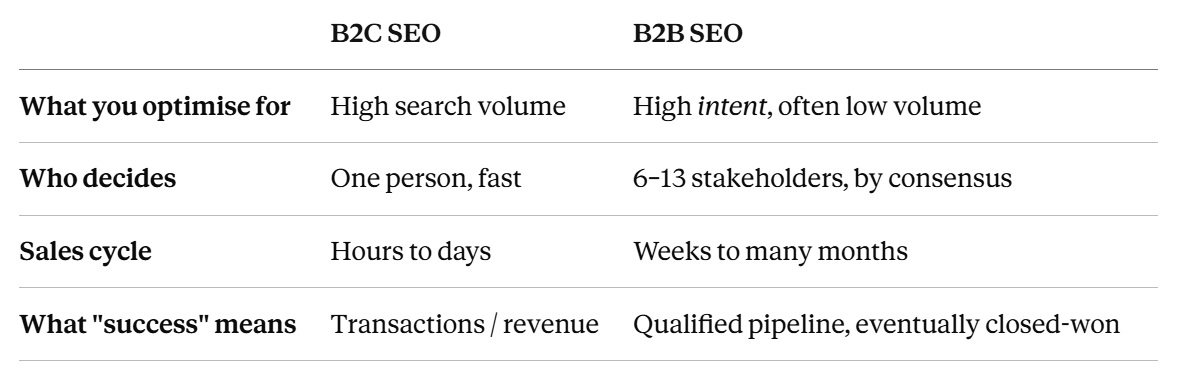
Generally, B2B stakeholders (buyers, procurement managers etc) are going to use Google, but, their search behaviour may vary - each niche/industry is going to have its own typical behaviours when it comes to keywords searched, content browsed & ultimately decision making / purchases etc.
This is why even low search volume keywords can have high significant value, if a LSV (low search volume keyword) has 10 searches a month but 1 of those leads to a £1m buying decision - it demonstrates clearly that it's not just about search volume.
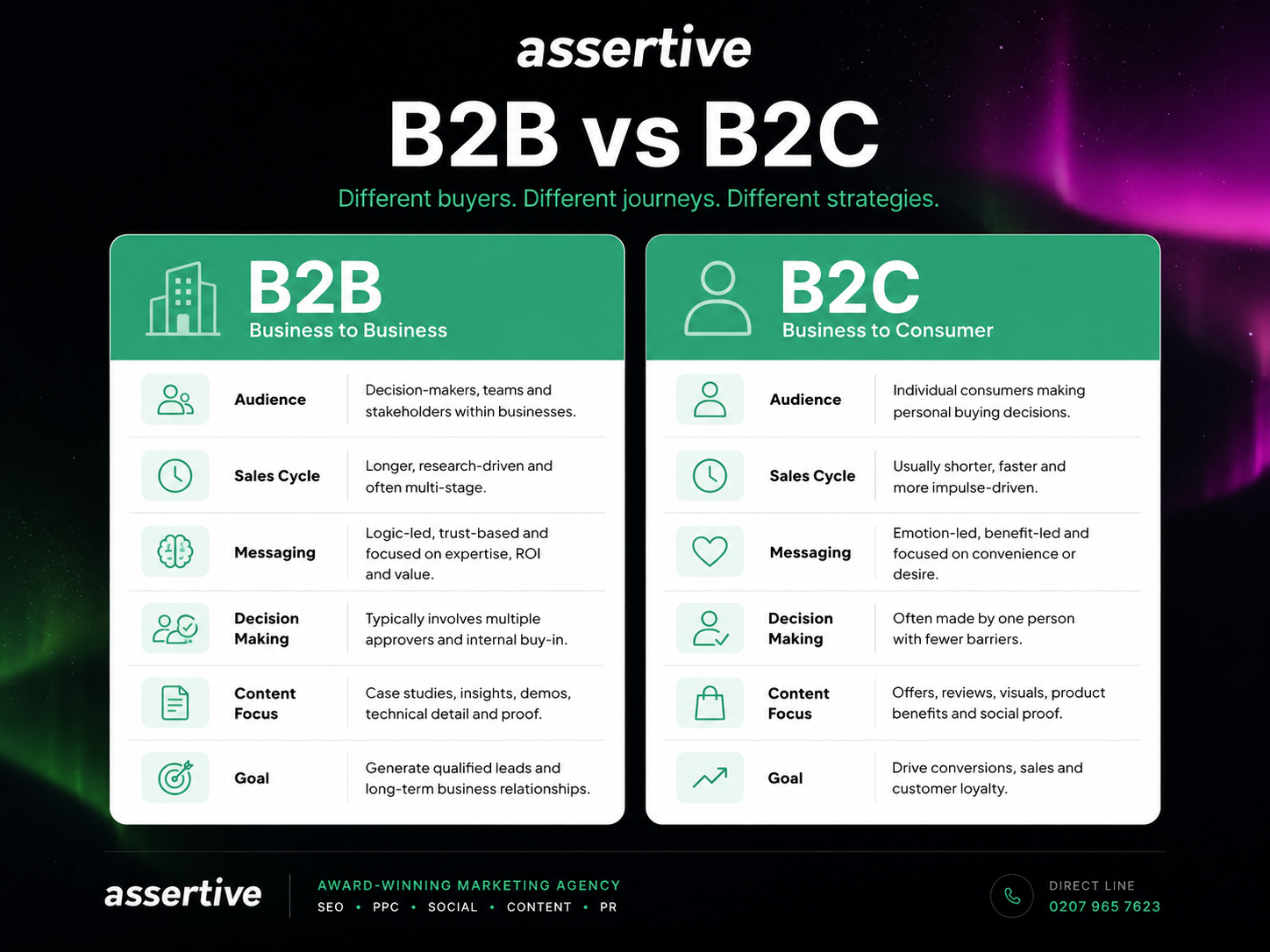
B2B vs B2C The Key Differences
Below is a comparison table outlaying the key differences between B2B and B2C SEO:
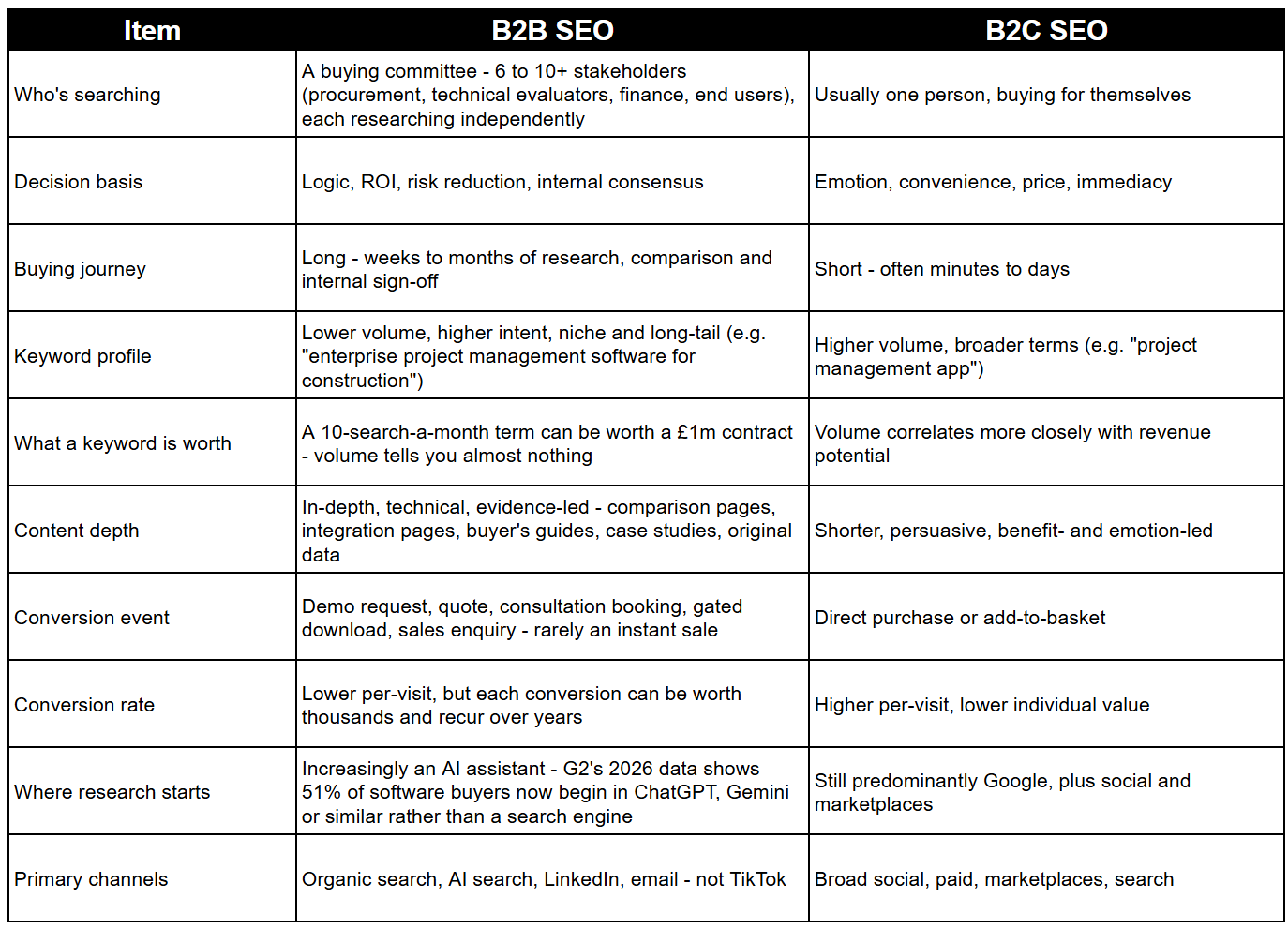
B2B vs B2C: Who's searching
B2B:
A buying committee - 6 to 10+ stakeholders (procurement, technical evaluators, finance, end users), each researching independently
B2C:
Usually one person, buying for themselves
B2B vs B2C: Decision basis
B2B:
Logic, ROI, risk reduction, internal consensus
B2C:
Emotion, convenience, price, immediacy
B2B vs B2C: Buying journey
B2B:
Long - weeks to months of research, comparison and internal sign-off
B2C:
Short - often minutes to days
B2B vs B2C: Keyword profile
B2B:
Lower volume, higher intent, niche and long-tail (e.g. "enterprise project management software for construction")
B2C:
Higher volume, broader terms (e.g. "project management app")
B2B vs B2C: What a keyword is worth
B2B:
A 10-search-a-month term can be worth a £1m contract - volume tells you almost nothing
B2C:
Volume correlates more closely with revenue potential
B2B vs B2C: Content depth
B2B:
In-depth, technical, evidence-led - comparison pages, integration pages, buyer's guides, case studies, original data
B2C:
Shorter, persuasive, benefit- and emotion-led
B2B vs B2C: Conversion event
B2B:
Demo request, quote, consultation booking, gated download, sales enquiry - rarely an instant sale
B2C:
Direct purchase or add-to-basket
B2B vs B2C: Conversion rate
B2B:
Lower per-visit, but each conversion can be worth thousands and recur over years
B2C:
Higher per-visit, lower individual value
B2B vs B2C: Where research starts
B2B:
Increasingly an AI assistant - G2's 2026 data shows 51% of software buyers now begin in ChatGPT, Gemini or similar rather than a search engine
B2C:
Still predominantly Google, plus social and marketplaces
B2B vs B2C: Primary channels
B2B:
Organic search, AI search, LinkedIn, email - not TikTok
B2C:
Broad social, paid, marketplaces, search
Map your target buying committee before opening a keyword tool
This is the step that a lot of B2B guides skips, and it's the one that makes the rest of your strategy coherent as well as viable. If 6 to 10 people influence the decision and each does their own research, then ranking for one persona's queries gets you that initial all important visit.
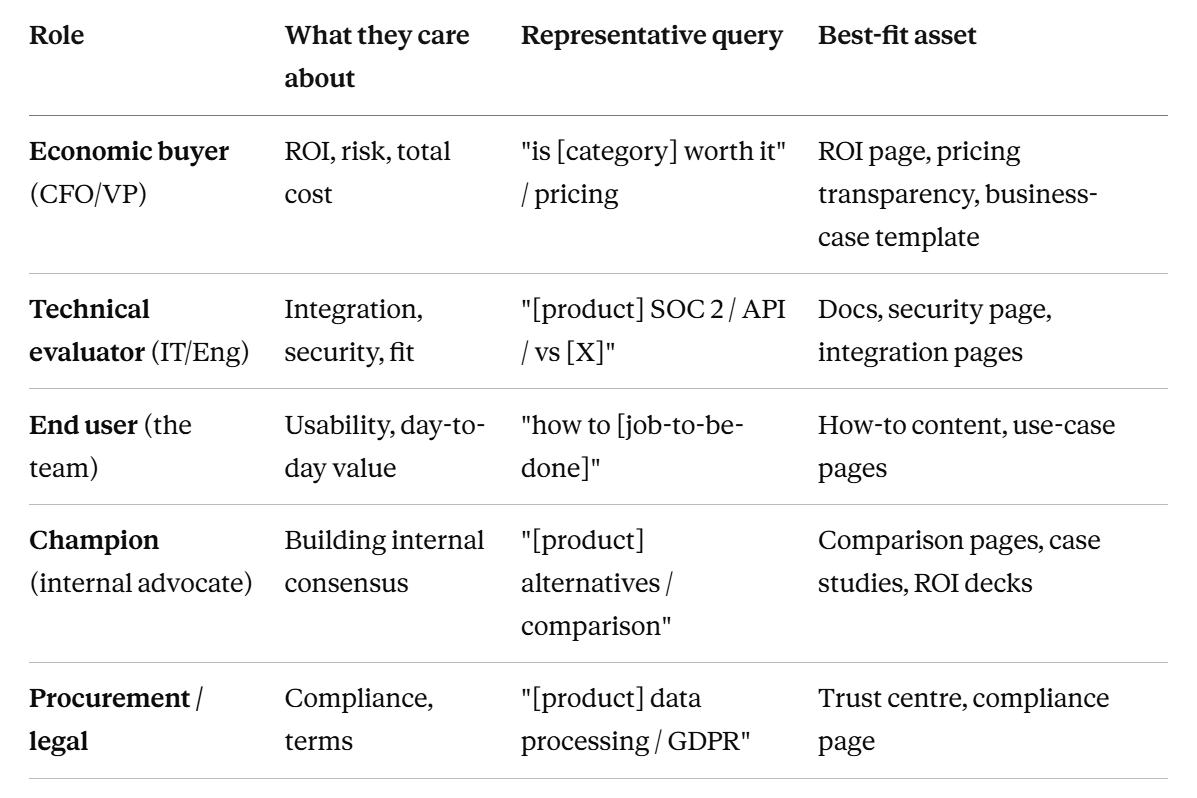
Assessing what people search for in relation to what your brand offers is one thing, but ultimately understanding what is likely to drive a sale is another, this is why keyword targeting and intent mapping are crucial in the early phases of B2B SEO.
Before you can map a target "buying committee", you need to know who sits on it. In B2B the "customer" isn't a person, it's a business - & inside that business there are several people who each search differently, care about different things & sign off on different parts of the decision. A persona is simply a working profile of one of those people.
For each persona we work with clients to pin down:
Their role & what they're accountable for - a CFO, a head of IT & an end user are evaluating the same purchase through completely different lenses
The problem they're trying to solve - the actual pain point in their words, not your product category
The language & jargon they use - the exact phrasing they'd type into Google or an AI assistant, which is rarely the phrasing your marketing team uses internally
What they need to see to say yes - ROI evidence for finance, integration & security detail for technical evaluators, ease-of-use for the end user
Where they research - Google, LinkedIn, AI assistants, industry publications, peer communities
Keyword strategy: intent over volume, confirmed by sales
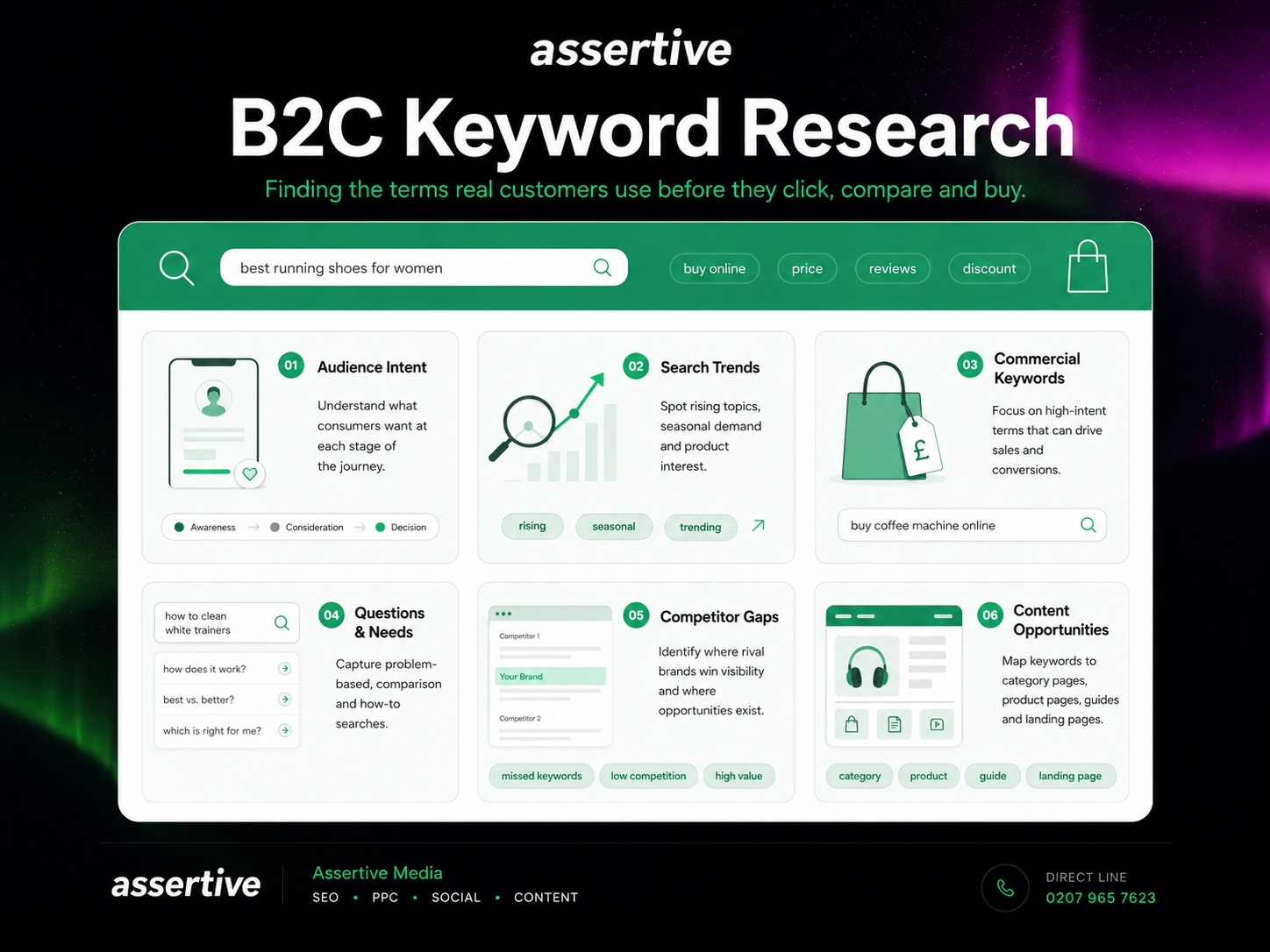
The keyword search volume trap is a common B2B SEO mistake. Big informational keywords ("what is [category]") are competitive, attract early-stage researchers, and can generally convert poorly.
This is why keyword segmenting by intent is the best way forward in any B2B SEO campaign - look at core keywords, then look at the longer-tail queries behind them where CPCs are higher or where search volume and competition is lower but opportunity exists.
The differentiator is where the source keyword data came from. Keyword tools offer the same data that's potentially already being used by your competitors. The terms that actually map to pipeline may come from inside your business, especially if you already have data from active PPC / pay per click campaigns.
Other sources of data can include:
Sales-call transcripts and win/loss interviews - the exact phrases buyers use to describe their problem, and the objections that recur, identify seed keywords and long-tail keywords from what commonly comes up
Support tickets and onboarding questions - the real friction points, which become high-intent how-to and comparison content.
Your CRM's closed-won notes - what the deals that closed were searching for.
The "People also ask" and AI-generated follow-up questions for your category - these reveal the committee's actual decision criteria.
Tier the result by intent, not volume:
Transactional / commercial - comparison, alternatives, pricing, "[category] software for [industry]." Build these first.
Solution-aware - "how to solve [problem]," buyer's guides, evaluation-criteria content.
Problem-aware - top-of-funnel education that frames the problem in your favour.
Most B2B sites over-invest in top-of-funnel blog content and under-invest in the bottom-funnel pages that buyers actually convert on - this is where we stand out as a B2B SEO agency, we have extensive experience in delivering B2B SEO campaigns for clients.
Match intent to page type, then cluster for authority
Once keywords are tiered by intent, then the next phase is to assign each a page type. A page that mismatches intent won't rank no matter how good the writing is, this is why it's crucial to really nail down not only the keyword research but also the types of page content being served.
Once the keyword search data is clustered, it then becomes easier to start the content creation phase (to either revamp existing pages or provide new content for new landing pages).
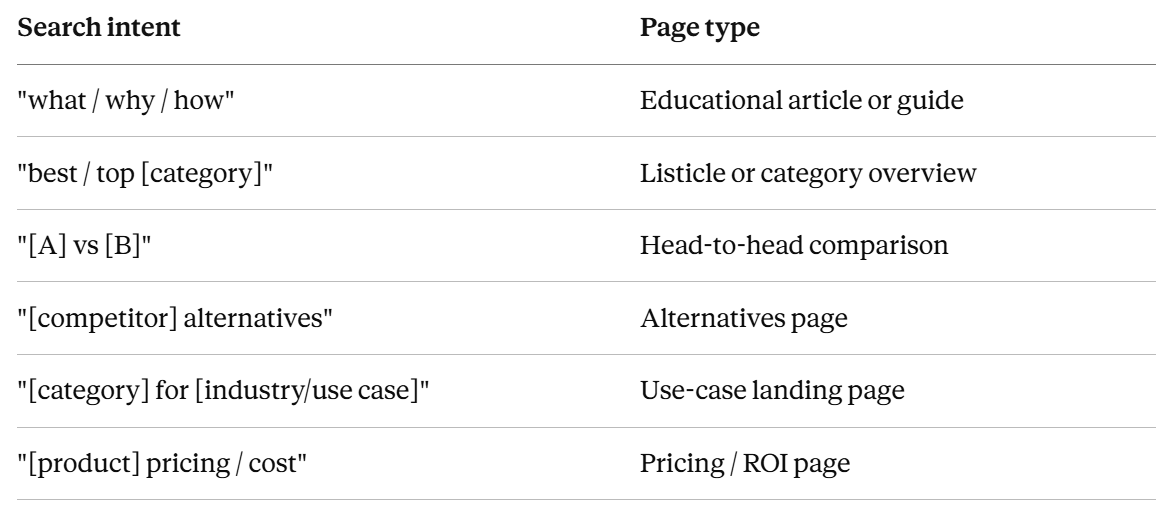
During a B2B SEO strategy, we work with clients to create specific content clusters that are designed to maximise topical coverage & ultimately get your website in front of more buyers searching Google, browsing AI mode or using Google Gemini.
Map keywords to the buying journey, not just to intent
At Assertive, we tier keywords by intent because that's what helps to predict pipeline potential, it also helps to connect those tiers back to the funnel language your marketing team works in day to day which is generally awareness, consideration & decision.
Each stage attracts a different kind of searcher, needs a different kind of page, & converts in a different way.
Here are the key stages to be aware of, you may see these on the web referred to as TOFU and BOFU.
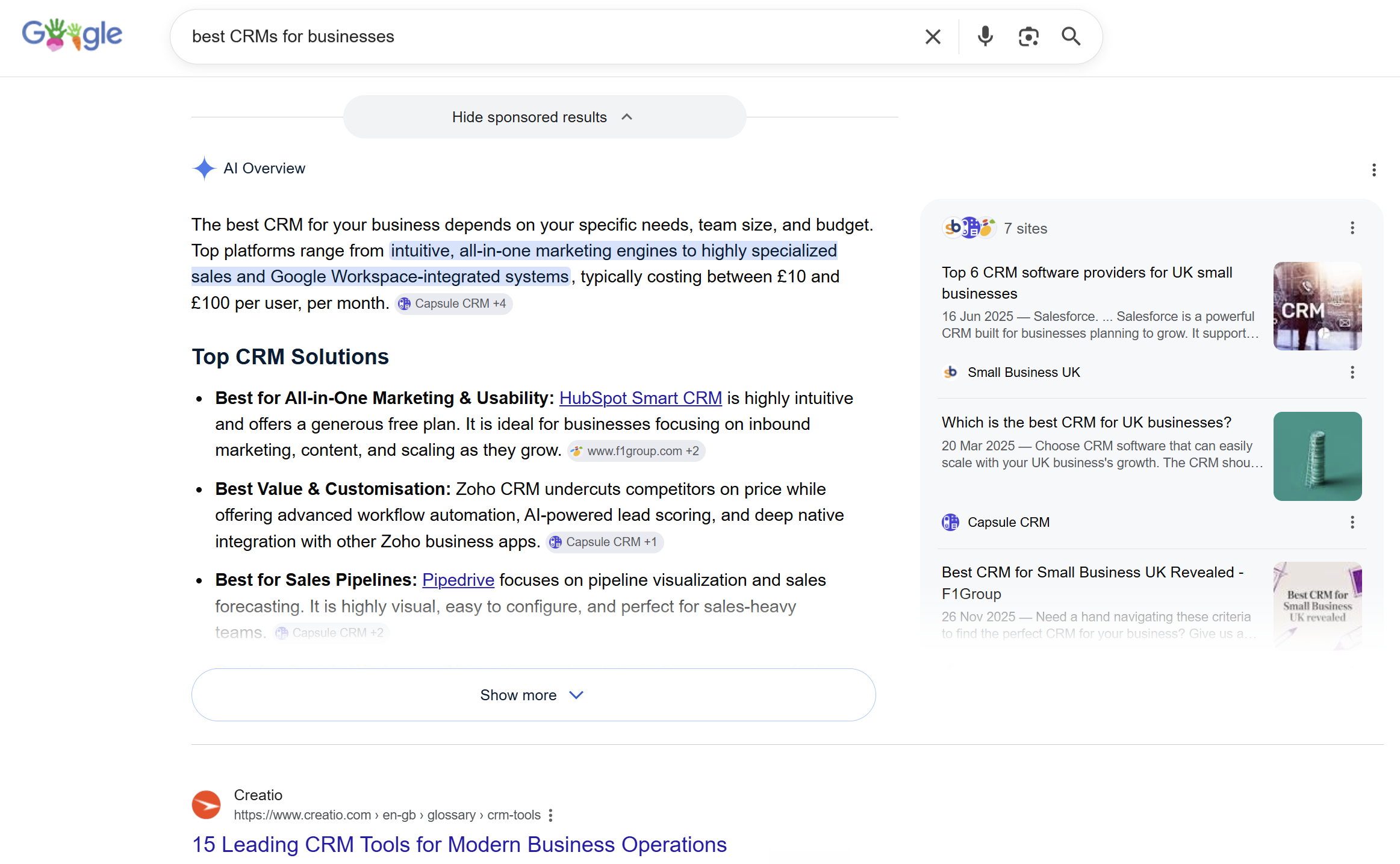
Awareness (top of funnel) - your potential buyer has realised they have a problem & isn't thinking about vendors yet. These are your problem-aware searches ("why is [process] so slow", "[industry] benchmarks"). Content here is educational - guides, explainers, original research. It rarely converts on the first visit & it isn't supposed to, its job is to get you into the consideration set early & start building trust. This is also the most challenging within SEO now as a lot of awareness queries are answered by Google's AI overviews, so it's even more important to craft content that not only ranks well but is also cited in AIOs.
Consideration (mid funnel) - Your potential buyer now knows solutions like yours exist & is comparing approaches. These are your solution-aware searches ("how to solve [problem]", "[category] buyer's guide", "evaluation criteria for [category]"). This is where you frame the decision in your favour & demonstrate you understand the problem better than competitors.
Decision (bottom of funnel) - Your potential buyer is actively evaluating named options & is close to a commercial conversation. These are your transactional & commercial searches ("[you] vs [competitor]", "[competitor] alternatives", "[category] pricing", "[category] for [industry]"). These pages have unambiguous intent, they convert, & they're the ones AI assistants lean on when assembling a shortlist.
The mistake tend to see is a B2B site that's done all its work at the awareness stage - a busy blog generating traffic - while the consideration & decision pages that actually drive enquiries are thin or missing entirely. A good B2B SEO strategy weights effort towards the bottom of the funnel first, then builds the top-of-funnel content that feeds it.
B2B SEO - Bottom Funnel Pages for Pipeline + AI Citations
These 5 page types are some of the highest-converting assets in B2B SEO and, not coincidentally, the ones AI assistants & LLMs lean on when assembling a shortlist for citations
Ultimately, creating content like this that helps to solve problems, provides comparisons & options is usually good for an SEO & AI SEO strategy (increasing probability of being cited in LLMs as a source).
They deserve disproportionate attention:
Comparison pages ("[you] vs [competitor]") - you control the framing and capture buyers in active evaluation - although consideration is required here to not over-promote your own brand offering against competitors as this is something that Google & LLMS are attempting to stamp out
Alternatives pages ("[competitor] alternatives") - intercept demand your competitors created - this is a great way to ride competitor demand with your own offering
Pricing / ROI pages - buyers, and AI tools, reward transparency. Publishing realistic ranges ("£X–£Y for a mid-market deployment," "8–12 weeks to value") earns trust and citations; hiding pricing loses both
Integration pages - one per major tool you connect to; each captures the technical evaluator's "[product] + [their stack]" query
Use-case / industry pages - "[category] for [specific industry]," answering the buyer who needs to see themselves in your solution
These pages punch above their volume because the intent is unambiguous, they also age well, which matters: most B2B content gets ignored by the rest of the web entirely.
An analysis of 912 million posts found 93% of content earns zero external links, and only 3% gets links from multiple sites (Backlinko). Pages buyers genuinely need are the exception in this instance.
B2B Content that earns trust & original data that can help with link earning
Beyond the page-type fit, three things separate B2B content that ranks from content that doesn't:
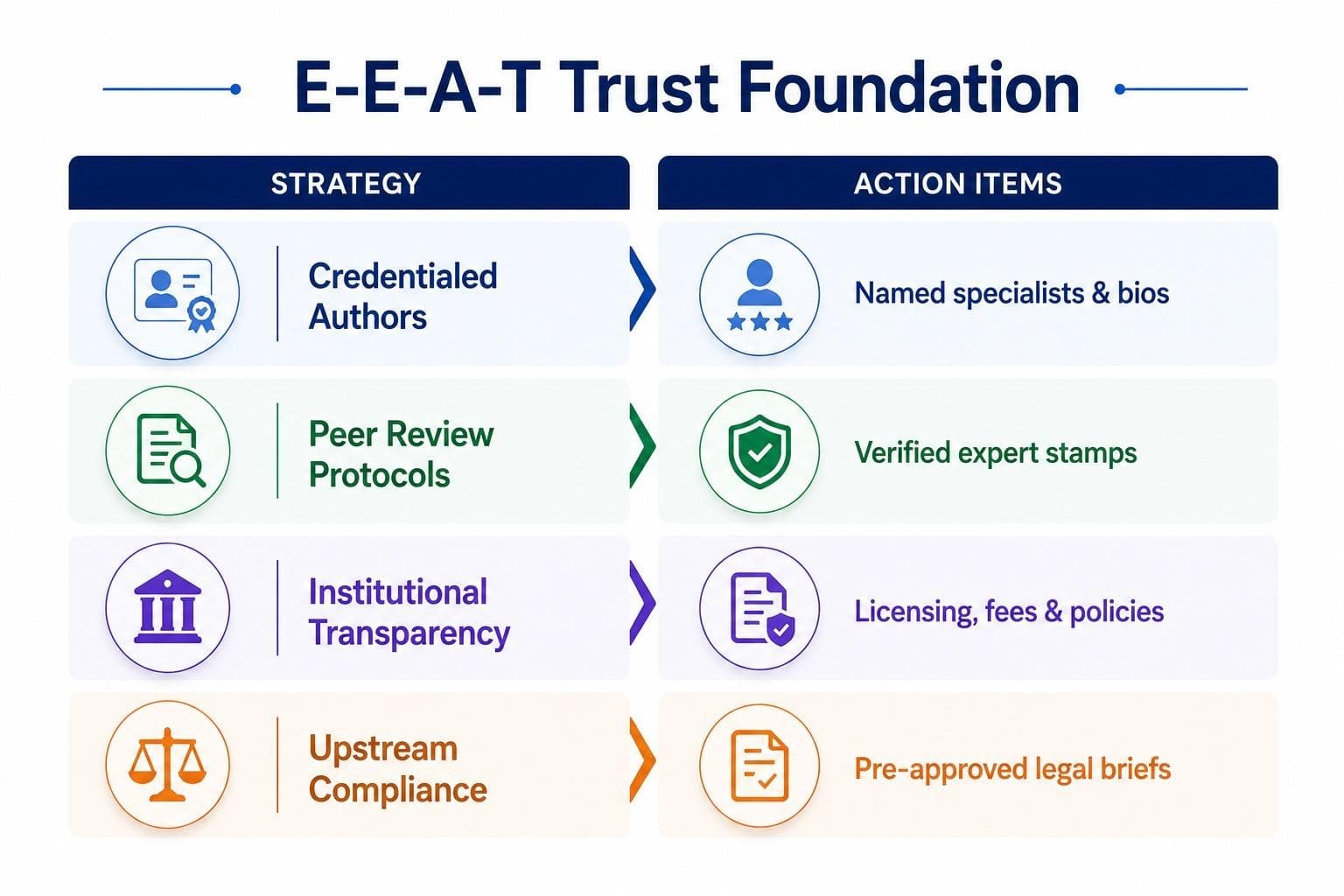
Demonstrable expertise (E-E-A-T)
Named authors with real credentials, specific examples, and a point of view a generalist couldn't fake - Fake E-E-A-T is not viable. B2B readers and the algorithms watching their behaviour can tell the difference between someone who has done the job and someone who has summarised the first page of Google to produce the contentOriginal data and frameworks
The most linkable, most citable B2B asset is information that exists nowhere else: a survey of your customers, benchmarks from your own dataset, a model or framework with a name. Original research is the rare content type that reliably earns the external links 97% of content never gets and it's increasingly what AI engines citeSpecificity over generic thought leadership
"10 trends shaping B2B in 2026" earns nothing. "What a 200-person SaaS company's martech stack actually costs we analysed 50 implementations" earns links, rankings, and AI citations, because it answers a real question with data a buyer can't easily find elsewhere
Technical foundations and authority
Good technical SEO compliance is crucial for any good B2B SEO campaign - this means everything from comprehensive technical SEO auditing through to on-site optimisation to improve indexability, crawlability & accessibility.
Things crucial include:
Crawlability and indexation clean architecture, logical internal linking, an accurate sitemap, sufficient internal links, clear anchors, managed robots.txt and directives
Core Web Vitals and speed Improve user experience with a quick loading website, no layout shifts or anything that could impede engagement or conversion
Structured data schema for articles, products, FAQs and organisation
Internal linking route authority to your bottom-funnel money pages, and connect each cluster's spokes to its pillar
What a B2B conversion actually looks like
In B2C a conversion is usually a sale, someone adds to basket & checks out. B2B generally does not work like that, the buying journey is too long & too considered for a first-visit purchase, so before you measure anything, you need to be absolutely clear on what a conversion actually is for your business.
For B2B websites the meaningful conversion events are:
Demo or consultation requests - highest-intent action, someone asking to talk
Quote or pricing enquiries - a buyer ready to discuss commercials
Gated content downloads - whitepapers, benchmarks or guides exchanged for an email address
Newsletter or email sign-ups - lower intent, but the start of a relationship
Contact form completions & direct calls - straightforward enquiries
The key thing to understand is that a lot of your most valuable traffic won't convert on the first visit, & some of the committee may never fill in a form at all
Off-page & authority: specific tactics that work in B2B
Earning links through original data is the highest-value play & we've covered why above, but it isn't the only one - & in a "boring" B2B niche it helps to have a few repeatable tactics rather than waiting for a piece of research to land. The ones that consistently work for B2B businesses tend to be:
Free tools & calculators - a genuinely useful tool earns links passively & for years. It doesn't need to be complex, it needs to solve one real problem your buyer has - a pricing calculator, a benchmark checker, a sizing tool. People link to tools far more readily than they link to blog posts
Partner & supplier pages - if you work with suppliers, integration partners, resellers or clients, many of them have a "partners" or "who we work with" page. These are some of the easiest relevant links to earn, you just have to ask
Digital PR to industry press, not mainstream media - for most B2B brands the goal isn't national coverage, it's being mentioned in the trade publications & industry blogs your buyers actually read. A data-led story pitched to the right niche outlet earns links that also reach the right audience
Guest contribution & thought leadership - genuine expert content on respected industry sites builds both authority & awareness, provided it's real expertise & not thin guest-post filler
Earning citations in AI answers - increasingly the same assets that earn links (original data, clear comparisons, named frameworks) are what LLMs cite when answering buyer questions. Off-page authority & AI visibility are converging