











Search for a “free Google keyword ranking checker” and you’ll find hundreds of them. Enter a URL, enter a keyword, click the button. What you’ll rarely find is a tool that’s actually free. Most cap you at three to five searches before the sign-up wall, and the ones that don’t are either running scraped SERP data that’s days out of date or quietly funnelling you into a paid trial you didn’t ask for.

We’ve built this agency on straight talk, so here’s the uncomfortable answer: the best free Google keyword ranking SEO checker tool on the market isn’t a tool at all. It’s a report you already have access to, using the only dataset that matters Google’s own. That tool is Google Search Console, and if you know how to read it, it will give you more accurate, more granular, and more actionable keyword ranking data than almost every paid rank tracker on the market.
This guide walks you through exactly how to use Google Search Console as a free keyword ranking checker. We’ll cover what it can do, where it falls short, how to extend it with free companion tools, and how to turn that data into real SEO decisions. No trial funnel. No upsell. Just the workflow we use with our own clients.
What Is a Free Keyword Rank Checker (and Why Most of Them Aren’t Really Free)?

A keyword rank checker does one job: it tells you where a given page on your website ranks in Google’s search results for a specific keyword. Enter the URL, enter the keyword, and the tool returns a position ideally across different countries, devices, and over time.
In theory, that’s simple. In practice, the “free” rank checker market is full of hidden costs. Most tools fall into one of three categories:
- Trial-gated tools that let you check three to ten keywords before demanding a credit card.
- Scraped SERP tools that return positions based on cached data, often two to five days old, from IP addresses and locations that don’t match yours.
- Lead-capture tools that display a result on screen but require you to hand over an email to see anything useful beyond the first ten rankings.
None of those are genuinely free. A genuinely free keyword ranking tool gives you position data with no usage cap, no paywall, and no account lock-in. When you apply that filter, the list shrinks dramatically and Google Search Console ends up at the top, because it’s not only free, it’s also the only tool on earth using Google’s actual ranking data rather than a scraped approximation of it.
Why Your Business Needs to Track Keyword Rankings

Google processes around 8.5 billion searches a day. Ranking on page one for even a mid-volume commercial keyword can drive more revenue than most paid ad campaigns. But rankings aren’t static. Algorithm updates, competitor content, changing search intent, new SERP features like AI Overviews, and your own technical issues all push positions up and down constantly. If you’re not measuring, you’re guessing.
Tracking keyword rankings tells you more than just “am I on page one.” It tells you:
- Which pages are gaining or losing visibility, and how quickly.
- Which keywords you’re earning impressions for that you never intentionally targeted often a goldmine for quick-win content optimisation.
- Which URLs are fighting each other for the same query (keyword cannibalisation).
- Which pages have ranking but poor click-through rates, meaning the title tag or meta description isn’t doing its job.
- Which content has decayed and needs refreshing before the traffic drop hits.
- Modern Google rankings are determined by a stack of signals that have evolved well beyond the classic “have the keyword in the title” school of SEO. The factors you’re really being judged on today include:
- Search intent alignment does your page actually answer the question the searcher is asking?
- Topical authority and depth does your site cover the subject comprehensively, or is this a one-off page?
- Content quality and originality is it helpful, accurate, and more useful than the result above you?
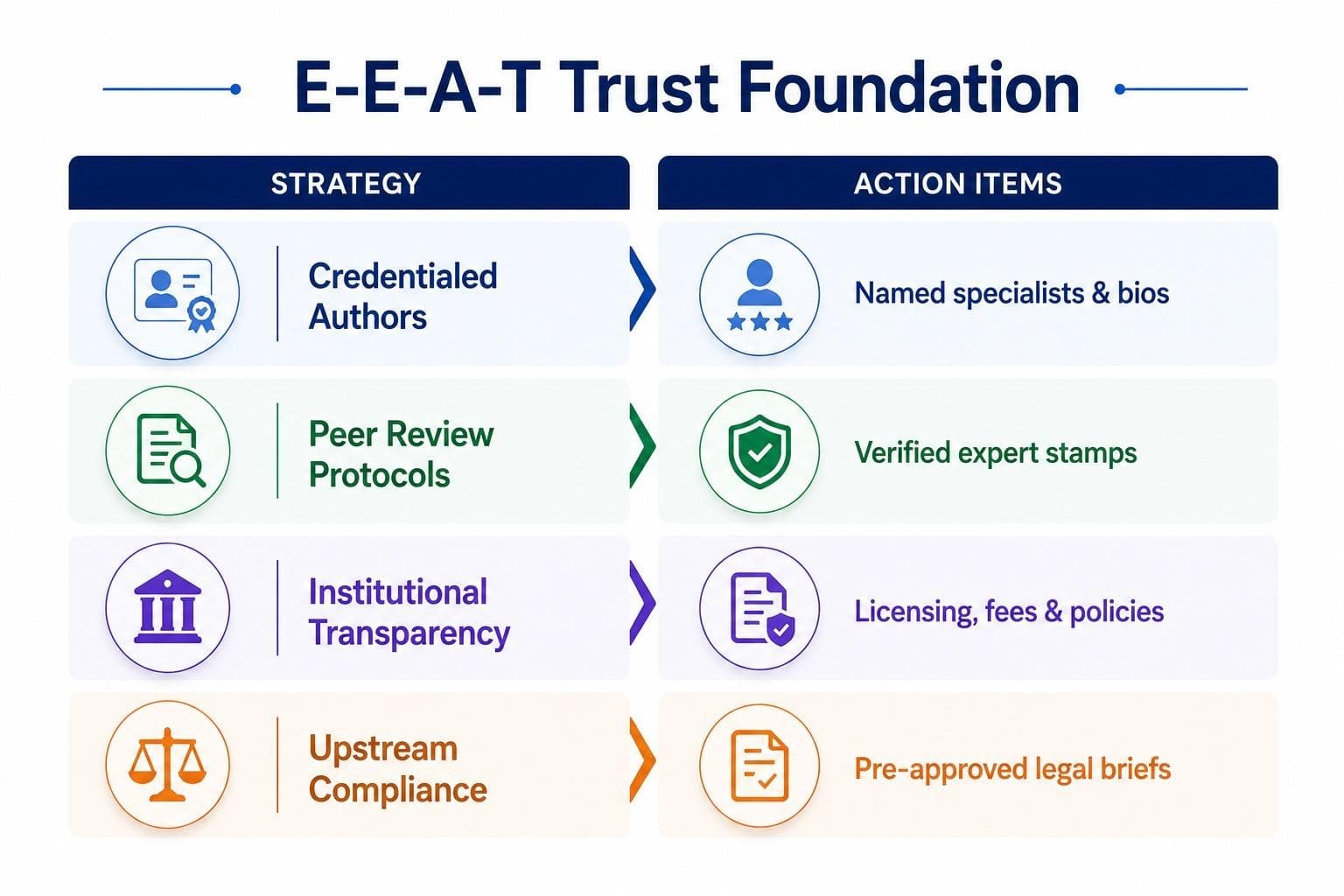
- E-E-A-T signals experience, expertise, authoritativeness, and trust markers across the page and site.
- Entity coverage are the people, places, and concepts related to the topic named and explained?
- Freshness for time-sensitive queries, recent publish or update dates matter.
- Internal linking do other pages on your site reinforce this page’s topical focus?
- User engagement pogo-sticking, dwell time, and return visits feed back into future rankings through NavBoost and similar systems.
Rank tracking is how you tell whether your work against those factors is landing. Skip it, and you’re running SEO blind.
How to Check Keyword Rankings for Free Using Google Search Console

Google Search Console is a free product from Google that shows you exactly how your site appears in Google Search. It’s the same platform Google uses internally to communicate with site owners, and the ranking data inside it comes straight from Google’s own logs not a third-party scrape.
If you haven’t already set it up, the process takes about ten minutes. Here’s how to get to rank-checking as quickly as possible:
1. Go to search.google.com/search-console and sign in with the Google account that manages your website.
2. Add your property. You can verify ownership via DNS record, HTML file upload, Google Tag Manager, or Google Analytics.
Domain-level properties show data across all subdomains and protocols recommended for most sites.
3. Wait for data to populate. New properties take 2–3 days to start showing meaningful query data.
4. Open the Performance report from the left-hand menu. This is where all your ranking data lives.
5. Tick the “Average position” metric at the top of the report. By default, GSC shows clicks and impressions but hides position you have to turn it on.
6. Scroll down to the Queries tab. You’ll now see every keyword your site earned impressions for, with its click count, impression count, CTR, and average position.
7. Filter by page to isolate rankings for a specific URL. Click the “Pages” tab, select a page, then switch back to “Queries” you’ll see only the keywords that page ranks for.
8. Filter by country and device using the tabs at the top of the report. This is how you check your rankings in the US versus the UK, or on mobile versus desktop.
9. Compare date ranges to track movement. Use the date picker to compare “last 28 days” against “previous period” the table will show position change for every query.
10. Export the data. Use the export button at the top right to download as CSV, Excel, or push directly to Google Sheets for further analysis.
That’s it. No sign-up wall, no row limit on individual queries you’re investigating, no trial period. Every website owner has access to this data on day one.
What Google Search Console Shows You That Paid Rank Trackers Don’t
The assumption behind most paid rank trackers is that GSC is a consolation prize useful, but limited, and eventually you’ll “graduate” to a real tool. That assumption is wrong in several important ways. GSC gives you data no paid rank tracker on the market can match:
- Actual Google data, not a proxy. Paid rank trackers scrape the SERPs from data-centre IPs at sampled intervals. GSC reports the positions Google’s own logs recorded when real users searched. When the two disagree, GSC is right.
- Impressions alongside position. A paid rank tracker tells you “you rank #4.” GSC tells you “you rank #4, and this keyword earned 12,000 impressions last month.” Demand context is everything a #4 ranking on a zero-impression keyword is worthless; a #8 ranking on a 50,000-impression keyword is a business-changing opportunity.
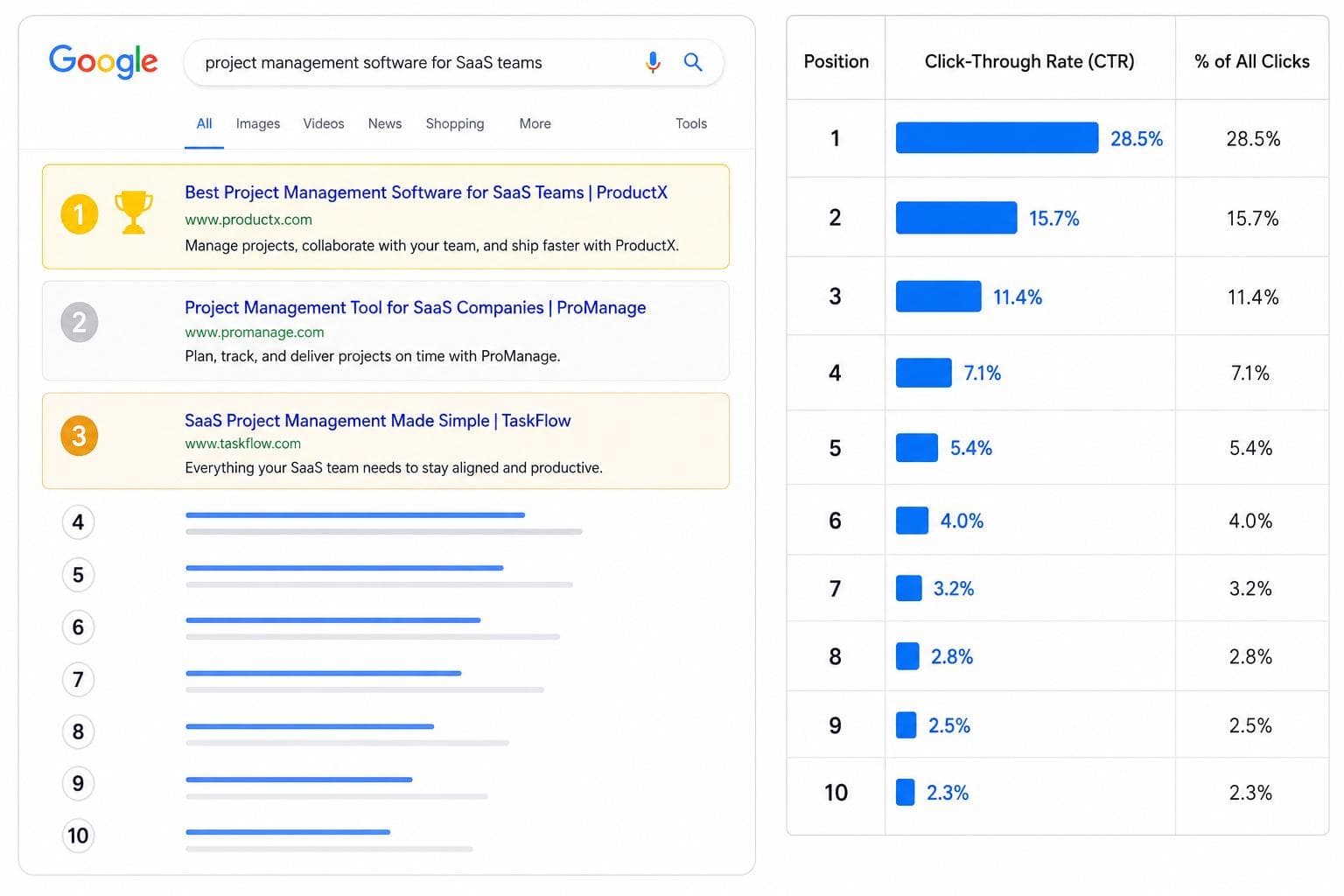
- Real click-through rates. GSC shows you the actual CTR per query, which reveals title tag and meta description problems no ranking-only tool can detect. A page at position 3 with 2% CTR has a title tag problem, and GSC is the only tool that will tell you.
- Long-tail queries paid tools don’t know exist. Most third-party keyword databases don’t store queries below a certain search volume threshold. GSC shows you every query that earned an impression, including the long-tail and zero-volume queries that often convert better than head terms.
- Branded versus non-branded split. Use the query filter to exclude your brand name and you get a clean view of how your site performs without the free traffic layer of brand recognition.
- Page-level attribution. GSC tells you which URL is ranking for which query. That’s how you detect cannibalisation, find the wrong page ranking for a commercial term, and spot intent mismatches.
- Search appearance data. GSC increasingly shows you when your page appears in AI Overviews, featured snippets, video carousels,
- FAQ boxes, and other SERP features data that’s often hours or days ahead of what paid tools report.
No paid rank tracker gives you all of this. Most give you only the ranking number, often with less accuracy than GSC, at a monthly cost running into the hundreds of pounds.
The Limitations of Using GSC as a Rank Tracker (and How to Work Around Them)
GSC is the best free keyword ranking tool on the market, but it isn’t perfect. Being honest about where it falls short matters partly because a few of the limitations have practical workarounds, and partly because knowing where the data lies to you prevents you from acting on noise.

Average position isn’t real-time rank
The “average position” metric is literally the average of every impression’s position over the selected date range. If your page ranked at position 2 for half the week and position 8 for the other half, GSC will show you position 5 a number that was never actually true. Workaround: shorten the date range to daily or 2-day windows when investigating volatility, and segment by country and device to remove averaging artefacts caused by geo or device differences.
The 1,000-row UI cap
The Performance report interface caps table exports at 1,000 rows. For large sites earning tens of thousands of keyword impressions, that’s a real limitation. Workarounds: use the GSC API (free, no row cap), connect GSC to Looker Studio (which can pull full datasets), or enable the bulk data export to BigQuery for unlimited historical data. The Search Analytics for Sheets add-on is another free option that can pull up to 25,000 rows at a time directly into Google Sheets.
2–3 day data lag
GSC data is never real-time. There’s typically a 2–3 day delay before today’s data shows up. For weekly and monthly strategic work that’s irrelevant, but if you’re trying to react to an algorithm update or a sudden ranking drop within hours, you’ll need a SERP API or a paid rank tracker alongside.
Anonymised low-volume queries
Google hides queries it considers too rare to show, for privacy reasons. These appear in your totals but not in your query list, which is why your query-level clicks will never add up to your total clicks. Workaround: cross-reference with GA4 landing page data and server log analysis to fill in the gap at page level, and use page-level queries rather than site-level where possible.
16-month data retention
GSC only retains 16 months of history in the UI. Anything older is gone. Workaround: set up the BigQuery bulk export as early as possible once enabled, it stores every query-impression row indefinitely under the free tier for most small and mid-size sites. Monthly manual exports into a Google Sheet work too if BigQuery feels heavy.
No competitor tracking
GSC only shows data for sites you own and verify. It can’t tell you how competitors rank. Workaround: pair GSC with free competitor spot-checks (incognito searches from the target country) for qualitative competitor analysis, or use a paid tool alongside GSC for systematic competitor tracking. For most small businesses, the free approach is enough.
Free Tools That Extend GSC’s Rank Data
Used alone, GSC is already the best free rank checker available. Used alongside these free companion tools, it becomes a serious rank-tracking stack:
• Looker Studio (now back to datastudio). Free dashboarding from Google. Connect your GSC property in two clicks and build ranking dashboards with date-range filters, country comparisons, query-level breakdowns, and automatic alerts. There are dozens of free GSC Looker Studio templates available.
• Google Sheets with Search Analytics for Sheets. A free add-on that pulls GSC data directly into Sheets, bypassing the 1,000-row UI cap and letting you set up scheduled pulls for automated reporting.
• Google Search Console API. Free programmatic access. If you’re comfortable with Python or JavaScript, you can pull unlimited query-by-page data and build your own rank-tracking scripts.
• BigQuery bulk export. Enable it inside GSC settings and Google will stream every query-impression event into BigQuery. The BigQuery free tier is generous enough for most SMB-scale sites, and you get unlimited historical data plus SQL-level query flexibility.
• GA4. Link your GSC property to GA4 and you can pull query data alongside conversion, revenue, and engagement metrics in a single report.
None of these cost anything. Between them, they close almost every gap in GSC’s native interface.
A Practical Weekly Rank-Tracking Workflow Using GSC
Here’s the workflow we recommend to clients who want to self-serve their rank tracking without paying for a tool. It takes about 30 minutes a week:
11. Open GSC and filter the Performance report to the last 7 days, compared against the previous 7 days. Country: filter to your primary market.
12. Sort the Queries tab by “Position change.” Flag any query that moved by three positions or more in either direction.
13. For queries that dropped, click through to see the ranking URL. Check whether the competitor now above you changed their content, earned new links, or whether Google’s algorithm shifted the SERP type.
14. Sort by impressions, descending. Review the top 50 queries. Any query with high impressions but a CTR under 2% at positions 1–5 has a title tag or meta description problem fix it.
15. Filter the Pages tab for each high-value commercial URL. Check that the top-ranking queries for that page match the page’s intent. If your product page is ranking for informational queries, you have an intent mismatch to fix.
16. Look for pages that rank for queries you didn’t target. These are often the richest opportunity a small content update to formally address the unintended query can push you from page 2 to page 1 quickly.
17. Once a month, run the same process across a 12-month date range. Year-over-year trend data is where declining pages reveal themselves before the traffic damage becomes visible.
That’s the workflow. It’s not complicated, and it doesn’t cost anything. What it does require is discipline, a reasonable understanding of what the numbers mean, and the willingness to act on what the data tells you.
Why Choose Assertive Media to Help You Rank Higher on Google?
Running GSC reports is the easy part. Knowing what to do with the data is where most in-house teams and business owners stall not because the data is confusing, but because turning a position change into a revenue decision requires context that only comes from doing this across a lot of sites.
Assertive Media has been an SEO agency since 2007. We’ve worked across more than 40 industries, from financial services and legal to eCommerce, travel, and SaaS. Every campaign we run uses GSC data as its foundation not because it’s cheap, but because it’s the most accurate dataset available. We then layer technical audits, content strategy, link analysis, and AI-search optimisation (AI Overviews, LLM visibility) on top.
Here’s what working with us means for your rankings:
Identify the underperforming keywords hiding in your GSC data
Every GSC account we’ve audited without exception contains a layer of keywords sitting at positions 8 to 20 that would take very little work to push onto page one. These aren’t hidden, but spotting them systematically and prioritising by commercial value is the difference between a casual reader of the Performance report and someone doing this for a living. We find them, prioritise them by revenue potential, and turn them into a concrete work plan.
Diagnose why you’re being outranked
When a competitor outranks you, the cause is usually one of five things: content gap, intent mismatch, backlink deficit, technical issue, or weak E-E-A-T signals. Each needs a different fix, and getting the diagnosis wrong is how SEO budgets get wasted. We audit each potential cause methodically before recommending work.
Turn rank tracking into revenue growth
Rankings don’t pay bills. Revenue does. We map keyword opportunities to your commercial pages and your business model, so the work we prioritise is the work most likely to move the number that actually matters revenue from organic search, not position counts.
How Assertive Media Helps You Get More From Your GSC Data
Our services are built around the same principle that runs through this guide: use the best data available, then do the hardest work on top of it. For rank tracking specifically, we offer:
• SEO audits that dig into your GSC data at query-by-page level, surface hidden opportunities, identify cannibalisation and intent mismatch issues, and output a prioritised 90-day action plan.
• Ongoing SEO strategy that uses your own ranking and impression data to drive every content, technical, and link decision not vanity metrics or third-party keyword estimates.
• Monthly reporting built on GSC and GA4 data, tying ranking movement directly to business outcomes, so you always know whether the investment is paying back.
• LLM and AI Overviews visibility tracking, because a growing share of search impressions now happen inside AI answers and GSC is starting to show that data.
If you want to discuss how your current rankings translate into actual revenue opportunity, we offer a free initial consultation. No signup, no credit card, no upsell funnel just a conversation about what your GSC data is telling you and what you could do about it.
Conclusion
The best free Google keyword ranking SEO checker tool has been sitting inside your Google account the entire time. It’s more accurate than any paid rank tracker, it uses Google’s own data rather than a scraped approximation, it has no usage cap, and it costs nothing. Most of the “free” rank checkers you’ll find in a Google search are worse tools dressed up as free offers because the real thing is already available to every website owner, and no SaaS tool can match it.
What we’ve seen over nearly two decades of SEO work is that the tool isn’t the problem. Most businesses have plenty of access to ranking data. What they don’t have is the time, the methodology, or the pattern recognition to turn that data into decisions that move the business. That’s where an experienced agency earns its fee.
Use GSC. Build the weekly workflow. Set up the free companion tools. And if you get to the point where you want someone to do the interpretation and the prioritisation alongside you or instead of you that’s what we’re here for.