










People don’t just Google anymore when they’re looking for information and recommendations; they ask AI tools. Google AI Overviews, Perplexity, and ChatGPT are changing how people search for and find information.
According to Search Engine Land, 37% of consumers now turn to AI tools instead of using Google, while Forbes reports that 60% of searches now end without a click.
So, SEO is dying…right?
No.
However, it is evolving. A successful organic strategy today isn’t just about ranking; it’s about being used as a source.
In this guide, we’ll break down how LLMs find and choose your content, and how to structure it to gain more visibility.
TLDR: How to Structure Content for LLMs
LLMs like Perplexity and ChatGPT don’t rank pages. They extract and reuse content fragments, citing relevant sources. So, LLM optimisation requires direct answers, structured data, standalone sections, and jargon-free terminology.
While technical signals such as internal linking and schema markup reinforce visibility, topical depth and quality content are what ultimately secure long-term citations.
What Are Large Language Models (LLMs)?
Large Language Models are systems trained on extensive datasets that enable them to find, understand, summarise, and generate human language.
These advanced models utilise transformer architectures to predict a likely sentence or word in each sequence.
There are three main characteristics of LLMs like ChatGPT and Perplexity:
- They’re Large Scale: These tools are trained on vast amounts of data, including code, textbooks, and website content. This enables them to understand context, grammar, and human language.
- Generative AI: LLMs use their knowledge base to generate content, including answers, recommendations, blog posts, and translations.
- Transformer Model: Neural networks (transformers) can identify the relationships between words in a sentence.
How Do LLMs Actually Choose Sources?
It’s important to remember that LLMs don’t rank content the way search engines do. Instead, they use ‘fraggles’ (fragments of content on pages) rather than viewing full web pages.
So, before you even think about optimising your content, you need to understand what you’re optimising for.
LLMs Find Answers
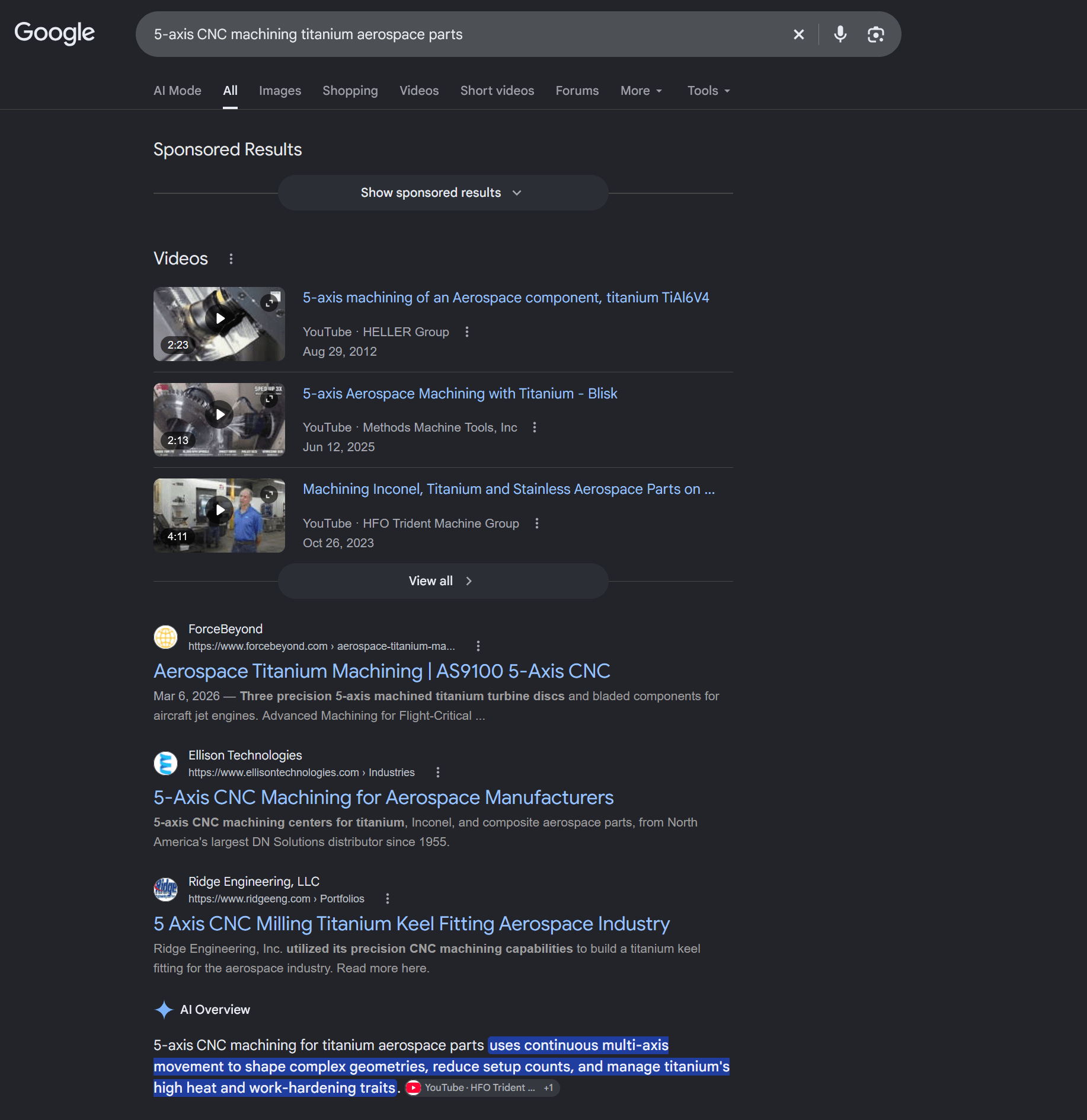
When you type a query into Google, bots will search which website pages are the closest matches and display a results page. You can then review the results and click on different ones to find your information:

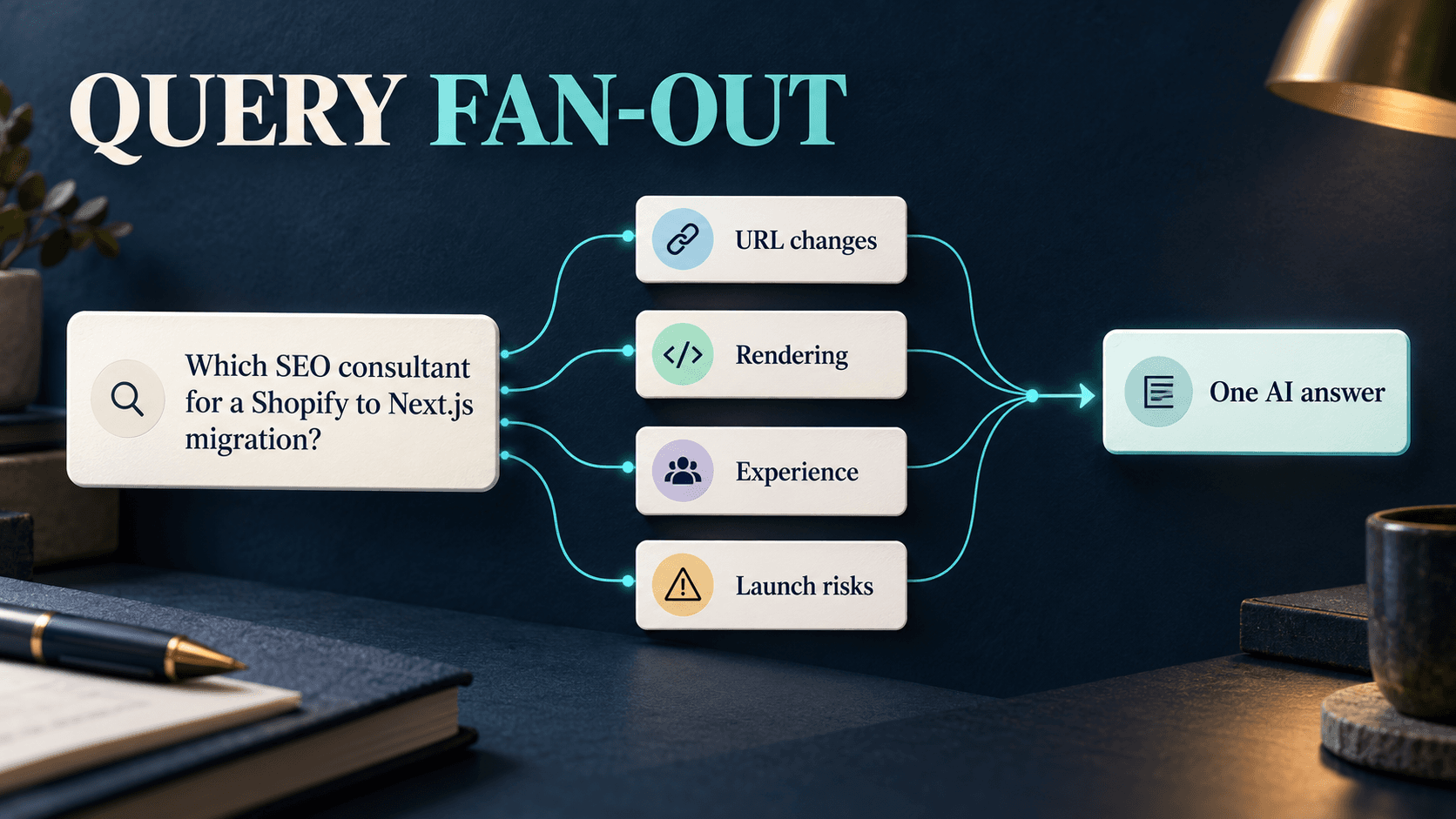
LLMs work differently, as they generate responses. They don’t look for the best webpage or article. Instead, LLMs look for content that they can understand, break down, and reuse:

So, if your content structure is hard to understand or doesn’t provide clear answers, LLMs are less likely to cite it.
Why Many Websites Fail to Appear in AI Searches
LLMs typically choose content that has the following attributes:
- It’s clear and direct.
- There’s a strong structure.
- The content has a logical flow.
- There’s factual yet simple language.
Websites that fail to appear in AI searches usually create long-form content with no structure, don’t directly answer questions, and focus on sounding good rather than clarity.
The Core Principle of AI Search Visibility
LLMs don’t digest content as humans do. Instead, they scan, extract, and generate responses. These tools aren’t quoting your content as much; they’re using pattern matching against text generated during training.
So, it’s not about the overall quality of your content; it’s whether the LLM can package it for AI-generated answers.
Every section of your content should be clear enough to understand on its own. Remember, you’re writing for both machines and humans, which can be a challenging balance to strike.
What’s the Best Content Structure for AI Visibility?
The way you structure your content directly impacts its visibility in AI-generated answers. Poorly structured data, content that doesn’t get to the point, and unclear headings are the key things to avoid when creating content.
1: Use Direct Answers
There’s a common misconception that you should get creative with your content, but website pages and blog posts aren’t novels. There’s no need to warm up or build suspense. Instead, you should answer the question immediately.
Take a look at this AI search result for the question “How do I measure for a new carpet?”:

As you can see, the top cited source is a website called Online Carpets. The content gets straight to the point, answering the question, which is why Perplexity cited it first.

Key Takeaway: When structuring content for LLMs, focus on direct answers and break the content into clear sections that AI tools can identify, extract, and summarise.
2: Use Questions As Subheadings
When someone types a query into an LLM, they usually ask a question. LLMs are trained based on how people ask questions, and your content structure should follow that.
For example, in this post, we used “What Are LLMs?” as a subheading, instead of “LLM’s Explained“.
Using clear question-focused subheadings makes it easier for AI models to match your content to queries.
Key Takeaway: If your subheading could easily appear in an FAQ section, it’s working well. But if it reads more like a section in a table of contents, it needs more work.
3: Use Standalone Sections
Is each section of your content independently meaningful? For example, if someone saw only that block, would they understand the context and get value from it?
While traditional search engines scan a webpage for context, LLMs don’t read everything. Instead, they retrieve passages that match the searcher’s question.
When answering questions in your content, ensure they make sense without additional context.
Even small phrases like “as discussed previously” can have a negative impact, as LLMs will assume that the content can’t be cleanly extracted.
Top Tip: Take a section of your content and paste it into a blank document. If it makes sense and delivers value, you have a standalone section that’s suited to LLMs. However, if you need to add extra context, it’s time to revisit the section.
4: Structure Everything
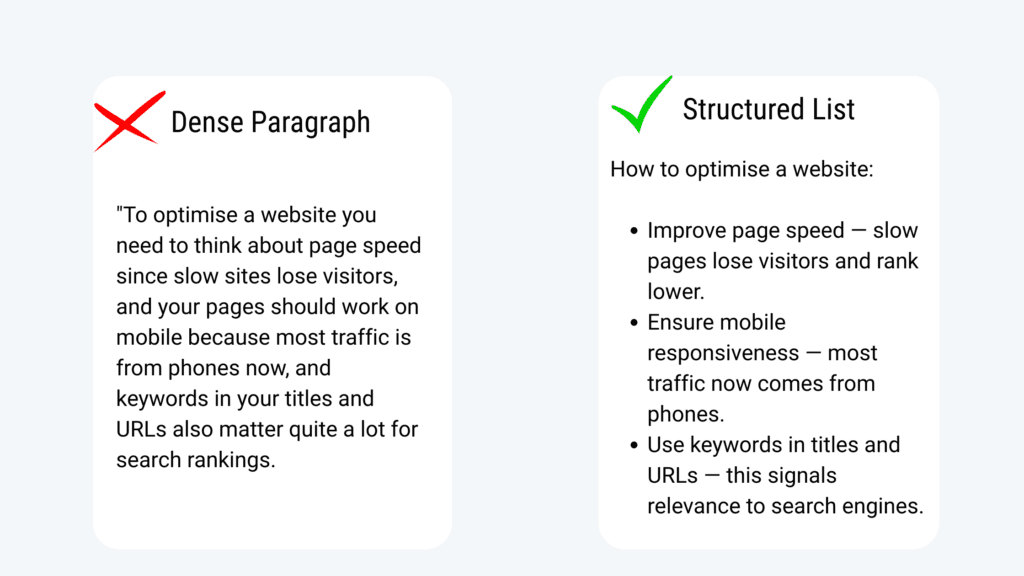
LLMs love structure because it makes content easier to understand. When you use lists, bullet points, tables, and break up paragraphs into digestible points, it prevents your content from blurring together.
When you structure your content properly, AI tools can cite specific points without having to quote the entire paragraph.

When structuring content:
- Use Numbered Lists: If you’re explaining steps, stages, or priorities, use numbered lists.
- Bullet Points: If the points you’re making are non-sequential (examples and features), bullet points are the best option.
- Comparison Tables: Tables make it easier to digest product or service comparisons.
- Paragraphs: Keep your paragraphs short (up to two sentences). This makes it easier to convey a point without blurring important information.
5: Simplify Key Terms
Clarity and consistent terminology are vital for both readers and AI. When you over-explain concepts using unnecessary jargon, it can prevent humans and LLMs from finding and accessing relevant information.
While over-explaining concepts is tempting, if the term you’re using isn’t universally understood, it can impact your website’s visibility in AI-generated answers.
6: Use Summaries
There’s a difference between repeating and reinforcing key points. As LLMs scan your content in sections, you can help AI models find relevant information by using summaries and key takeaways.
Humans rarely read an entire article; they skim it for key information, and AI models operate similarly.
How to Use Summaries Properly:
- If your content is longer than 800 words, add a TL;DR section at the top.
- Summarise sections with the most important points.
- Use key takeaways to reinforce the main points of your content.
Should I Add Schema Markup to My Pages?
Schema markup is structured data that’s added to your website’s HTML. It stays behind the scenes and won’t affect your page’s appearance. But what it does do is label your content and give it meaning.
Just as meta titles and descriptions help your audience understand what your webpage is about, schema markup helps LLMs understand your content.
The Different Types of Schema Markup
How to Format Content for AI Searches
Structure is only half the puzzle; the way you write and format your content also matters. Vague language, unclear hierarchy, and poorly structured FAQs can all negatively impact your brand’s visibility in AI searches.
Limit Vague Language
Only use vague language when you’re reinforcing a point. For example, using it depends or sometimes is fine if it serves a purpose in your content, but specificity always wins.
Remember, LLMs look for structured answers to questions, and being clear enhances trust.
Write in Complete Thoughts
Every paragraph you create should feel complete and self-contained. You can test this by assessing whether the paragraph could be transferred into a bullet point and make complete sense.
If the paragraph isn’t self-contained, it’s time to revisit the paragraph and ensure it doesn’t rely on the previous paragraph.
Ensure There’s A Clear Hierarchy
Each page should only have one H1 heading and clear subheadings. For example, use H2s for main sections, then expand into H3s and H4s if you want to break them further.
Add FAQs
Adding FAQs should never be a case of using what you think someone might want to know. Instead, you should use keyword research tools and platforms like AlsoAsked to see what they’re actually searching for.
It’s also best to avoid using AI tools to create FAQs, as they often just rephrase the answers already in your content.
Topical Authority Still Matters
In many ways, writing content for LLMs is similar to traditional SEO. The websites that get citations offer genuine value and depth, not just proper content structure.
If a website is credible and regarded as an authoritative source of information, it’s more likely to appear in AI answers.
Here’s how to establish authority.

Cover Topics Thoroughly
When focusing on content creation, it’s vital to cover topics thoroughly. Topic clusters are one of the best ways to do this, as they expand on a core principle.
For example, if you created a guide on SEO, you could expand the main guide into different sub-topics, such as on-page, off-page, local, and technical SEO.
If your website demonstrates expertise, AI answer engines are more likely to cite it.
Find Authoritative Sources
Linking to authoritative sources places your content within a credible network, and it signals that the information you offer is reliable. However, there’s a difference between linking to random publications and citing high authority sources.
When choosing which publications to link to, focus on official bodies, highly-regarded publications, and academic institutions.
Use Internal Linking
Internal linking is a core component of topical authority, as it shows how each page fits into a wider theme.
Both SEO and AIO rely on search indexes to find relevant information, and a consistent internal linking strategy can improve your chances of being listed in AI searches.
What Can Prevent A Website From Appearing in AI-Generated Answers?
If you have strong domain authority and topical relevance but your website isn’t appearing in AI answers, the lack of LLM visibility could be due to one of the following mistakes:
- You’re creating long introductions that don’t provide clear answers.
- Your writing is overly focused on opinions over value.
- The blocks of text are unstructured.
- There aren’t any clear headings or a logical flow.
- You’re focused on impressing rather than explaining.
Key Takeaways
- Your content doesn’t need to be robotic, but it should be easy for humans to understand and LLMs to extract.
- Similar to traditional SEO, avoid keyword stuffing and overcomplicating your content to reduce ambiguity.
- Remember that other websites are also competing for citations in LLM responses. Not structuring and formatting your content correctly can reduce your ability to do so.
- Don’t neglect your SEO strategy. While search is evolving, Google still handles the most queries daily.
Are you prepared for AI-powered search? Our AI-readiness audits evaluate your content structure, format, and brand signals to prepare you for the future.
Please get in touch with us today to learn more.
FAQs
Does SEO still matter with AI tools changing how people search?
Absolutely. Google still has the highest volume of queries, and AI search engines rely on indexed content. While your strategy should evolve to align with LLM visibility, building strong SEO foundations is key to supporting that visibility.
How is AI search different from traditional search engines?
Traditional search engines like Google and Bing scan vast databases to return a list of pages for users to choose from. In contrast, AI tools generate a single response by pulling fragments from reliable sources.
So, standard SEO is about competing for a click through optimised meta titles and descriptions. With AI searches, your website content is competing for extraction and citation.
What type of content is most likely to be cited by LLMs?
LLMs scan multiple sources, and the content that’s most likely to be cited has these characteristics:
- It answers questions directly
- Is split into standalone sections
- Has structured formatting
- Covers topics with depth and offers value.
What is schema markup, and do I need it?
Schema markup is code that’s added to your website’s HTML. It’s a label that tells AI tools what your content means and enhances readability.